Online Reporter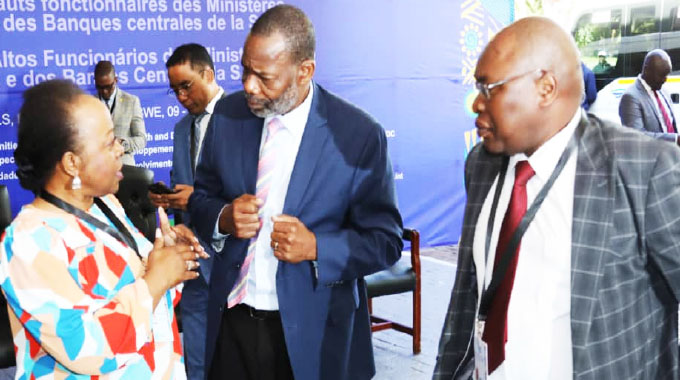
Rutendo Nyeve, Victoria Falls Reporter
ZIMBABWE’S economy is advancing steadily towards deeper regional integration within the Southern African Development Community (SADC), with notable progress in Finance and Investment Protocol indicators that include macroeconomic stability, budget management and inflation control.
This comes as the Committee of SADC Ministers of Finance and Investment and Peer Review intensifies efforts to harmonise economic policies across the region, fostering greater cooperation and financial convergence.
Speaking in an interview with Zimpapers on the sidelines of the SADC Senior Officials meeting in Victoria Falls yesterday, Zimbabwe’s Chief Director in the Ministry of Finance, Economic Development and Investment Promotion, Mr Joseph Mverecha — who chairs the SADC Senior Officials Committee highlighted the country’s achievements in meeting key regional benchmarks.
“Nearly all other countries are making progress in some areas and some areas have slippages. That is virtually across nearly all other countries, and Zimbabwe is an integral part of that and we are making very good progress in some areas,” said Mr Mverecha. He pointed out that Zimbabwe has maintained a budget deficit below the SADC threshold of three percent of GDP, a critical marker of fiscal discipline.
“Our budget deficit over the past three or so years is less than two percent of the GDP. So, we are making good progress on inflation stabilisation and on the budget deficit to GDP,” said Mr Mverecha.
Inflation, which had been a major challenge, has shown signs of stabilisation due to tight monetary policies and fiscal restraint. Additionally, Zimbabwe is working on other areas of economic convergence, aligning with regional peers to ensure sustainable growth.
The SADC Finance and Investment Protocol serves as the cornerstone for regional economic integration, with member states committed to harmonising policies to facilitate trade, investment and financial stability.
Under this framework, subcommittees are advancing key agendas, including macroeconomic convergence, financial market development and peer review mechanisms.
“The meetings we are having for senior officials from the Ministries of Finance, Economic Planning, and from the Central Bank are focused on several issues to advance regional integration. The SADC Member countries have a roadmap for regional integration to advance co-operation on economic and financial matters,” said Mr Mverecha.
Central to these efforts is the Peer Review Mechanism, which evaluates member states’ performance against agreed macroeconomic indicators. These indicators are structured into three tiers which include primary indicators focused on GDP, budget deficit, public debt and inflation.
The secondary indicators cover GDP growth, current account balance, monetary growth and forex reserves, while tertiary indicators include assessing financial stability, inclusion and market deepening.
“The key issue is to determine whether certain countries are moving closer towards regional convergence, which is a prerequisite for deeper regional integration,” said Mr Mverecha.
As SADC moves towards stronger economic integration, the peer review process will play a pivotal role in identifying strengths and addressing weaknesses across member states. Senior officials are compiling consolidated reports on macroeconomic convergence, which will guide ministerial discussions in the coming months.
“The focus will then be on how we can expand the peer review mechanism into 2025 and 2026 so that we can consolidate all the gains and also make progression where there is regression,” said Mr Mverecha.
Zimbabwe’s adherence to fiscal discipline and inflation control positions it well within the SADC framework.
However, challenges remain, including enhancing financial inclusion, improving foreign reserve buffers and ensuring sustainable debt levels.
The push for regional integration is not just about policy alignment but also about fostering resilience against global economic shocks. By strengthening financial systems, boosting intra-regional trade and maintaining macroeconomic stability, SADC aims to create a more robust and interconnected economic bloc.