Chronicle Editor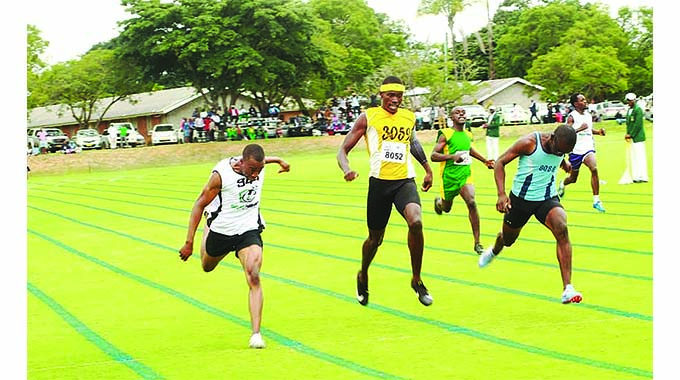
Sikhumbuzo Moyo, Senior Reporter
Zimbabwean schools’ sports, particularly athletics, have long been plagued by a dilemma that could possibly be the main reason the country is yet to win a track or field athletics medal at the World Athletics Championships or at the Olympic Games.
The question that lingers is whether or not the victors are good enough to repeat their success at the next higher level, or if they are merely being pushed to the next level because they came first even with their poor grades or times.
The selection process for athletes in Zimbabwean schools’ sports starts at the inter-house competitions, which are used to select a school team that will participate in the inter-schools or cluster track and field competitions. The district teams then clash in what is generally known as inter-district competitions, but it ought to be Nash or Naph provincials or provincial finals where a provincial team gets selected to represent that particular province at the nationals or inter-provincial finals.
Schools are taking every chaff as long as the athlete would have crossed the finishing line without anyone in front of him or her.
However, this should not be the case. This is where the National Association of Primary School Heads (Nash) and their Secondary School counterparts need to step in and do justice to schools’ athletics. Athletics needs to be professionalised, and the schools’ sports authorities need to support experts (sports directors) and provide them with all the resources that they may need.
The selection of athletes needs to be streamlined to only include those who meet specific performance benchmarks. Every stage of the competition must have its own standards. When preparing for their inter-house competitions, athletes must know that if they fail to clock a certain time or distance, they will not represent their house. The same must be the case with inter-schools preparations. Standards must and should be known.
Athletics is not about quantity but quality. It is not about mass participation; it must never be. Every school and every district should have records of all athletic events. These records should be used to set performance benchmarks, which should be used to select podium athletes.
Podium athletes are those who have met specific performance benchmarks. They are not just gold medallists but athletes who have performed consistently well across multiple competitions. Podium athletes are the only athletes who should represent their districts and provinces in national competitions.
The Head in Charge of athletics in the province, Sikhumbuzo Ndlovu, recently announced that the province would only be taking podium athletes to the national finals at Peterhouse College in Marondera, Mashonaland East. This is a step in the right direction, but the problem is not with Ndlovu or Bulawayo. It is a national disease that needs a brutal cleansing.
But does Ndlovu and his fellow school heads in Bulawayo really understand what a podium athlete is? From what then happened after that announcement at White City Stadium, the answer is obviously a big and emphatic no.
To them podium athletes are those who won gold, regardless of their gold winning record. That means an athlete, say the 20 and under age group in high jump gets a gold despite clearing 1,4 metres would still make it to their provincial team as a ‘podium athlete’.
What Naph and Nash need to do is to take a deliberate position of turning around schools athletics management. This is 2023 where the world is led by technology yet schools still do not have simple things as athletics events records. Those records are key enablers towards podium athletes but as it is, Nash Bulawayo cannot tell us who record holders are in any of the athletics events, they simple can’t tell us. They however, can tell us which district won the 2015 provincials.
For schools, districts and provinces to have podium athletes, there is an immediate need to have statistics, starting from school level as they prepare for their inter-schools competitions.
Let’s use the 100m under-20 sprints. The world and continental record of 9.91 seconds is held by Leslie Tebogo of Botswana.
What Nash must then do is to set up their own benchmark, obviously not the Tebogo record. They can put it at 11.30 seconds, meaning anyone who would be time at that (11.30 secs) or below qualifies to compete at the Nash finals but if your clock above that, you just get your gold medal at provincial level and go home, you would not have qualified for the national finals.
That resolution should then cascade downwards to provincial qualification standards and any athlete who fails to be within that bracket, simply does not proceed to the provincial finals, the same goes with district and schools finals.
It’s of no use taking someone who ran 100m in 15 seconds to the next level of competitions but sadly Naph and especially Nash still do that. Every stage of the competition must have its own standards. When preparing for their inter-house competitions, athletes must know that if they fail to clock a certain time or distance, they will not represent their house, and the same must be the case with inter-schools preparations.
Everyone must adopt the heats narrative which is clear that it’s never about position but it’s all about time. All participants in a particular heat can actually qualify for the semifinals or finals due to their times, that must be the gospel for athletics as a whole.
This business of taking schools athletics as time out excursion must come to an end. A gold medal must never be good enough, it must not be the alpha and Omega to the next stage.
Those who were at White City Stadium on Friday last week must not be charmed by what they heard from the HIC athletics.
The idea is top notch, it’s the way to go but its execution is what is off track. We saw a race that produced a gold medallist, it must have been during relays but their times were clearly not worth to even talk about yet they will be part of the Bulawayo trip to Marondera.
After satisfying the technical side of athletics, both Naph and Nash need to then take a critical view of how officials, encompassing both coaches and officiating ones, are selected.
In conclusion, it is high time that schools, especially Naph and Nash, began to professionalise athletics by supporting experts (sports directors) and providing them with all the resources that they may need. The selection of athletes needs to be streamlined to only include podium athletes. This will lead to the production of real podium athletes, and competition standards will naturally go up.



 Online Reporter