Zvamaida Murwira, Harare Bureau
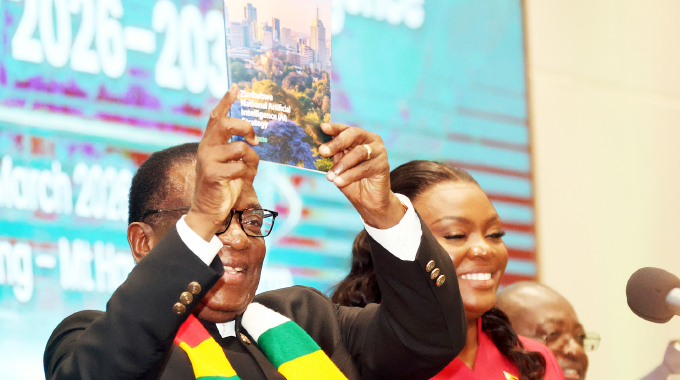
ZIMBABWE will leverage on artificial intelligence (AI) to modernise agriculture, unlock the country’s mineral wealth, deliver quality healthcare and provide world-class education in line with the modernisation and industrialisation drive, President Mnangagwa has said.
In his foreword for the Zimbabwe National Artificial Intelligence Strategy (2026-2030) document, which was launched at the new Parliament building in Mount Hampden on Friday, the President said the country intends to build “a future where AI is a tool of empowerment and a catalyst for inclusive growth and a guardian of our cultural values and ethics”.
“Our strategy is not about importing foreign solutions, it is about cultivating our own, building an AI that understands our values, speaks our own languages and addresses our unique challenges, leaving no one and no place behind,” said President Mnangagwa.

“We will leverage AI to modernise our agriculture, unlock the full potential of our mineral wealth, deliver quality healthcare to the most remote corners of our nation and provide a world-class education for every Zimbabwean child, building a future where AI is a tool of empowerment and a catalyst for inclusive growth and a guardian of our cultural values and ethics.”
AI, President Mnangagwa said, will be implemented responsibly and ethically.
“We approach this new frontier with great responsibility, to adopt and deploy this strategy ethically, with a steadfast commitment to human dignity, privacy and security.
“This strategy is therefore a call to action, a call to our most innovative entrepreneurs, our most dedicated public servants and our most ambitious young people a call to every Zimbabwean to join us in this national endeavour where Government will provide the enabling environment and strategic direction, but the true engine of this transformation will be the creativity and hard work of the Zimbabwean people, including in particular academia and the private sector.”
Through collective responsibility, Zimbabwe can be a force to reckon with in the Fourth Industrial Revolution, he added.
“Together, we will build a future where Zimbabwe is not just a participant in the Fourth Industrial Revolution and beyond, but a leader,” he said.
He also said the advent of AI will spur economic growth and reshape the world.
“We stand at the dawn of a new era, a time of unprecedented technological advancement that will reshape our world, where the 21st century is defined by the rapid pace of technological change and at its heart lies Artificial Intelligence (AI),” the President added.
“This is not merely a technological shift, it is a fundamental reordering of our societies and economies, and for Zimbabwe, a nation defined by its unwavering spirit of innovation, this is a moment of profound opportunity.”
President Mnangagwa said the National Artificial Intelligence Strategy was not merely a policy framework, but a bold declaration of Zimbabwe’s intention to actively shape the future, to harness the powerful currents of the Fourth Industrial Revolution and “to secure our rightful place as a leader in technological innovation on the African continent and beyond”.
“Our vision is clear: to establish Zimbabwe as a beacon of AI for Development in Southern Africa, with this strategy firmly anchored in our philosophy of ‘Nyika inovakwa nevene vayo/Ilizwe lakhiwa ngabanikazi balo’ — a nation is built by its own citizens and rooted in the philosophy of Ubuntu, recognising our shared humanity and our interconnectedness,” he said.
Friday’s launch ran under the theme “Harnessing Artificial Intelligence for inclusive development”.
Overall, the strategy presents a framework to harness AI as a driver of inclusive growth, innovation and national sovereignty, aligned with Vision 2030, the National Development Strategy 1 and 2, and the Heritage-Based Education 5.0 philosophy.
It positions AI as a transformative force to propel the country from a resource-dependent economy to a competitive, knowledge-driven nation, ensuring that it shapes, rather than being shaped by, emerging technologies while embedding local values, protecting cultural heritage and addressing national priorities in economic diversification in key economic sectors such as agriculture, mining, health, education, tourism, as well as building climate resilience, among others.
The strategy is anchored in four interconnected pillars — AI talent and capacity development to cultivate a skilled, innovative workforce through AI literacy, research hubs, sector-specific academies and diaspora engagement National AI infrastructure and computational sovereignty to establish high-performance computing, sovereign data platforms, world-class data centres and secure inclusive connectivity AI adoption and service transformation to drive sector-wide adoption, improve service delivery, optimise industries and enhance citizen experiences while ensuring equitable access and governance, ethics and regulatory framework to implement an Ubuntu-based, multi-level governance system with robust legislation, ethical safeguards and leadership in responsible AI.