Vusumuzi Dube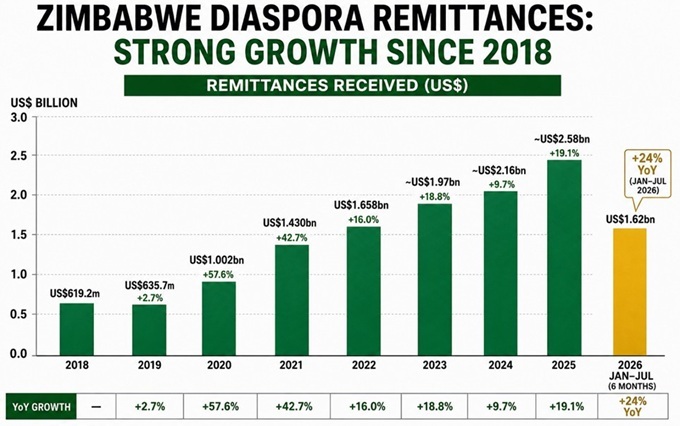
Mahwani Kangausaru.
For a long time, remittances from diasporas were viewed through the lens of household consumption money sent home to pay school fees, buy food, cover medical expenditures, build houses and support extended families.
This understanding is becoming less and less adequate.
The fast-growing inflows of Zimbabwe’s diaspora are now of such a magnitude that they should be considered not only as a social safety net, but also as a significant source of local wealth capable of supporting investment, industrialization and economic development.
Former African Development Bank President Dr Akinwumi Adesina has been one of the biggest promoters of this change in thinking. In a significant speech in 2022, he pointed out that remittances to Africa had climbed to US$95.6 billion in 2021 from US$37 billion in 2010, compared to only US$35 billion in official development assistance received that year. The African diaspora was thus dubbed by him as the continent’s “largest financier”.
Zimbabwe makes a more and more persuasive basis for Adesina’s position.
From US$619 million to nearly US$3 billion.
In 2018, formal diaspora remittances into Zimbabwe amounted to a mere US$619.2 million. They rose slowly to US$635.7 million in 2019 before increasing dramatically to US$1.002 billion in 2020.
Inflows then increased to US$1.43 billion in 2021, US$1.66 billion in 2022, around US$1.97 billion in 2023, US$2.16 billion in 2024 and US$2.58 billion in 2025.
The latest figures imply that the rising trend is continuing.
Formal diaspora remittances rose to US$1.62 billion in the first seven months of 2026, from US$1.30 billion in the same period in 2025, a 24 percent increase, the Reserve Bank of Zimbabwe said. July saw the greatest monthly inflow in the seven-month period, at US$ 258.5 million.
If the current momentum is maintained, Zimbabwe is within striking reach of the US$3 billion annual remittance mark.
Its importance is more readily grasped over a longer horizon. Annual inflows from the diaspora have more than quadrupled since 2018.
South Africa remains critical.
Zimbabwe’s biggest single source of remittances is South Africa.
South Africa sent US$504.14 million to Zimbabwe between January and July 2026, accounting for 31.1 percent of total inflows from the diaspora. Close behind was the United Kingdom with US$458.60 million or 28.27 percent.
The United States donated US$182.86 million, Australia US$101.47 million and Ireland US$32.05 million. Therefore, South Africa and the United Kingdom accounted for roughly 60 per cent of all diaspora remittances in this era.
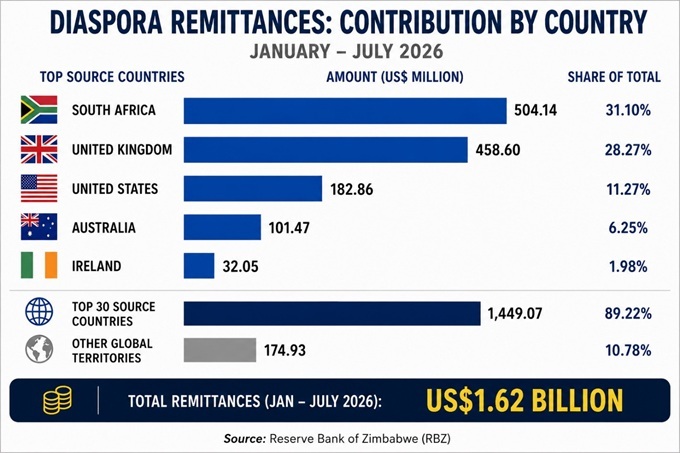
These data also illustrate the geographic dispersion of Zimbabwe’s diaspora economy. Historically reliant on neighboring South Africa, what is now a significant flow from developed markets where Zimbabweans have taken up professional roles.
More crucially, some of the diaspora are slowly shifting from supporting spending at home to buying land, establishing businesses and accumulating other assets.
That shift needs strategic policy support.
Remittances have one big advantage.
Another reason for Zimbabwe to pay more attention to diaspora inflows is that US$1 of remittance income is economically different from US$1 of total mineral export revenue.
Zimbabwe’s mining industry generates much bigger gross foreign-currency inflows, but mining itself needs significant imported inputs.
The 2025 data makes the difference. Mining revenues were about US$8.4 billion and procurement about US$3.4 billion. Of the $3 billion, only roughly $410 million was for locally manufactured purchases, with the remainder of the $3 billion relying on foreign or imported suppliers.
Mining firms need imported machinery, replacement parts, chemicals, technology and specialist services. Foreign investors also have access to legitimate repatriation of dividends and investment proceeds.
This is not an argument against mining. Mining remains one of Zimbabwe’s most important economic pillars and a critical generator of exports, employment, fiscal revenues and investment.
Instead the comparison shows why headline export earnings alone do not reflect the whole story of foreign currency generating.
By contrast, remittances tend to be received by Zimbabwe as transfers, without the country having to first acquire machinery and intermediate inputs to “produce” them.
They so constitute an incredibly valuable source of external cash flows.
The next challenge is converting flows into capital.
The policy debate, therefore, should be moving more and more from how much the diaspora sends home to what Zimbabwe does with the money when it arrives.
Remittances are nevertheless of important welfare role, even if the vast majority is spent. They assist household, education, health, housing and domestic demand.
But even a small percentage of that redirected into productive investment might be a large reservoir of patient domestic capital.
With remittances amounting to US$3 billion per annum, mobilizing only 10 per cent for investment would translate into US$300 million per annum.
At 20 percent the potential investment pool is $600 million a year.
Zimbabwe consequently does not necessarily need to reallocate funds currently helping vulnerable households. The goal should be to develop attractive vehicles through which diaspora Zimbabweans with investible savings might freely invest some of their cash in the productive economy.
These may include reputable diaspora bonds, infrastructure instruments, housing and mortgage products, diaspora investment funds and professionally managed entities funding agribusiness, mining beneficiation, tourism, renewable energy and manufacturing.
The keywords are reliable and investible.
Being Zimbabwean investors does not automatically mean Diaspora funds will flow into productive projects. Like any investor, diaspora Zimbabweans need to be assured that their wealth is safe, investments are transparent, returns are competitive and funds may be repatriated ultimately where needed.
So financial institutions have a big role to play in inventing products that turn billions of dollars in annual transfers into long-term savings and investment.
From remittance economy to investment economy.
Zimbabwe’s diaspora is already showing its economic impact.
This is no longer a marginal development, moving from US$619 million in 2018 to US$2.58 billion in 2025 and US$1.62 billion in the first seven months of 2026. Former African Development Bank President Akinwumi Adesina has been a longtime advocate for Africa turning diaspora remittances, which are largely flows of household consumption, into a source of investment and development.
It is a sign of the rise of one of Zimbabwe’s most stable sources of external funding.
Adesina’s larger thesis is also highly pertinent to Zimbabwe: Africa must stop looking at its diaspora as a source of remittance and start seeing them as investors who can finance the continent’s growth.
Crossing the US$3 billion remittance threshold would be a big milestone for Zimbabwe.
But the bigger success will be to create the structures and investment vehicles that can allow some of those billions to finance industries, farms, infrastructure, energy projects and Zimbabwean businesses.
The next chapter of Zimbabwe’s diaspora story should therefore not simply be about remittances. It should be about investment.


 Online Reporter