admin
admin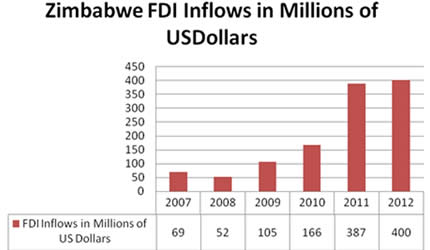
Since 2009, Zimbabwe has been registering growth in FDI following the adoption of the multi-currency regime which stabilised the economy. FDI has increased by 280 percent from US$105 million in 2009.
Zimbabwe also embarked on a reform agenda through adoption of friendly policies to attract FDI. These included the creation of a one-stop investment shop and the adoption of the Medium Term Plan. Deputy Minister of Economic Planning and Investment Promotion Dr Samuel Undenge, however, said there was concern over misconception by foreign investors of the country’s indigenisation and empowerment law.
“Investors are reacting differently to indigenisation as noted in investment conferences held in and outside the country. As a result, the number of registered investors is far below the approved numbers,” he said.
He said the Government was working on harmonising the indigenisation and investment policies to improve Foreign Direct Investment.
“Of concern is also the poor ranking of the country in terms of the World Bank Ease of Doing Business indices with the country ranked 171 in 2011 out 183 (countries),” said Dr Undenge.
Zimbabwe requires Foreign Direct Investment to finance US$9,2 billion worth of programmes and projects as espoused in the MTP, given the fact that it had no capacity to fund this with its own resources.
The MTP identified FDI as a critical enabler for economic growth and, in particular, attainment of investment to Gross Domestic Product ratio of 25 percent by 2015, creating jobs and raising industrial capacity.
To this end, Zimbabwe had undertaken numerous investment promotion tours to South Africa, Hong Kong, Dubai, Australia and Brazil – among other countries – as it intensifies efforts to attract FDI.
Unctad figures show that global FDI fell 18 percent to US$1,35 trillion in 2012. It also forecast FDI this year to remain close to last year’s level, with a upper range of US$1,45 trillion. Developing countries surpassed advanced economies as FDI recipients.
“FDI flows to developing countries proved to be much more resilient than flows to developed countries recording their second highest level – even though they declined slightly (by 4 percent) to US$703 billion,” said the report.
Developing countries accounted for a record 52 percent of the global FDI inflows, exceeding flows to developed economies for the first time ever, by US$142 billion. On the other hand, FDI flows to and from developed economies declined by 32 percent to US$561 billion, a level that was last seen a decade ago.


 Online Reporter