Online Reporter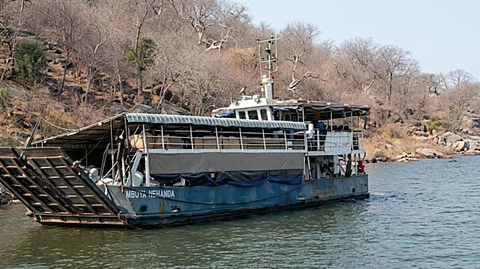
Taygeta Zihwi and Amos Mpofu, Correspondents
ZIMBABWE is mourning. Yet perhaps one of the most troubling realities of our time is that grief has become an almost constant companion.
Hardly a day passes without news of a devastating road accident, a life lost to gender-based violence, or a tragedy that leaves families shattered and communities searching for answers. One moment the nation is grieving one loss, and before that pain has fully settled, another tragedy emerges. Funerals follow funerals, condolences follow condolences, and a nation already carrying deep emotional scars is asked once again to bear another burden.
The recent Lake Kariba tragedy has added to that burden.
What began as an ordinary journey ended in devastating loss, leaving families desperately searching for loved ones, survivors grappling with unimaginable memories and the nation struggling to comprehend the scale of the disaster. As recovery operations continued, the number of confirmed deaths rose to 97, while reports suggested the vessel may have been carrying far more passengers than its stated capacity of 90.
Beyond the immediate heartbreak, the tragedy has raised serious questions about safety, responsibility and accountability.
Yet behind every number is a story.
Those who lost their lives are not merely statistics appearing in news reports. They were mothers and fathers, sons and daughters, husbands and wives, friends, colleagues and neighbours. They were people with hopes for the future, appointments they intended to keep, children waiting for them at home and loved ones expecting to hear their voices again.
That is why the Kariba tragedy has touched Zimbabweans well beyond the families directly affected.
There is something deeply distressing about watching families wait anxiously for news while rescue and recovery teams search for bodies. Many Zimbabweans have found themselves imagining how it would feel to receive that devastating phone call, to lose contact with a loved one without warning, or to learn that someone who left home that morning would never return.
We do not need to know the victims personally to share in the pain.
Such is the nature of collective grief. When a tragedy reaches a certain scale, it ceases to belong to one family or one community. It becomes part of the emotional experience of an entire nation.
Yet Kariba is not an isolated case.
Zimbabweans are already carrying the weight of countless other losses. Road accidents continue to claim lives at an alarming rate, sometimes wiping out entire families in a single incident. Gender-based violence continues to rob communities of women, men and children, leaving behind trauma that lingers long after headlines fade.
Almost every week brings another story of violence, disaster or sudden death.
The danger is that we slowly become desensitised.
We hear the news, express our shock, send our condolences, attend funerals and return to our daily routines. Then another tragedy strikes, and the cycle starts all over again.
Repeated exposure to grief can leave people emotionally drained. Some become angry. Others live in fear. Some retreat into silence, not because they are healing, but because they no longer know how to process the constant stream of sorrow.
That silence should not be mistaken for recovery.
A nation cannot continue burying its people without reflecting on what repeated loss is doing to those left behind.
Across Zimbabwe, there are families mourning fresh losses while still carrying the pain of previous ones. There are parents who have buried children and are somehow expected to resume normal life. There are children growing up without mothers or fathers. There are survivors of accidents who continue reliving traumatic moments long after public attention has shifted elsewhere.
We need to recognise that grief does not end when the coffin is lowered into the ground.
The funeral may conclude. Visitors may return to their homes. Newspapers may move on to other stories. But for the bereaved, life has changed forever.
Birthdays arrive without the person who should be there. Christmas comes with an empty seat at the table. A familiar voice is suddenly absent. A telephone number remains stored in a mobile phone, even though it will never ring again.
That is why our response to grieving families matters.
In our desire to comfort those who are hurting, we often encourage them to be strong, accept what has happened and move on. While these words are usually offered with good intentions, grief does not always require solutions or explanations.
Sometimes people simply need someone willing to sit beside them in their pain.
A grieving person may need permission to cry. They may need to speak repeatedly about the person they have lost. They may need someone to acknowledge that what happened was devastating and that finding it difficult to cope is entirely normal.
As a society, we need to become better listeners.
Zimbabwe has long been known for its strong sense of community during times of bereavement. Families, churches, neighbours, colleagues and traditional leaders often rally around those who have suffered loss.
This remains one of our greatest strengths. But support should not end with the funeral.
Many bereaved families receive tremendous assistance during the first few days, only to find themselves alone when life returns to normal for everyone else. Yet it is often during those quiet weeks and months that the reality of loss becomes most painful.
When the visitors stop coming and the phone stops ringing, loneliness can become overwhelming.
That is why we should make a conscious effort to check on people long after the funeral. A simple phone call, message or visit can mean more than we realise.
The same compassion must be extended to survivors.
Those who survive major accidents and disasters often carry emotional wounds that cannot be seen. They may struggle with nightmares, anxiety, guilt or fear. Some may feel guilty for surviving when others did not. Others may become terrified of travelling or revisiting places associated with the tragedy.
They need reassurance that such feelings are not unusual and that seeking help is not a sign of weakness.
Our children also require special attention.
Children often process grief differently from adults. A child may struggle to explain why they are suddenly withdrawn, performing poorly at school, having nightmares or behaving differently.
When tragedy strikes, adults must pay close attention to these changes.
Schools can play a crucial role by providing safe and supportive environments for children coping with loss, whether they have lost parents, siblings, relatives, teachers or friends.
Zimbabwe must also continue confronting the devastating consequences of gender-based violence.
Every woman killed by a partner leaves behind far more than a grieving family. She leaves children without a mother, parents forced to bury a daughter and communities left asking whether warning signs were ignored.
We cannot continue treating gender-based violence as a private matter.
Violence flourishes when communities remain silent. It flourishes when neighbours hear repeated disturbances and choose not to intervene, when families dismiss warning signs as ordinary relationship problems and when victims are blamed rather than protected.
Preventing these deaths requires collective responsibility.
It requires men to challenge harmful behaviour among other men. It requires families to take threats seriously. It requires communities to support victims instead of judging them. And it requires institutions to respond effectively when people seek help.
Mourning victims after they have died is not enough.
We must create conditions that protect them while they are still alive.
The same principle applies to road accidents and other preventable tragedies.
We cannot continue expressing shock every time lives are lost without addressing the factors that contribute to those deaths. Road safety, responsible driving, vehicle maintenance, law enforcement and emergency preparedness are not abstract policy issues. They are matters of life and death.
The difficult questions raised by the Kariba tragedy must therefore not disappear once public attention shifts elsewhere.
Families deserve answers. The nation deserves accountability. Most importantly, the lessons learnt must lead to real changes that help prevent similar tragedies in the future.
People can endure extraordinary hardship when they believe some good may eventually come from it. But when tragedy is simply forgotten, grief can easily become mixed with frustration, helplessness and anger.
That is why accountability matters.
The media also carries an important responsibility.
In the age of social media, tragedy can be replayed endlessly. Images of grieving relatives, bodies and desperate rescue efforts can circulate for days. While the public deserves information, families deserve dignity.
Responsible journalism should inform without sensationalising suffering. It should provide facts without unnecessarily exposing audiences to traumatic images.
At the same time, citizens should allow themselves space to step away from disturbing news when necessary. Caring about what is happening in the country does not require consuming every heartbreaking image or video.
Sometimes stepping away is not indifference.
It is self-care.
Zimbabwe must rediscover the value of looking after one another.
We need communities where people can openly admit, “I am not coping,” without fear of judgement. We need workplaces that recognise how grief affects concentration and performance. We need schools equipped to support traumatised children. We need churches and community organisations that offer compassionate spaces for healing. And we need accessible professional support for those whose grief becomes overwhelming.
Above all, we must stop measuring strength by how quickly someone appears to recover after tragedy.
There is no return to normal after profound loss.
There is only a new reality that people gradually learn to navigate.
Perhaps the most important lesson from the Kariba tragedy is a reminder of how fragile life truly is and how deeply connected we are to one another.
Every passenger on that vessel had a life beyond the journey.
Every victim of gender-based violence had dreams beyond the relationship that ended their life.
Every person killed on our roads had family and friends waiting for them.
Their stories must never be reduced to statistics.
As Zimbabwe mourns, condolences alone are not enough. We need compassion that lasts long after the cameras have gone. We need communities that remain present after the funeral. We need systems that learn from tragedy rather than simply react to it. We need leaders who listen to grieving families and act on what they hear.
And we need citizens who recognise that protecting life is a collective responsibility.
We cannot bring back those we have lost. We cannot erase the pain of families learning to live without their loved ones.
But we can decide what their deaths mean for the rest of us.
We can choose to become more compassionate, more vigilant and more willing to speak out when silence puts lives at risk.
We can demand safer roads, safer transport systems and stronger protection for vulnerable people.
And we can stand beside those who have been left behind.
Zimbabwe has endured more than its fair share of hardship. But resilience should never mean becoming accustomed to suffering.
True resilience means finding the courage to confront tragedy, to heal from it and, wherever possible, to prevent it from happening again.
Today, as we mourn the victims of Kariba and the many Zimbabweans lost through accidents and violence, perhaps the most important question is not how we will remember them.
It is how we will change.
Because every life lost reminds us that the lives still with us are precious.
And perhaps the most meaningful tribute we can pay to those we have buried is to build a Zimbabwe where fewer families have to endure this kind of grief.