IN the theatre of national governance, the presentation of a budget is often a delicate balancing act, a high-wire performance where the weight of expectation meets the hard floor of fiscal reality.
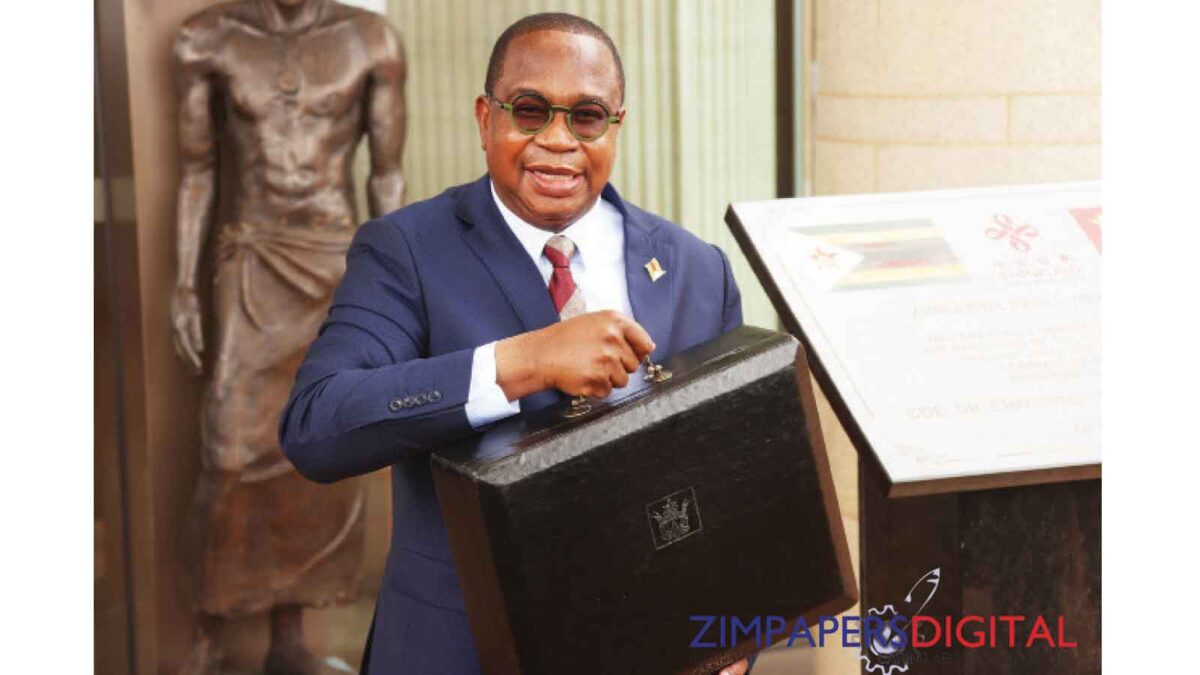
The 2027 National Budget, presented by Finance Minister Professor Mthuli Ncube, was a masterclass in walking the tightrope with uncommon grace.
Facing the dual spectres of a volatile global economy and an imminent, potentially catastrophic super El Niño, the Treasury has managed to deliver a package that offers tangible relief to the ordinary Zimbabwean while fortifying the nation’s defences against the gathering storm.
The genius of the 2027 Budget lies in its dual focus: it stimulates the household economy while simultaneously building a macroeconomic fortress.
At a time when many governments would instinctively reach for the tax lever to fund climate mitigation, Treasury resisted.
Instead, it doubled down on a strategy of fiscal discipline and revenue buoyancy.
By increasing the personal income tax-free threshold upward from US$100 to US$150, adjusting the corresponding tax bands and slashing the Intermediated Money Transfer Tax (IMTT), Prof Ncube has directly addressed the cost-of-living pressures facing workers.
This represents strategic empowerment.
By leaving more money in the pockets of citizens, the Government is stimulating domestic demand and easing the burden on the social welfare net.
This move, coupled with the decision not to introduce new taxes, demonstrates a rare empathy in fiscal policy — a recognition that the taxpayer is a partner in development, not merely a revenue source to be tapped.
This balancing act was made possible by a confluence of favourable factors, chief among them the country’s robust foreign currency inflows.
There has been a remarkable surge in foreign currency receipts, which rose by 33,7 percent to US$15,9 billion in the first nine months of 2026.
This is not fortuitous.
It is the dividend of rising commodity prices on the global market — occasioned geopolitical disruptions in Eastern Europe and the Middle East — and the astonishing resilience of the diaspora.
Diaspora remittances alone are projected to surpass US$3,4 billion in 2027, having grown from a mere US$1,2 billion in 2020.
These inflows have provided the fiscal space for Treasury to maintain a stable exchange rate and contain inflation, which is projected to remain in the single digits.
The economy is growing, with a projected GDP of US$66 billion, more than double the 2019 figure.
This growth is the engine that funds the Budget, and Treasury has managed it with a steward’s hand.
However, the true test of a budget is not how it manages the present, but how it prepares for the future.
Here, the 2027 Budget shines in its prescience.
The world is changing, and the climate is changing with it.
The recurring El Niño phenomenon is now a present and escalating reality.
To its credit, Treasury has not buried its head in the sand.
The allocation of a staggering US$400 million as a contingency against the super El Niño drought is a bold acknowledgment of this new normal.
This is a strategic buffer designed to prevent the humanitarian crises that have defined past climate shocks.
Complementing this is the strategic grain reserve, which is being built up to 600 000 tonnes by 2027, and the subscription to the African Risk Capacity sovereign drought insurance policy.
Zimbabwe is no longer merely reacting to climate disasters; it is actively anticipating them.
Yet, the Budget also implicitly suggests a deeper, more transformative path.
Zimbabwe must also change with the world.
While the contingency funds are essential for survival, investment in irrigation is the pathway to prosperity.
Zimbabwe’s status as one of the most dammed countries in the region is a latent superpower.
The allocation of ZiG4,8 billion for water and sanitation, and the continued focus on projects like Kunzvi-Musami and Gwayi-Shangani, are steps in the right direction. However, to truly insulate the economy and the nation from future climate-related shocks, we must exponentially grow our irrigation capacity.
The Lowveld and the Tugwi-Mukosi basin, for example, hold the key.
By channelling more resources into irrigation infrastructure — funded, in part, by the levy on grain importation — Zimbabwe can move from a perpetual cycle of food insecurity to becoming a major food exporter in the region and beyond.
The potential is immense, and the 2027 Budget lays the foundation by ensuring the fiscal buffers are in place to make these long-term investments possible.
In all, the 2027 National Budget is a testament to the power of disciplined, compassionate governance.
Treasury has navigated a treacherous path — providing tax relief without new revenue measures, while simultaneously saving for a rainy day that looks increasingly likely to be a drought.
He has done so not through magic, but through the hard work of fiscal consolidation, the strategic exploitation of rising commodity prices and the support of a resilient diaspora.
This year’s Budget is a confident statement that Zimbabwe can withstand global shocks.
But as we brace for the super El Niño, the message is clear: we have the resources to respond, but the true victory lies in building a future where we no longer have to.
It is now up to us to ensure that the seeds of this Budget, particularly in our irrigation fields, bear fruit for generations to come.