admin
admin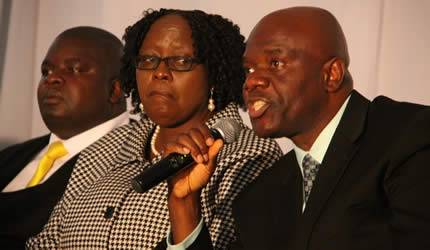
He was officially opening a two-day Zimbabwe-South Africa Investment and Trade Conference here yesterday.
China contributed the lion’s share of the inflows, followed by South Africa, Mauritius, Australia and Lebanon.
While the global FDI inflows have slowed down during the past three years, inflows into Zimbabwe have been on an increase, despite misconceptions that the country’s indigenisation policy was inhibiting investments.
There has been a steady increase from investment inflows from as low as US$60 million in 2009, US$166 million in 2010 and US$387 million last year, Minister Mashakada said.
“The growth trajectory trend is what we want to pursue as a country and we want South Africa to be a key driver in FDI,” he said. “There is a realisation that Zimbabwe is open for business, hence the call for more people to come and invest in the country.
The Zimbabwe of yesterday and of tomorrow is completely different.”
Minister Mashakda said Zimbabwe had embarked on a “reform agenda” through adoption of friendly policies to attract foreign direct investment. These included the creation of a one-stop investment shop and the adoption of the Medium Term Plan.
Zimbabwe required foreign direct investment to finance US$9,2 billion worth of programmes and projects as espoused in the MTP, given the fact that it had no capacity to fund this with its own resources.
The MTP identified FDI as a critical enabler for economic growth and, in particular, attainment of investment to gross domestic product ratio of 25 percent by 2015, creating jobs and raising industrial capacity.
To this end, Zimbabwe had undertaken numerous investment promotion tours to South Africa, Hong Kong, Dubai, Australia and Brazil – among other countries – as it intensifies efforts to attract FDI.
Minister Mashakada said South Africa was Zimbabwe’s most preferred source of investment.
He added the conference also sought to develop strong banking relationships and access to lines of credit with South African, regional and international banks keen to facilitate trade and investment in Zimbabwe. This could pave the way for the resuscitation of the 20-year R2,65 billion facility South Africa had made available in pre-independence Zimbabwe.
Earlier, an official from Gauteng Province (Economic Development), Mr Nkosiphendule Kolisile, urged SA investors to seriously consider business opportunities in Zimbabwe. Gauteng province is the country’s fourth largest economy, constituting 7,7 percent of the GDP and 35 percent of SA’s economy. In Africa, the province is the fourth largest trading partner of Zimbabwe.
Mr Kosile said Zimbabwe was on the correct recovery path which provided friendly business opportunities.
“Please, exploit opportunities next door . . . this is (the) time now,” he said. “We can do a lot to turn the corner that has already been turned by the Zimbabweans. Zimbabwe is on the correct path of recovery – it can stand up again and became a giant, particularly in Southern Africa.” He commended Zimbabwe for holding a peaceful referendum, saying it was “a key milestone” in implementing political reforms as espoused in the Global Political Agreement.
The conference, which ends today, is being attended by senior Government officials from both countries, civic society, Zimbabwe and SA companies and fund managers.


 Online Reporter