daniel chigunwe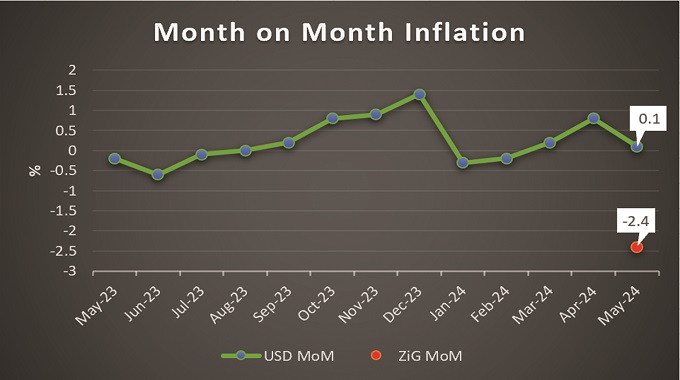
Nelson Gahadza
Zimbabwe’s operational environment is seen as complex, with no easy solutions to the numerous economic challenges in the form of currency, inflation and the high cost of doing business.
This is despite a number of fiscal and monetary measures that authorities continue to introduce and tweak in an effort to create an enabling environment.
The RBZ presented the 2024 Monetary Policy Statement on April 5, 2024, which introduced measures aimed at bringing macroeconomic stability, fostering policy predictability, and ultimately rebuilding consumer confidence.
Key policy measures included the continuation of the multi-currency system to 2030 in line with Statutory Instrument 218 of 2023, the introduction of the ZiG as a new currency to replace the ZW$, an increase in statutory reserve requirements on foreign currency deposits from 15 percent to 20 percent, and a reduction in the bank policy rate from 130 percent to 20 percent.
The introduction of ZiG, backed by gold and other minerals, is expected to stabilise the exchange rate and drive the Government’s de-dollarisation agenda.
True to expectations ZiG has been stable on both the formal and informal channels. At the same time, the first month-on-month ZiG inflation figures came out at a negative -2,4 percent.
However, despite the seemingly stable environment, some businesses are still worried over the outlook.
Financial services group CBZ Holdings, in its outlook for 2024 released last week, said global interest rates are expected to remain elevated, thereby perpetuating the high cost of international capital as well as the strengthening of the US dollar against other currencies.
It highlighted that monetary policy measures that were recently introduced by the Reserve Bank of Zimbabwe (RBZ) are expected to foster stability on the foreign exchange markets while perpetuating tight liquidity conditions on the money market.
“Climate change will continue to adversely impact the country’s agricultural and related sectors, hence the need for both the private sector and the Government to step up efforts towards climate change mitigation, adaptation, and relief programmes,” the group said.
Delta Corporation, in its 2024 financials, said the tax measures adopted in the 2024 budget have had far-reaching impacts on the business and the market in general.
It said the beverage sector has been particularly affected by the hefty sugar tax and the restrictions on the route to market.
“The Government introduced a new structured currency, the ZiG, with effect from April 5, 2024 but the fiscal measures to support the policy recommendations by the monetary authorities are still to be announced.
“There are inherent macroeconomic rigidities that need to be addressed to ensure the achievement of a stable currency,” the company said.
Delta noted that the economy will be impacted by lower mineral prices and reduced agricultural output following the El Niño-induced drought in 2024, although there are mitigations from increased mining output and resilient Diaspora remittances.
“The business will benefit from the improved product supply following the commissioning of additional production capacity during the past year and improved operational efficiencies across the business segments,” it said.
Experts believe the economy continues to be characterised by significant shifts in policies as authorities respond to currency and inflation developments, resulting in phases of currency liquidity mismatches, divergent exchange rates, and swings in inflation.
Enock Rukarwa, an investment analyst, told Business Weekly that on the backdrop of a contractionary stance being pursued by the Government, anchoring inflationary pressures and exchange rate volatility, liquidity both in USD and ZiG will be constrained for the greater part of 2024.
He said the tight liquidity circumstances have started creating a vicious bubble around interest rates, where money market rates and minimum lending rates are scaling upward.
“Dollarisation penetration will continue to broaden as traders fully embrace the multi-currency regime.
“Furthermore, our economy is highly informalised, and such a set-up perpetuates increased dollarisation as economic agents hedge revenues and wealth positions against potential inflationary pressures,” he said.
He noted that overall gross domestic product growth will be subdued, especially after factoring in El Nino-induced effects, a high cost of borrowing, and decreasing capacity utilisation.
According to the government, Zimbabwe’s economic growth is expected to fall to 3,5 percent in 2024 from 5,5 percent in 2023, mainly due to the drought caused by El Nino.
National Foods, on its part, said changes made to the VAT status of many of the operation’s products will make it increasingly challenging for the formal sector to compete against the informal sector and grey imports.
It said post-quarter-end, IMTT has increased from 1 percent to 2 percent on USD transactions, placing further pressure on the value chain.
“We are hopeful that the authorities will deploy some policy consistency in the period ahead to enable local players in the formal sector producing basic commodities to focus on supplying the consumer consistently in what will be a challenging period ahead,” National Foods said.
The group said its focus will be to ensure adequate stocks of competitively priced basic goods for consumers across the country over the next 12 months.
“In the period ahead, considerable focus is also being placed on ensuring that the new categories that have been added to the group’s portfolio are successfully launched and achieve the targeted returns on investment.”
Analyst Batanai Matsika told Business Weekly that while authorities have placed much focus on currency stability, that doesn’t address some of the broader constraints that the economy will continue to see in 30 years.
“Chief among them is the issue of working capital constraints; hence, most companies are still operating at suboptimal levels simply because there is no adequate funding within the broader economy or the local economy,” he said.
The latest survey by the Confederation of Zimbabwe Industries showed 2023 capacity utilisation had slowed to 53,2 percent from 56,1 percent.
Matsika added that limitations in terms of attracting foreign direct inflows (FDI) have been an issue across different industries.
However, according to Matsika, consumer-focused businesses like Delta will benefit from resilient consumer demand, and there is an opportunity to invest in capacity.
“Capital-hungry sectors like mining and probably agro-focused and manufacturing need funds to capitalise; hence, there is a need to change the interest rates.
ZB Financial Holdings, in its outlook, said that although the economic environment is likely to remain challenging in 2024, as characterised by high levels of inflation, exchange rate volatility, and climatic changes, particularly the effects of El Nino, the group is confident that set strategies will assist it in navigating these erratic economic conditions through the implementation of effective front-end systems, brand equity promotion, and continuation of its mantra of creating happy people.
First Capital Bank (FCB) said the operating environment presents risks and opportunities, and the bank remains positive about growth prospects in the medium term through diligently harnessing the opportunities while exercising robust risk and cost management.
“To boost its capacity to support the expected economic rebound, the Bank has mobilised an additional US$15 million line of credit from the African Development Bank. This brings the total available facilities from various regional and international funders to US$48,5 million, significantly enhancing the Bank’s capacity to support growth in the key sectors of the economy and facilitate the anticipated economic rebound,” it said.
Simbisa Brands noted that the relative stability of the ZiG since its introduction has been beneficial in retaining customers, preserving operating margins, and reducing borrowing costs.
It, however, said the long-term success of the ZiG and the contingent benefits will depend on both market confidence and the Government’s commitment to consistent monetary policy.
Transport and logistics company Unifreight said Zimbabwean fuel is the most expensive, with the pump price at US$1,68 compared to US$1,11 in Zambia.
Additionally, vehicle registration is also significantly higher at US$1,560 compared to only US$132 in Zambia.
“These exorbitant costs make operating a cross-border fleet in Zimbabwe less attractive. Duties levied on diesel currently stand at US$0,427c, and 25 percent of export proceeds are converted into ZiG, which cannot be freely converted back into USD at the controlled exchange rates published by the Reserve Bank.
“Luckily, Unifreight has a flexible business model that allows us to change the number of assets running cross-border as we need,” the company said.



 Online Reporter