admin
admin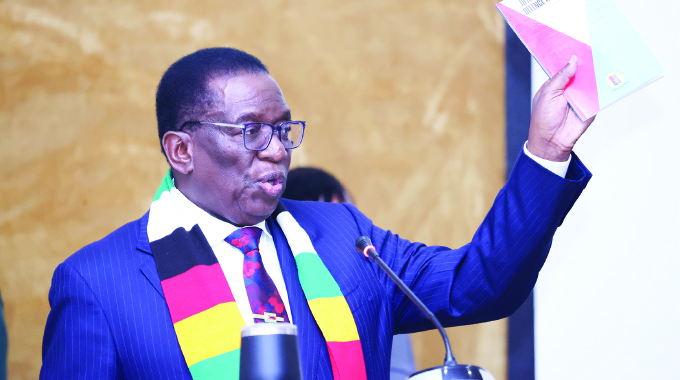
Dr Gwinyayi A Dzinesa, Correspondent
President Mnangagwa, in his address at last week’s Harare launch of the African Journal of Defence and Security, produced by the Zimbabwe National Defence University (ZNDU), emphasised the institute’s role in delivering peace and security — Artificial Intelligence (AI) research that matters. AI is the ability of a digital computer or computer-controlled robot to perform tasks commonly associated with intelligent beings.
President Mnangagwa said: “Whilst the concept of security has been broadened to include non-military dimensions, I exhort the university to undertake more research in the traditional security paradigm, as well as emerging issues such as the use of artificial intelligence and drone technology.”
The President’s exhortations to the ZNDU to ramp up research on responsible AI for peace and security could not have been more timely.
On June 13, the African Union (AU) Peace and Security Council (PSC) dedicated its 1214th virtual meeting to a discussion on “Artificial Intelligence and its Impact on Peace and Security in Africa”.
Comprising 15 elected members, the PSC is the AU’s standing decision-making organ for the prevention, management and resolution of conflicts.
The PSC recognises that AI is a double-edged sword. AI presents both opportunities and risks for continental peace and security. For example, peaceful applications of AI can help achieve the peace and security goals set out in AU Agenda 2063, “Africa’s blueprint and master plan for transforming Africa into the global powerhouse of the future”.
The use of AI can enable more effective conflict analysis and early warning. AI can support AU-mandated peace operations, such as the Southern African Development Community (SADC) Mission in the Democratic Republic of Congo (SAMIDRC). This includes the use of drones for medical deliveries, monitoring and surveillance.
AI technology can also contribute to the identification of safe routes to enable civilians to flee to safer areas and facilitate humanitarian access and delivery in conflict settings.
However, AI can be misused for political disinformation, cyber-attacks, terrorism or insurgencies and instigating violence. For example, AI-generated deep fakes can be used to impersonate political figures for propagating false information .
There are also concerns about technology-facilitated gender-based violence and hate speech targeting women and minorities.
Therefore, the PSC tasked the AU Commission — the secretariat that undertakes the day-to-day activities of the Union, to expedite the development of a comprehensive Continental AI Strategy to transform the continent, while managing associated risks and harm.
The PSC’s 1214th session also stressed the importance of continuous dialogue and enhanced collaboration on the use of AI between and among Member States, Regional Economic Communities (RECs) like SADC, the private sector and think tanks, as well as between the AU, the United Nations and other stakeholders, to ensure a harmonised approach towards harnessing AI.
Notably, President Mnangagwa has assumed the rotational chairmanship of SADC at the 44th Summit of Heads of State and Government.
According to Foreign Affairs and International Trade Permanent Secretary Ambassador Albert Chibindi: “As chair, Zimbabwe will promote regional integration projects, infrastructural development, transportation networks and energy systems, pursuant to the timely theme for the 44th summit, which is, ‘Promoting Innovation to Unlock Opportunities for Sustained Economic Growth and Development towards an Industrialised SADC.'”
The SADC chairpersonship will allow Zimbabwe to promote the urgent development and implementation of national and regional AI strategies in line with PSC’s call.
As of March 2024, Mauritius — the most advanced sub-Saharan country but only 57th globally, was the only one of the 16-member bloc to have developed a national AI programme.
Zimbabwe, like other member states, including South Africa, is developing a national AI policy.
Zimbabwe’s Minister of Information Communication Technology, Postal and Courier Services Dr Tatenda Mavetera told a Zimpapers AI/Digital conference in July this year that the national plan would ensure ethical and effective AI integration.
The ZNDU can be a crucial player in crafting the national strategy and helping to ensure the peaceful applications of AI technology.
For instance, a well-resourced Institute of Strategic Research and Analysis (ISRA) can serve as a national think-tank and platform for comprehensive, cutting edge peace and security AI research.
The ISRA could consider, sensitive to its current research agenda, themes suggested by the PSC for the AU Commission.
These include:
1) the impact and implications of AI on national, regional, continental and international peace, security, stability, democracy and development;
2) responsible integration of AI in military operations;
3) enhancing efforts to combat misinformation, disinformation and fake news through AI-driven tools while also addressing the risks associated with AI-generated false information;
4) strengthening cyber security measures through AI technologies that simultaneously mitigate digital threats and robustly protect digital infrastructure; and
5) fostering inclusive and resilient communities through AI-driven youth and women empowerment. The African Journal of Defence and Security presents a critical vehicle for conveying the incisive research output.
Additionally, the ZNDU’s Master of Science in Conflict Prevention and Early Warning Mechanisms (MCPEWM) positions it as a potential hub for promoting AI-driven early warning systems to detect and analyse potential conflict indicators, enabling proactive conflict prevention measures.
Significant national investment and deep collaboration with carefully selected partner organisations would be crucial to developing advanced peace and security AI research, tools and enablers for delivering breakthrough moments.
Dr Gwinyayi A. Dzinesa is a faculty member of Africa University, Zimbabwe and a Senior Research Fellow at the Institute for Pan African Thought and Conversation (IPATC), University of Johannesburg



 Online Reporter