Chronicle Editor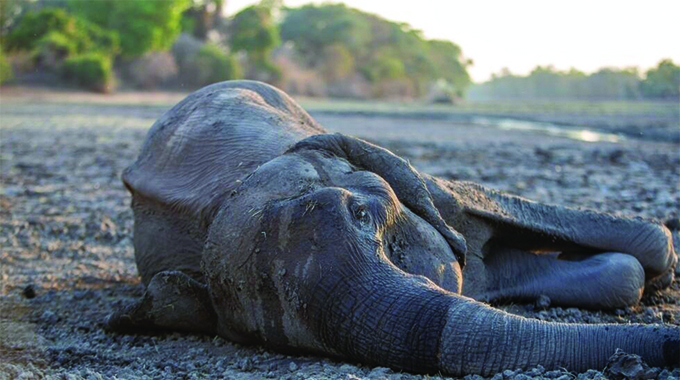
AT least 100 elephants have died in the Hwange National Park from lack of drinking water occassioned by a climate-induced prolonged dry spell, the International Fund for Animal Welfare (IFAW) has said.
The rainy season in Zimbabwe used to run reliably from October to March but in recent years it has become erratic, sometimes starting in December.
In a statement, IFAW landscape programme director Phillip Kuvawoga said elephants and other wildlife are dying in Zimbabwe due to an extended dry season which has reduced once abundant water holes to muddy puddles.
“Summer rains are five weeks late due to the ongoing El Niño phenomenon as dozens of elephants have already died in Hwange National Park, the county’s largest protected area home to about 45 000 elephants. At least 100 elephants are already reported dead due to lack of water.
“Elephants and other wildlife species will face a crisis if the rains don’t come soon. In 2019, over 200 elephants died in Zimbabwe due to severe drought; this phenomenon is recurring,” he said.
The Zimbabwe Parks and Wildlife Authority intervened to address the situation by drilling 100 solar-powered boreholes to pump underground water into pools for the animals to drink.
But with so much surface water drying up, animals are still forced to walk longer distances, sometimes across national borders, in search of food and the precious liquid.
Zimbabwe has for years been lobbying the Convention on International Trade in Endanngered Species of Flora and Fauna (CITES) to lift the ban on trade on ivory in order to raise funds for conserving its elephants whose population has surpased its carrying capacity.
The country has a population of over 80 000 elephants against the carrying capacity of 45 000.
Animal rights groups oppose the calls by the country to remove the ban on trading in elephants and ivory, arguing that doing so would open floodgates of poaching and illegal trade in ivory.
Zimbabwe is sitting on stockpiles of ivory worth over half a billion United States dollars which it could sell and fund efforts to conserve the animals, which include drilling of boreholes and fighting poaching. — New Ziana



 Online Reporter