admin
admin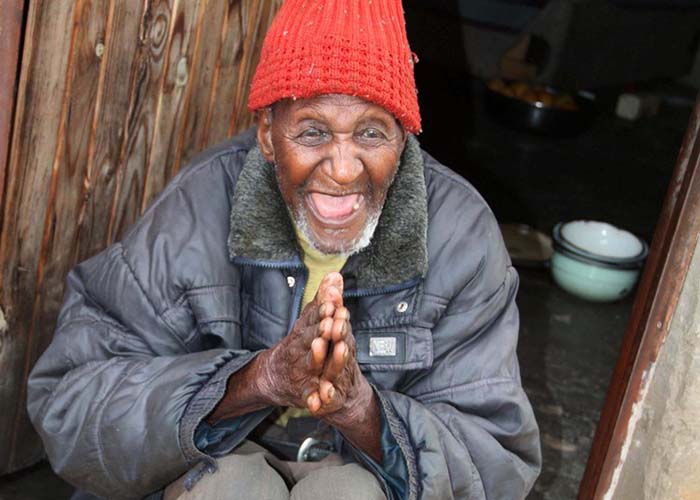
He is hard of hearing, and speaks in a high-pitched tone.
His eyes battle to see, but a mere mention of the word “Christmas” brings an animated spark to his face.
At the official age of 111 (although he insists that he is 115-years-old), Sekuru Aaron Gumbo – also known as Sekuru Magwenzi – is one of the oldest people in Zimbabwe and the few around the world who can claim to have experienced more Christmases than others.
In between lapses of concentration, his eyes light up as he tries to select memories from the Christmases he has witnessed.
Although he struggles to remember most of the past 114 Christmases, he told The Sunday Mail last week that a few stand out.
When The Sunday Mail arrived at his homestead in Mukarazhizha Village, Murewa, Sekuru Gumbo – who also insists that his identity card was misspelt Gombo – was in his blankets but volunteered to prove that he can still walk.
With his walking stick, the old man sauntered in his yard, watching over his garden, chicken-run and adjacent maize field.
During the interview, the visibly frail Sekuru Gumbo would lose coherence at times, but spoke with exuberance that belied his fragility, as he narrated his most memorable Christmas.
“I can’t remember them all. But I think the 1980s had the best Christmas celebrations for me. At that time, I was the headman in the village and would invite family and friends from the entire village to feast at my house.
“I had many cattle and would slaughter a beast for everyone who attended. The party would last for days. I recall one feast which lasted until New Year’s Day. So, that was seven consecutive days of feasting. We made the traditional brew – seven-days – but when it ran out, we reverted to the one-day brew. People would dance well into the night.”
Sekuru Gumbo, however, contends that in his earliest memories of Christmas, the day was laden with controversies as most black people viewed it as an extension of colonialism.
He said his earliest memories of Christmas dated back to 1910 when there was disillusionment in the family about whether they should celebrate the day or not, given that it had been “brought by colonialists”.
“In 1910, my father was not too happy about celebrating Christmas. His argument was that by celebrating Christmas, we were glorifying the colonisers who were killing our people and taking our land.
“So, in those years, we were not always keen on celebrating this day. There was a feeling that by celebrating Christmas, we were betraying our ancestors and submitting to colonialism.”
Amazingly, Sekuru Gumbo recalls one bleak Christmas for whites.
“Christmas in 1914 was a bit different from what we had earlier known it to be. There was a palpable sense of sadness among the white people. We only later got to learn that it was because the (First World War) was at its peak and they were concerned about it.”
He said the glum mood was also apparent during the early 1940s at the height of the Second World War.
Sekuru Gumbo said although black people initially had reservations about Christmas, perceptions changed as Christianity began to grow.
“After the initial scepticism, black people started to love Christmas and make it a special day. This was mainly because Christianity was growing and black people began to understand the religion.”
Asked how he plans to spend his Christmas this year, Sekuru Gumbo paused for a long while before he gave an unexpected response.
“I want coke and biscuits. Did you bring coke and biscuits from Harare?” he asked.
Sekuru Gumbo explained that during the past few years, he has developed a love for “junk food” even though he has spent the bulk of his years sticking to a healthy diet of traditional foods.
He said the death of his wife, Mrs Georgina Magwenzi, at 90 in 2011 had affected his diet, as she was the only person who knew what to cook for him.
Georgina was Sekuru Gumbo’s third wife.
“When my wife died, I realised that no one could cook the way she used to. So, I have since changed my diet. I eat anything. And I must admit that I have developed a ‘sweet tooth’.
“I don’t have teeth to chew with, but I also prefer soft meat. But for this Christmas, I am not going to feast. I just want my coke and biscuits.”
Sekuru Gumbo’s children, however, said they are planning to have a big Christmas feast for him this year beyond his coke and biscuits.
His ninth-born son, Mr Tineyi Magwenzi (61), said the family wants to make the occasion special.
“We have called all his remaining children to come and spend Christmas with him. He has nine children, but some of them are late. His first-born and my brother, Phineas, is late. He was born in 1930. Of the remaining children, Miriam Madziva, who was born in 1938, is the oldest and she is the fourth-born in the family.
“We have now lost count of how many grandchildren, great grandchildren Sekuru Gumbo has, but we have invited all of them to come for Christmas and spend the day with him.
“He hardly remembers many of them, but recalls many of their names and makes demands to those he remembers.”
Sekuru Gumbo’s national identity card shows that he was born on January 5 1905.
He, however, insists that his birthday is January 1 1901 as the process of acquiring IDs at that time was flawed.
During the interview, Sekuru Gumbo frequently uttered the words “kufa hakuna member (death is unpredictable) and muviri wangu unogona kufa asi mweya wangu hauzorere (my body may be dead but my spirit will live on)”.
Asked to give a piece of advice to the younger generation this Christmas, Sekuru Gumbo spoke with much verve.
“Feast but don’t fornicate!” he thundered as he gave a lengthy tirade of how a good number of his friends had died earlier than him because of their love for women.



 Online Reporter