

 admin
admin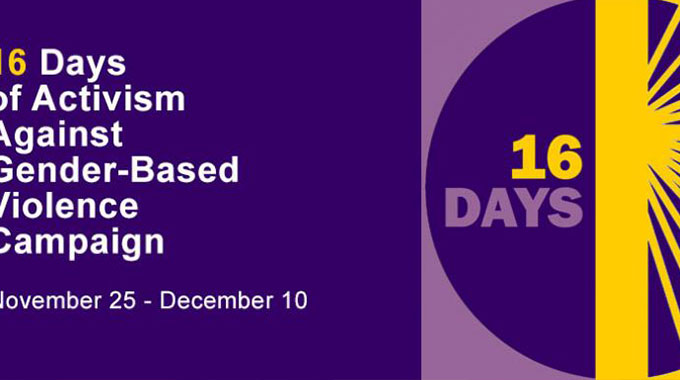
16 Days of Activism against gender-based violence is an international campaign to challenge violence against women and girls.
This campaign runs from 25 November to 10 December.
25 November is the actual international day for the commemoration of the elimination of violence against women and girls andit ends with the International Human Rights Day.
This year’s theme is, “Orange the world: Generation Equality Stands Against Rape!!”
The colour orange symbolises a brighter future, free from violence of women and girls. The local theme as Zimbabwe is “Prevention, Protection, Participation and Services; End Gender-Based-Violence”.
People and institutions should prevent gender-based violence. We should protect survivors and women and girls who are vulnerable to GBV.
We should all participate and come up with services that are holistic and are survivor-centred and we should use the right based approaches in the provision of the services.
It is also important not only to have policies and laws that protect against women and girls against gender-based -violence but also to have practical solutions to the problem.
Violence against women affects women regardless of their social class, age, background or level of education. Forms of violence vary and it can be physical when a person is assaulted, verbal (usually includes insults or words that degrade the other person) psychological, economic abuse and exploitation.
Such violence can devastate families, undermine workplace productivity and stalls development. Violence prevents women and girls from participating fully in their spheres of life, be it in education, work or income generating activities, or social. It can also lead to death.
Kofi Annan (former Secretary General of the United Nations, 1997-2006) once said that, “Violence against women is perhaps the most shameful human right violation. And it is perhaps the most pervasive. It knows no boundaries of geography, culture or wealth. As long as it continues, we can not claim to be making real progress towards equality, development and peace”.
This statement emphasises how devastating rape is and how it hinders progress and development of a country.
Gender-based violence is still widespread and devastating. It is estimated that one in every three women will experience violence in their lifetime.
According to Zimbabwe National Statistics Agency in 2016 8 069 women were raped, in 2017 there were 7 394, in 2018 there were 7 738, 2019 (January and February 1 361.
These numbers are alarming as these are reported cases. So many cases go unreported due to various reasons like fear of not being believed and supported, fear of stigma that may arise and that sometimes rape happens within the family.
Zimbabwe is a signatory to various international and regional human rights instruments that protect women and girls against gender-based-violence in its various forms. Thus Zimbabwe has a duty to take positive action in protecting its citizens.
The Zimbabwe Constitution talks about the protection of the family and obliges the state to adopt measures for the prevention of domestic violence.
Further in a different section, the Constitution states that very person has the right to bodily and psychological integrity which includes the right to freedom from all forms of violence from the public or private sources. Thus the protection is not just at home but also within the public sphere.
There are various other laws that can be used when one is a survivor of gender-based-violence including the Domestic Violence Act when the violence is within the home or the Criminal Law Codification and Reform Act when the violence is physical or sexual in nature.
There are various actions we can take so that violence against women and girls end.
We can report to the police when violence occurs and break the silence. We can give support and protection to survivors of violence.
We can spread information and awareness; help change attitudes and practices that harm women and girls by speaking out against perpetrators.
During the 16 days people are encouraged to dress in orange as a way of participating in this worthy cause.
– For more information contact us Zimbabwe Women Lawyers 134 J Tongogara Street/ 14th Avenue, Bulawayo. Telephone +263 292 887185-7


 Online Reporter