admin
admin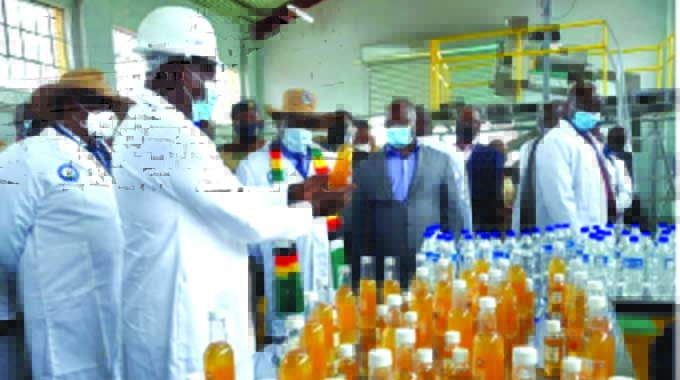
Lovemore Chikova Development Dialogue
The year 2021 is about to close, but it will continue to linger in the minds of many in rural areas who have witnessed development being brought at their doorsteps this year.
That rural areas were being neglected in the past is no secret, starting from the days of the successive colonial regimes which did not see value in developing such areas.
After independence, a number of developmental projects were implemented in rural areas, but these were not being done at an accelerated speed.
The year 2017 saw the coming in of the New Dispensation which resulted in more focus being directed to the rural areas for increased pace in development.
But this year, President Mnangagwa and his Government directed much of the focus on development of rural areas, setting a strong base for their industrialisation and modernisation.
In fact, when President Mnangagwa spoke about development on several occasions during the course of the year, he made it a point to emphasise his popular statement that no one or any place will be left behind.
It was during this year that the New Dispensation came up with a rural development master plan focusing on alleviating poverty by bringing the once marginalised areas into the mainstream economy.
This week, President Mnangagwa launched the Presidential Rural Development Scheme set to benefit more than 1,8 million households throughout the country.
The scheme, meant to uplift livelihoods in rural communities through creation of employment opportunities for women and youths, among other vulnerable members of society, was launched at Sekusile-Makorokoro Nutrition Garden in Mangwe District in Matabeleland South.
Under the scheme, Government will drill and equip one borehole in each of the country’s 35 000 villages.
Each village will also be empowered with a nutrition garden with a wide range of fruit trees and sweet potato vines being distributed to households.
Government will also drill 9 600 boreholes for schools, while each ward will receive two boreholes for youth horticulture projects.
Addressing people during the launch of the scheme after touring the project, President Mnangagwa said Government was transforming rural communities through fully exploiting local resources such as land, water and mineral resources.
During the course of the year 2021, President Mnangagwa commissioned the Marula/Mapfura Processing and Value-Addition Factory built by the National Biotechnology Authority of Zimbabwe at Rutenga growth point in Mwenezi district, Masvingo.
The factory will transform lives of more than 30 000 households in the district who will pick up the abundant mapfura/marula fruits and sell them for processing.
It will produce stock feeds, edible oils and juice and a vibrant industry around those products is expected around Mwenezi district.
Indications were that the factory would generate $400 million annually from processing the wild mapfura/marula fruit.
The plant has capacity to produce 75 000 litres of concentrated mapfura/marula juice monthly which translates to 150 000 litres of wine and 5 000 litres of high value oil per season.
It was expected to directly employ over 100 people and thousands more indirectly. During the mapfura/marula off season, the plant can also process other products like oranges and watermelons.
The year 2021 saw President Mnangagwa launch of the Vision 2030 Accelerator Model in Lupane, Matabeleland North, a game changer that will result in the Agricultural and Rural Development Authority (ARDA) producing at least 117 000 tonnes of maize countrywide worth US$21 million per each harvest.
The model will also result in a potential wheat harvest of 130 000 tonnes valued at US$46 million.
The rural development model is expected to uplift marginalised areas, as ARDA optimally utilises at least 26 000 hectares under irrigation schemes.
President Mnangagwa launched the model at ARDA’s 180-hectare Bubi-Lupane Irrigation Scheme in Matabeleland North province, which is already implementing it.
Under the model, employment will be created for local communities providing labour to the irrigation schemes that will be dotted around the country.
Villagers will be roped in as partners in the schemes and ARDA is expected to pay dividend on profit to approximately 55 000 families and direct beneficiaries, with an estimated assistance to one million indirect beneficiaries.
The model will guarantee food, feed and fibre security for rural communities.
In the near future and as part of the Vision 2030 Accelerator Model, ARDA will construct decentralised micro-processing hubs, with feed-stock produced at the irrigation schemes.
This will be part of the on-site value addition that the authority expects to implement throughout the country.
The opening of the Tabudirira Vocational Training Centre in Mutoko, Mashonaland East, was another game changer in terms of the accelerated rural development taking place in Zimbabwe.
President Mnangagwa commissioned a US$1 million fruit and vegetable processing plant at the centre, which is expected to benefit farmers in the area.
The plant, funded by the African Development Bank, will transform Mashonaland East province’s horticulture landscape, with a positive impact of the livelihoods of thousands of farmers in the area.
Farmers in the area had been struggling to access a ready market for their produce in their vicinity, resulting in them travelling long distances in search of markets.
The processing plant will enable the farmers to do crop value addition in line with the country’s Vision 2030 of attaining an upper middle income economy, which is anchored on the National Development Strategy 1.
In the rural Matabeleland region, Government in 2021 stepped up efforts to implement key development projects in line with the devolution policy and Vision 2030.
These projects are anchored by the Gwayi-Shangani Dam, which is now nearing completion after being pegged more than a century ago, with successive administrations failing to make headway.
The benefits of the giant dam are numerous, with President Mnangagwa already having commissioned work on a pipeline that will take water to Bulawayo.
This augurs well with the revival of Bulawayo’s industries that have been affected by many issues, including shortages of water in the second largest city in Zimbabwe.
Gwayi-Shangani Dam, being built at the northern edge of the escarpment in Matabeleland North, will impound 650 million cubic metres of water when full, making it the third largest interior lake in Zimbabwe and holding enough water even in drought years.
It will receive water from Gwayi and Shangani rivers.
The dam was first planned 109 years ago in 1912, but very little had been done until the coming in of the Second Republic which committed huge amounts of money for its fast tracked construction.
Already, work has started to prepare 10 000 hectares of land for establishment of irrigation projects under the National Matabeleland Zambezi Water Project of which the Gwayi-Shangani Dam is a major component.
The dam is expected to benefit communities in Binga and Hwange districts, as they can establish irrigation schemes and mitigate the effects of low rainfall.
Tuli Manyange Dam in Matabeleland South is another game changer in the drought prone region, as it will result in a greenbelt of irrigation crops throughout the year.
Villagers’ lives will be transformed by the presence of this dam and the drawing of water for irrigation purposes.
The Pfumvudza/Intwasa Programme for the 2021/22 farming season was launched by President Mnangagwa in Gokwe recently under which every farmer got inputs for free under the climate-proofed scheme.
As a huge statement on taking development to the rural areas, the President launched the programme, which has since been extended to cotton, at Chief Nenyunga homestead.
“As a country we are now 41 years old and I have seen that this area is behind, so I said we will meet here to assure you that from today onwards you will be part of the development programmes by the Government,” President Mnangagwa told the gathering.
Early this year, President Mnangagwa commissioned Muchekeranwa Dam, which lies on the border between Mashonaland East and Manicaland provinces. Apart from commissioning the dam, the President also launched the Presidential Fisheries Scheme and the Muchekeranwa irrigation project, which are spin-offs from the massive dam and meant to benefit the surrounding rural areas.
The dam will also result in the Muchekeranwa-Wenimbe pipeline being installed to bring water to the nearby Marondera town, with the surplus going to the capital city, Harare.
More importantly, the dam will provide water to Machiki Irrigation Scheme earmarked for local farmers and villagers who were moved to pave way for its construction a few years back.
The Emergency Road Rehabilitation Programme 2 launched by President Mnangagwa in Mt Darwin in April has seen rural roads being improved.
Apart from the road rehabilitation programme, some of the rural roads were uplifted under the devolution programme.
An efficient transportation system for rural areas has the potential to widen access to markets, facilitates easy movement of people and goods and helps integrate such areas with urban areas.
A modernised transportation system in rural areas also enhances access to schools, health facilities and markets.
Many rural development projects were implemented throughout the country under the devolution programme in 2021.
These included building of new clinics and renovation of existing ones, additional classroom blocks at schools, roads, bridges, weirs, irrigation schemes and recreational facilities.
Devolution also availed an opportunity for people in rural areas to participate in the development of their localities, be it at provincial or council level.
Feedback: [email protected]


 Online Reporter