admin
admin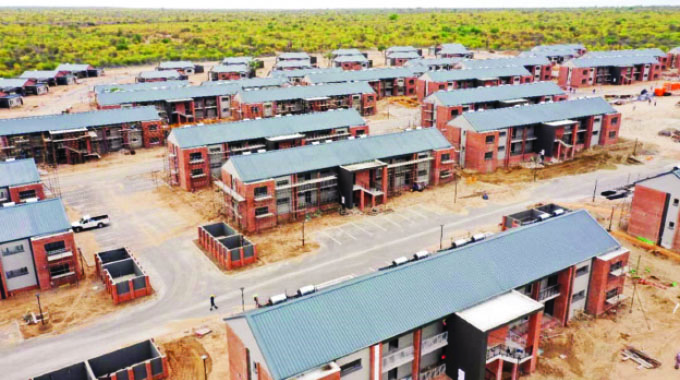
Thupeyo Muleya-Beitbridge Bureau
In the past, the story of infrastructure development has been that of many promises and little action. In fact, in the last decade it was becoming a perennial mirage. The district has had many ambitious projects, some failing to take off due to a number of sectorial challenges and bureaucracy among development agencies.
However, things took a turn in the last four years in Beitbridge district which has been undergoing a massive infrastructure and economic development revolution as part of the Second Republic’s thrust of leaving no one and no place behind.
Since 2018, the government has been fully implementing the National Development Strategy 1 (NDS1), a key enabler of the envisaged Vision 2030.
Infrastructure development and the improvement of service delivery went a gear up this year with the government being able to complete major projects. These were made possible through Private Public Partnerships (PPP), government funding under various initiatives including devolution and Constituency Development Fund.
Such initiatives also helped to breathe life in many communal irrigation schemes and saw a rise in horticulture projects, most of them powered by solar energy coupled with the use of drip irrigation to increase productivity.
Communication
Through community engagements, more mobile telecommunication base stations were installed and are now working in the remote areas, where people were relying on South Africa for such services.
A local community radio station, Lotsha FM (a new dawn) which broadcasts mainly in Tshi Venda was also successfully launched by the government in February and has become one of the major communication and development drivers in the district.
Border transformation completion
Zimbabwe is known as one of the key players in facilitating regional and international trade through its many ports of entry and exit, including Beitbridge. To that effect the slow movement of cargo and human traffic has in the past 10 years become a perennial headache for many people within the Sadc, Africa and international community.
At some point cargo was taking between 24 and 72 hours to cross into either South Africa or Zimbabwe due to a number of trade barriers.
However, by mid-June 2023 the government and its partner the Zimborders Consortium had completed the Beitbridge Border Modernisation programme, which cost US$300 million.
Beitbridge is the only land port between Zimbabwe and South Africa, which is a major player in regional and international trade in SADC. The project has set the border and the town on the road to real transformation due to its other spill-over effects. The port of entry now has three dedicated terminals to handle commercial, buses, light vehicles and pedestrians. It is also automated and uses biometrics to prevent irregular migrants and criminals from accessing the area that links South Africa with Zambia, Botswana, Mozambique, Angola, DRC, Malawi and Tanzania.
The move has paid dividends with the customs yard in Zimbabwe now able to hold up to 200 trucks at any given time, however, space remains a challenge on the South African border.
This set up has also made the port of entry/exit more user-friendly to importers/exporters and general travellers as they are now spending less time at the border due to obtaining efficient management systems.
In previous years all the border traffic was being cleared from one point with limited infrastructure and staff leading to staff burning out and creating a room for rent seeking activities.
Transport and infrastructure
development
In 2023, through funds from the Zimbabwe National Road Administration (ZINARA) and Treasury, the government was able to fix most damaged roads around Beitbridge district, including the completion of a 5.1km dual carriageway that links the border and major roads leading to Bulawayo and Harare.
To many travellers and residents in the border town, this project had become an eyesore in the last 8 years of the First Dispensation. Most impassable roads under Beitbridge RDC and the town council were maintained and upgraded through the ZINARA. In the rural component of the district, the Rural Infrastructure Development Agency (RIDA) managed to rehabilitate and maintain some impassable roads to link major business centres and communities with the Bulawayo and Harare highways.
Water and sewer infrastructure
As part of the out of port works, the Zimborders Consortium which modernised the border in partnership with the government, this year successfully completed constructing and equipping a new sewer oxidation dam, a 11,4 mega litres water reservoir. This has helped the Beitbridge Municipality to better handle sewer and water reticulation services.
Housing development
The deployment of staff in many border agencies has over the years been adversely affected by acute accommodation shortages in Beitbridge town. This challenge became history when the government was able to complete the construction of a new staff village with 220 housing units which was commissioned in April this year. A surfaced road linking the town with the new staff village has also been completed. Work to complete the construction of 16 garden flats to accommodate 64 families is already underway in the town. The project had not had attention for over 5 years.
Rural Development and
Devolution projects
Faced with a number of economic climate related challenges, the Beitbridge Municipality and the Beitbridge RDC have been struggling to provide people centred service delivery.
However, the government through Devolution Funds helped them to address their deficiencies.
This year the Beitbridge RDC received a total of $319 million dollars in devolution funds which were committed to civil works at various key amenities some of which were completed while others are under various stages of construction. The projects which were made possible in the RDC include, the construction of Dumba Clinic, Mazunga Clinic, Novhe Primary School, Zezani Clinic staff house repair, Mtangamtshena and Matshiloni secondary schools’ classroom blocks and Tshaswingo Primary School classroom block construction.
The local authority also managed to buy a council administration vehicle and upgrade its ICT facilities.
Authorities at the Beitbridge Municipality were able to complete the construction of Alfred-Beit Primary School using devolution funds in the Khwalu 2 suburb which is set to open doors for classes in January next year.
With their 2023 funds, the council managed to digitise services, buy solar power back up systems to ensure they offer continuous services, and to upgrade the Local Authorities Digital Systems (LADS) for budget formulation and to construct a new clinic to improve primary health care facilities.
Emergency responsiveness
Government completed the construction of a state-of-the-art fire station which has been commissioned in Beitbridge town. In addition, they donated a fire tender to the local authority and trained its staff to build their capacity for disaster response.
Crop and Animal Disease Control
A new animal plant and quarantine facility built through a PPP by the government and the Zimborders Consortium opened its doors to the public this year. This has been described by many farmers as a game-changer on how the country handles imports/exports of agriculture related products. The facility is located some 5km north of the Beitbridge Border Post and it is one of the key projects under the border modernisation programme that was completed in June this year.
Within this facility, there are various laboratories with a special focus on animal health, general hazards, and farming-related equipment that will be examined for conformity with imports and exports regulations.
Some of the laboratories will be managed by the Environmental Management Agency (EMA), Veterinary Services, Agriculture Plant, and the National Biotech Laboratory.
These have helped decongest the border now that such departments are now based at the facility full time to attend to issues as and when they arise.
Agriculture and rural transformation
This year most farmers in the district adopted the use of smart agriculture, that includes the use of solar powered boreholes, centre pivots, green house construction and drip irrigation. Such moves resulted in the district being self-sufficient in terms of horticulture products with some farmers breaking into new markets in other provinces.
New Boer and Kalahari goats’ farmers also emerged in the district where livestock production is a major economic driver.
A major fishery was launched in Beitbridge this year at Zhovhe Dam and it is set to benefit 16 000 households with start-up fingerlings in four provinces. An indigenous company, Toppick Investments also wrote a success story as they ventured into the citrus production which saw the planting of over 200 000 orange and lemon trees.
Immigration, Customs,
Crime and Justice
The police were able to control a wave of armed robberies that had swept across the district at the beginning of the year and intercepted a number of criminals smuggling firearms and other prohibited goods (supported by Zimra). The Department of immigration managed to control the illegal movement of people into and out of the country arresting a number of foreign nationals with the majority being from Malawi. The men and women at the Ministry of Justice, Legal and Parliamentary Affairs also made sure that all dangerous people and those breaking the laws of the land were sent to prison for rehabilitation.
Business Growth and Awards
Hundreds of exhibitors including bigger corporates and Small to Medium Enterprises converged in Beitbridge this year to participate at the business expo which was packaged with conferences, workshops and career guidance programmes for schoolchildren. The Sundrive Coalition Arts awards added colour in the local arts sector where individuals were recognised for the roles they play in the community.
International events
The district successfully hosted the World Children’s Day at Malala primary school in Beitbridge West where Vice President Constantino Chiwenga led the proceedings. The event was attended by envoys from various countries, including the United Kingdom Ambassador, Mr Peter Vowles and the United Nations agencies.
Environment
The Forestry Commission supported by various players helped communities to plant more trees and to minimise and control the cutting down of trees for firewood purposes.


 Online Reporter