Online Reporter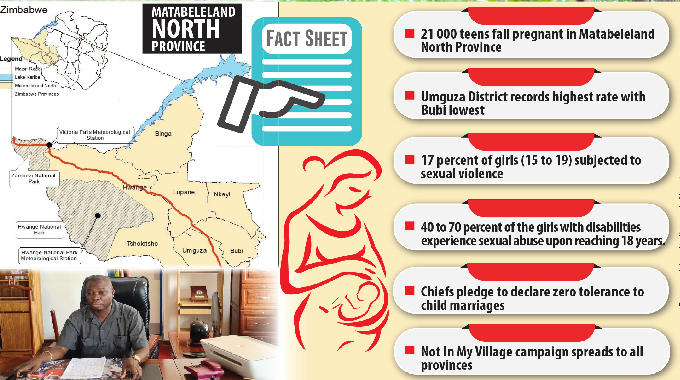
Raymond Jaravaza in Lupane
A staggering 21 000 teenagers have fallen pregnant in Matabeleland North Province within just over two years, a deeply concerning trend the Government is now aggressively working to reverse by tackling child marriages and teenage pregnancies.
According to the 2023–24 Zimbabwe Health Survey, the national teenage pregnancy rate now stands at 23 percent, up from 21,06 percent in 2015. Teen pregnancy refers to pregnancy in females under the legal adult age of 18.
Minister of State for Matabeleland North Provincial Affairs and Devolution, Richard Moyo, has expressed alarm at the province’s high rates and stressed the urgent need for intervention.
The figures were revealed during a National Aids Council (NAC)-organised advocacy meeting in Lupane, where Minister Moyo was the guest of honour. The meeting, attended by traditional leaders, police, Ministry of Health and Child Care officials and youth representatives, aimed to address child marriages and coincided with the official launch of the “Not In My Village” campaign in the province.
“Recent data from our health information system shows that between January 2023 and March 2025, over 21 000 teenagers fell pregnant in our province. The figures are particularly high in Umguza District, which alone accounted for 40 percent of teenage pregnancies. Bubi, by contrast, recorded the lowest figures. But let me emphasise — these are not just statistics; they represent the lives of young girls whose dreams are being shattered,” said Minister Moyo.
Surveys indicate that child marriages and teenage pregnancies in Matabeleland North are driven by a complex interplay of factors, including poverty, ingrained gender norms, cultural and religious beliefs and limited access to essential services and information.
Minister Moyo noted: “The provincial rate of teenage pregnancies here is even higher at 25 percent, with causes ranging from a lack of opportunities to harmful cultural practices.”
At the district level, Umguza recorded the highest number of teenage pregnancies, with 8 468 cases. Binga followed with 2 798, Lupane with 2 489, Hwange with 2 487, Nkayi with 2 132, Tsholotsho with 2 041 and Bubi with 929.
The “Not In My Village” campaign, organised by NAC, provides a platform for chiefs and stakeholders to develop strategies to combat HIV/Aids and address the social challenges contributing to its spread. Initially piloted in Mashonaland Central, the campaign is now being rolled out to other provinces, including Matabeleland North.
The initiative promotes community-driven solutions and inclusivity in the fight against HIV/Aids, while also tackling teenage pregnancies and child marriages — issues that rob children of their childhood, education, health and future prospects. A key aim of the campaign is to raise awareness and mobilise action by engaging traditional leaders to help end child marriages.
During plenary sessions, several chiefs agreed that increasing knowledge and awareness among both traditional leaders and the public about the causes and consequences of child marriage is essential to ending the practice.
Chief Siansali of Binga said traditional leaders must take a firm stand against child marriage.
“If, as a traditional leader, I put my foot down and declare that no child in my area of jurisdiction will marry before turning 18, I believe such practices will stop,” he said.
Chief Wonondo, born Misheck Magalela Hlabangana, of Bubi, stressed that traditional leaders must defend children’s rights.
“We are also parents and grandparents. It is our duty to ensure that the rights of children in our communities are protected at all times. We have the authority to work with law enforcement and report cases of child marriage and teenage pregnancy so that potential offenders understand that engaging in sexual activity with children is a crime,” he said.
Regent Chief Mabhikwa, born Zanele Khumalo, of Lupane, expressed concern that without swift intervention, more girls would continue to be vulnerable to abuse.
“Some cultural norms normalise child marriage. It is our responsibility as chiefs, headmen, and village heads to ensure that no child is forced into marriage at a young age,” she said.
Statistics released by the National Aids Council (NAC) paint a deeply troubling picture of the challenges faced by adolescent girls in Zimbabwe. Among girls aged 15 to 19, 23 percent have experienced sexual violence, while 17 percent have already given birth and another 17 percent are pregnant with their first child.
Additionally, nine percent of girls in this age group are living with sexually transmitted infections (STIs).
Even more alarming is the vulnerability of girls with disabilities, with between 40 and 70 percent reportedly experiencing sexual abuse upon reaching the age of 18.
The HIV/AIDS burden among young women is also alarmingly high; adolescent girls aged 15 to 19 have an HIV incidence rate 7,3 times higher than their male peers.
In response, the Government, in partnership with the United Nations Population Fund (UNFPA), has intensified the “Not In My Village” campaign. While the Government recently allocated US$17 million to support youth projects, specific, targeted support will be crucial for girls, who are child mothers due to early marriages or pregnancies, ensuring they also benefit from these initiatives.