admin
admin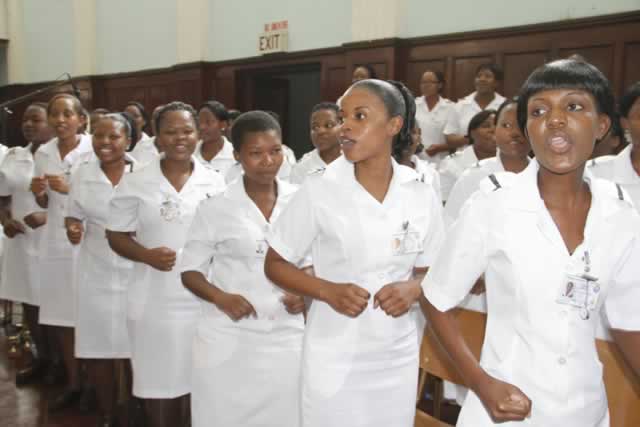

Patrick Chitumba Victoria Falls Reporter
THE government is working towards unfreezing all nursing posts to absorb 2,400 qualified yet unemployed nurses as it moves to improve the nurse-patient ratio in line with international standards, a Cabinet Minister said yesterday. Speaking to journalists on the sidelines of the Partners in Population and Development (PPD) meeting in Victoria Falls Health and Child Care Minister Dr David Parirenyatwa said the move would see the employment of 2,400 unemployed nurses.
“We are pushing for the unfreezing of nursing posts and that will see 2,400 nurses getting employed,” he said.
Government froze the recruitment of nurses a few years ago citing financial constraints in terms of sustaining the wage bill but there was an outcry over the shortage of nurses, especially at major public health centres countrywide.
Every year, hundreds of nurses graduate from training institutions countrywide but still struggle to secure employment.
Earlier on during the official opening of the meeting, Dr Parirenyatwa made reference to the Millennium Development Goals (MDGs) agreed at the millennium summit in September 2000.
He said the ideals of the summit were meant to guide efforts towards attaining global sustainable development, which captured the scope of the International Conference on Population and Development (ICPD).
“A careful perusal of these MDGs implicitly and explicitly requires us to revisit the population growth factor vis-a-viz economic development.
The ICPD noted the need to slow population growth in developing countries, citing its impact on social and economic development as well as on the environment,” he said.
Dr Parirenyatwa reaffirmed government’s commitment to the ideals of the ICPD, which seeks to ensure universal access to reproductive health services by 2015.
“This was mutually reinforced in the Maputo Plan of Action, which is premised on sexual and reproductive health in its full context as defined at ICPD in 1994.
“The Maputo Plan of Action identifies south-south co-operation as a strategy to attain both the goals of the ICPD and the MDGs,” he said.
“The major action areas for the Maputo Plan of Action inter alia include integration of HIV and Aids, STIs, malaria, sexual and reproductive health rights, strengthening community based sexual and reproductive health services, and repositioning of family planning as a key strategies for the attainment of the MDGs.”
Dr Parirenyatwa said since ICPD, Family Planning Services in Zimbabwe have immensely contributed to the increase of contraceptive usage currently at 60 percent from 48 percent in 1994.
“Knowledge of family planning methods is almost universal at 99 percent from 96.3 percent in 1988. Total fertility rate has significantly decreased to four children per woman from 5.5 in 1988.
“Despite these successes, the unmet need for family planning still remains at 13 percent.
“There is a need to reach out to all underserved populations,” he said.
Dr Parirenyatwa said adult HIV prevalence rate has declined from about 24.6 percent in 1996; to 20.1percent in 2005, 18 percent in 2007, and 15.2 percent in 2010.
“Concerted efforts are being made by all stakeholders to further reduce the prevalence to a single digit,” he said.



 Online Reporter