admin
admin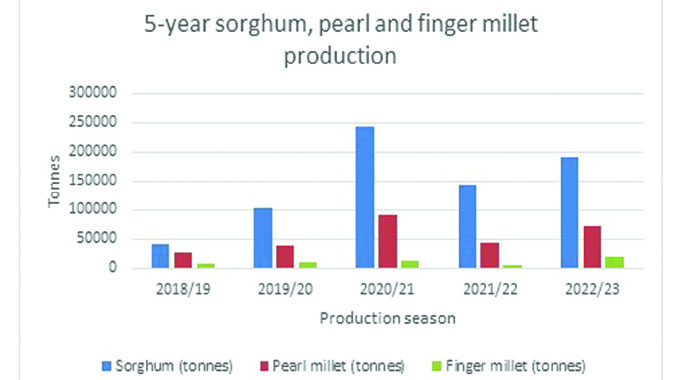
Edgar Vhera
Agriculture Specialist Writer
“A LITTLE and a little, collected together, becomes a great deal; the heap in the barn consists of single grains, and drop and drop make the inundation.”
There can be no better time to appreciate the applicability of this famous grain quote than now when the country is moving to ensure traditional grains complete its cereal self-sufficiency after production soared from 76 000 tonnes in 2019 to 281 000 tonnes this year to record a 268 percent growth.
Last year, the country harvested over 375 000 tonnes of wheat from 80 885 hectares against the country’s requirement of 360 000 tonnes. Production is this year set to reach 420 000 tonnes after hectarage was increased to 86 000.
The country expects to harvest 2 300 000 tonnes of maize from 1 940 969ha against total grain requirements of 2 287 742 tonnes.
This is all happening, thanks to Government’s concerted efforts in aligning crop production to the new revised agro-ecological zones, which is beginning to bear fruit as traditional grain yields are on the rise as stated earlier.
Provision of agro-inputs under the new ecological zones in the 2022/23 agriculture season resulted in a 45 percent increase in production from 194 097 tonnes in 2021/22 season to 280 956 tonnes currently.
Sorghum, pearl and finger millet production has been on upward trend with total production rising from 76 362 tonnes in 2019 to 280 956 this year.
The advent of Covid-19 induced lockdown in 2019 resulted in people being health conscious and demand for nutrient rich products like traditional grains increased. This was against the reluctancy by farmers in marginal areas to cultivate the crop preferring maize, which was not well-suited to their regions.
Traditional grain farmers cited inadequate inputs, labour intensiveness in production, low yield, challenges with birds, drudgery in processing activities such as winnowing and threshing, storage and marketing as reasons for the reluctancy.
Upon noticing the negative impact of climate change on crop production, Government promoted traditional grains cultivation by offering a cocktail of incentives such as paying a price equal to or higher than that of maize, provided inputs, assisted in control of quelea birds and allowed swapping with maize at the Grain Marketing Board (GMB).
At this year’s celebration of the International Year of Millets, it was highlighted that traditional grains offered valuable solutions in the face of climate change and the need for nutritious foods. They are climate resilient, nutrition rich, resistant to pests and diseases and have the ability to grow on arid lands.
Millets are an ideal tool in the country’s push to increase food security or food self-sufficiency with everyone capable of attaining better yields, better nutrition, a better environment and a better life.
Through increased production of traditional grains, maize and wheat, Zimbabwe is now cereal sufficient from local production.
This is in line with the country’s import substitution drive through increased local production as well as the need to guarantee food and nutrition security. Increased traditional grain production has helped the country shift focus from being maize-centric with these products complementing human and animal food requirements.
The country has witnessed visible signs of climate change over the last two decades with farmers in natural regions three to five having borne the full brunt of its negative impact. Agro-ecology has been at handy as a key part of the global response to climate instability, offering a unique approach to meet current food needs without compromising future demands.
What policies have led to increased traditional grain production?
Climate Proofed Presidential Input Support (Pfumvudza/Intwasa) Programme
The programme started supporting farmers throughout the country with inputs for traditional grain production in the 2020/21 season with individual farmers receiving seed, basal and top-dressing fertiliser.
The programme increased the number of supported households in 2021/22 and 2022/23 seasons. Smallholder traditional grains under Pfumvudza/Intwasa programme achieved an average high yield of 4, 70 tonnes per hectare in the 2020/21 season but fell to 0, 92 tonnes per hectare in 2021/22 because of drought. The productivity is expected to rise to 2, 70 tonnes per hectare at the end of this marketing season.
New agro-ecological region mapping
The country successfully revised the old natural region mappings that were done between 1945 and 1960 to adopt the new Agro-Ecological Zone mapping which aims to strengthen the capacity of farmers to plan for climate risks and boost agricultural production and food security.
The country is divided into five agro-ecological regions based on a combination of factors of rainfall regime, temperature, the quantity and variability of average rainfall, as well as soil quality and vegetation.
Lands, Agriculture, Fisheries, Water and Rural Development deputy minister Mr Vangelis Haritatos in 2020 said: “Traditional grains are critical in climate proofing our agriculture and will no doubt become more and more popular as Government teams up with all stakeholders along the value chain to educate people on their benefits, encourage and incentivise farmers to grow them and have an increasingly eager private sector producing finished products that are attractive to the consumers.”
Combination of Agro-ecology and Climate Proofed Presidential Inputs Scheme (Pfumvudza/Intwasa)
The 2022/23 season saw Government disbursing agriculture inputs by agro-ecological regions’ comparative advantages. The programme supported five Pfumvudza/Intwasa plots measuring 39 metres by 16 metres per farming household with an agro-ecological region-specific crop input package.
Input distribution under Pfumvudza/Intwasa was according to the agro-ecological region matching to maximise performance of the programme with farmers in region one and two getting an option to plant two plots comprising of sunflower, sorghum, pearl millet, groundnuts, African peas and sugar beans.
Farmers in region three had three optional plots comprising sunflower, sorghum, pearl millet, groundnuts, African peas and sugar beans while those in regions four and five got one mandatory plot each of sorghum, millet and sunflower with two optional plots of maize, African peas, ground nuts, sorghum, millet.
The package also included water retention enhancers, herbicides package for three plots as well as fall armyworm remedy.
National Agriculture Policy Framework (NAPF) 2019-2030
The NAPF, through its nine thematic pillars advocated a review of the country’s agro-ecological zones and the undertaking of production by comparative advantage. This was fulfilled when the country adopted the new agro-ecological zone mapping in 2022.
Traditional grain pricing
Noting the reluctancy of farmers in marginal regions to grow traditional grains, the Government raised their price to be above that of maize and eventually matched it. In December 2020 the Government announced pre-planting traditional grain producer prices that were 19 percent higher than maize. A traditional grain price of $38 000 per tonne was set against $32 000 for maize.
Currently the price for traditional grains and maize are at par at US$200 plus US$135 at interbank rate of every Tuesday.
Quelea bird and armoured cricket control
The Government intensified the control of quelea birds and crickets that were damaging late planted sorghum crop in Mashonaland Central, Manicaland and the Matabeleland Provinces.
The department of Migratory Pests and Biosecurity Control was further capacitated this year to incorporate the use of drone technology in curbing the threat of quelea bird threat.
To bust the quelea birds use of aerial technology in the form of calibrating planes will complement the drone technology alongside motorised backpacks on mounted vehicles, traps and nets as part of an elaborated plan to bust the birds.
National Enhanced Agriculture Productivity Scheme (NEAPS)
Agriculture Finance Cooperation (AFC) funded sorghum production under NEAPS through Government performance guarantees in the 2022/23 season.
Private sector interventions
Government’s call for private sector members to fund at least 40 percent of their raw material requirements from local production have resulted in increased traditional grain production by private players.
Private sector contractors under the aegis of the Food Crop Contractors Association (FCCA) and United Refineries contracted some sorghum farmers this last season.
Processors of traditional grains, such as Delta, National Foods, Buntu Foods, Hutano Foods and Let’s Grow formed the Traditional Grain Processors and Users Association (TGPUA) to boost production and take advantage of the high demand for traditional grain products.
Processors contracted some growers for consistent supply noting that malt products were in demand. The TGPUA platform was meant to establish collaboration for increased production after noting fragmented efforts within the traditional grain sector.
The TGPUA was formed with the objective of increasing market demand for traditional grains, lobby Government to improve enabling environment, lobby seed companies for traditional grain research, coordinate production support, work with farmer organisations and development partners to advise farmers of opportunity and investigate contract farming.
Self-financing
Individuals who are seriously taking farming as a business are producing maize for sale to Government or other players using their own resources.
Traditional grain trading on the Zimbabwe Mercantile Exchange (ZMX)
Traditional grains are among the list of 49 commodities that are currently being traded on the ZMX trading platform as a form of price discovery.
The communal sector dominated sorghum production, accounting for 86 percent of total production. However, the average yields are still low compared to the LSCF, A2, and old resettlement sectors.
There is an increase in sorghum production, especially in drier regions, due to agricultural input distribution based on agro ecological matching.
A communal farmer from Muchato Village, Ward 19 in Buhera district of Manicaland under Chief Nyashanu, Mr Zecks Muchato has vastly benefited from Pfumvudza/Intwasa programme. He started farming traditional grains five years ago on small plots but has since increased area to two hectares last season buoyed by the improving yields over the years, especially when Pfumvudza/Intwasa started in 2020.
“I used to plant traditional grains on an acre but have since increased to two hectares this season. I planted sorghum and finger millet on one hectare each and harvested 1, 50 and one tonne respectively,” he said.
Mr Muchato said he was selling sorghum at US$6 per 20 litre bucket while finger millet was going for US$16 per bucket.
He feels the outside buyers were offering low prices of US$16 per bucket instead of the usual US$20.
He is happy that he is now one of the shareholders to a local company they have formed. They will soon start processing and marketing finished traditional grains products.
“We have invested in setting up a local company that will specialise in contracting, buying, processing and marketing of small grains,” Mr Muchato boasted.
Mrs Muchato said they were grateful to the Government for the Pfumvudza/Intwasa programme, as it helped them access inputs easily.
However, she has called on the Government to supply them with finger millet seed, as they were only getting sorghum seed resulting in them using returned finger millet seed, which is compromising yields.
Another beneficiary of the Pfumvudza/Intwasa programme and communal farmer from Mutsakaruka Village, Ward 19 Buhera district of Manicaland under Chief Nyashanu, Mr John Chingwe last season planted 2, 5ha of sorghum, pearl and finger millet.
“I harvested 760 kilogrammes of pearl millet, 320 kg of rough millet and one tonne of sorghum. I sold my pearl millet at US$4 per bucket, rough millet between US$6-12 and sorghum at US$3. The Pfumvudza programme supplied all our input needs,” he said.


 Online Reporter