

 Chronicle Editor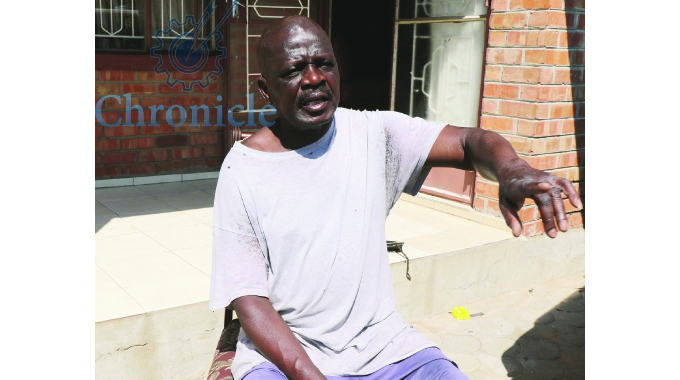
Flora Fadzai Sibanda, Chronicle Reporter
THE experience of being in the battlefield during the liberation war was heartbreaking and scary especially if you knew you had family members close to you also at the front, said Cde Chris Moyo (73).
Cde Moyo joined the liberation struggle in 1976 when he realised there was no future for him as a black man in the country.
He however, was not on the battlefield alone two of his younger brothers followed him a year later.
Cde Moyo of Njube suburb said he joined the war because he did not like the living conditions that his parents were being subjected to by the racist colonial government.
He said there was one incident which sparked his need to go to war; he was slapped by his white boss at a company he used to work as a guard. He could not slap him back because that was going to be a serious crime.
Cde Moyo left home without telling his parents.
A few months after arriving in Zambia, he learnt that his two brothers had also followed in his footsteps.
“I had been considering it for some time now as I did not like the living conditions that blacks including my parents were living in. They were given a limit of livestock they could keep. Whites also treated our parents like people who were stupid,” he said.
Cde Moyo said he told his friends that he wanted to join the war and two of them joined him.
“We boarded a bus to Kezi planning to use Shashe river to cross to Lupongo. I knew my parents were not going to be pleased or even allow me to go.
So instead, I did not go to bid them farewell; instead I went past my aunt.
I asked her to tell my parents about my decision.
The night we left to cross the Shashe river, whites set the sky aflame as they were trying to spot any movement from the sky.
But since l knew my way around Shashe, I was able to direct the others and we hid from them. When we got to Lupongo we were carried to Zambia by a helicopter,” added Cde Moyo.
He said he was heartbroken when his two brothers decided to join the war because he was afraid that they would be killed.
“A few months after arriving in Zambia I am not sure of the date as we did not have calendars to keep track of time. A new group of trainees was deployed at our camp.
I saw a man from our village. When l asked him how my family was, he told me Japhet and Freddy had also joined the war.
I was hurt and disappointed,” he said.
“The experience of being in the battlefield during war was heartbreaking and scary.
My brotherly instincts had kicked in so I was scared for my brothers. I was scared they would get killed and not make it. I was scared they would leave behind their families especially Japhet as he already had a family.”
The Chronicle crew also visited one of Cde Moyo’s younger brothers who decided to follow him to Zambia, Cde Japhet Moyo (71) at his home in Mpopoma suburb.
He said he got inspiration to go to war from his older brother Cde Chris Moyo (73) who had left for war in 1976.
He said left he in the company of their youngest brother, Cde Freddy Moyo who now lives at their rural home in Kezi.
He narrated his journey with his younger brother before they got separated as he had to go and train in Russia while Cde Freddy Moyo was sent for training in Yugoslavia.
He said the journey was tough as he would constantly worry about the safety of his brothers especially if there was news of a camp that had been under attack.
He said he had to fight throughout the war without knowing whether his brothers were alive or not, the only thing that kept him going was the fact that he was preparing a bright future for his children as he did not want them to grow in an oppressive environment like him.
Earning less for same jobs done by whites, not being allowed to venture into the city centre, among others did not go down with him.
After telling his younger brother that he wanted to follow their older brother’s footsteps and go to fight for the country, his siblings and two friends joined him.
“After telling Freddy I wanted to join our older brother he surprised me by saying he was also going to join us. He then told our two friends Meyiwa and Tony who also joined us.
We left on a Saturday morning to board a bus to Kezi.
We had made plans to say goodbye to our parents in Kezi as we knew how heartbroken they had been when Chris left without letting them know.
We got home in the evening and told our parents about our plans. I had never seen my parents so heartbroken.
My mother cried saying she was going to bury three sons at once. But because we had already made up our mind, they both gave us their blessings.”
The four crossed Shashe river; since they grew up in Kezi navigating around the area was not hard, went to Botswana, enroute to Zambia.
He said they were trained and grouped according to their physical wellbeing.
He said he was trained in the then Soviet Union (of which Russia was part of) and his brother in the then Yugoslavia.
“After the nine months I spent in Russia I came back to Zimbabwe and was given the title of being a commander.
I was called Major Moyo. I saw horrific things at the battle field that I cannot even tell you.
We gained independence in 1980 but I only got home in Kezi in 1982.
The first thing I did when I got home was to look for my brothers. I was happy to know we had all made it back home safely,” added Cde Moyo.


 Online Reporter
 Bongani Ndlovu