Online Reporter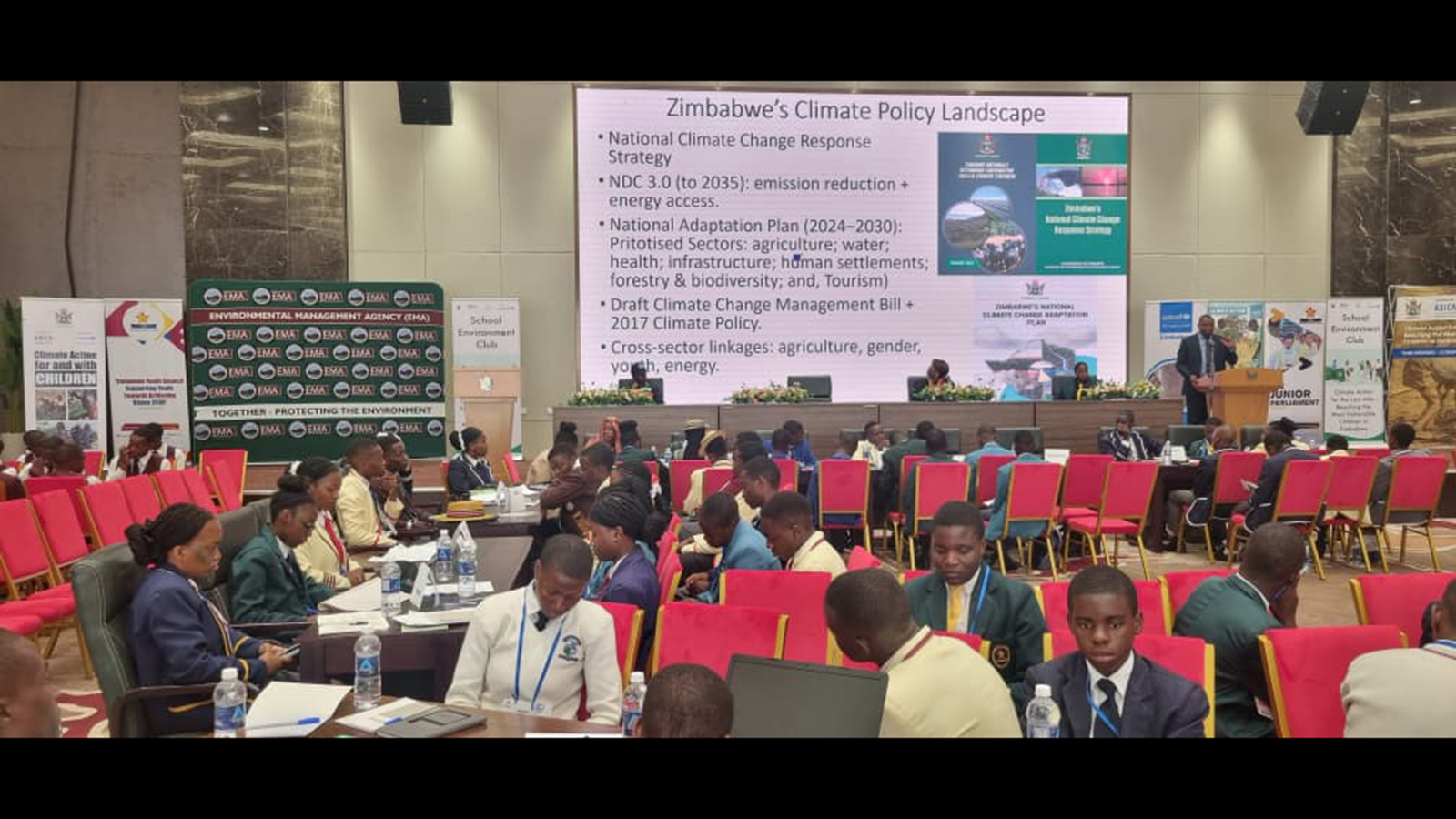
Peter Tanyanyiwa
Herald Correspondent
AT least 35 high schools from across Zimbabwe have today converged at the New Parliament Building in Harare for the Children’s COP30 Simulation aimed at empowering the next generation of climate leaders.
Organised by the Zimbabwe Sunshine Group and supported by key partners, the session provides a platform for young people to experience and participate in climate negotiations modelled on the United Nations Framework Convention on Climate Change (UNFCCC) Conference of the Parties.
The simulation, held under the theme “Nurturing Children and Youth Climate Leaders”, has drawn participation from hundreds of students representing 35 countries.
The event was made possible through a partnership involving the United Nations Children’s Fund (UNICEF) Zimbabwe, the Korea International Cooperation Agency (KOICA), the Zimbabwe Youth Council (ZYC), the Ministry of Environment, Climate and Wildlife (MECW), the Environmental Management Agency (EMA), and School Environment Clubs.
Zimbabwe Sunshine Group programmes manager, Claris Mandoreba said: “Today we are commemorating an event that we are calling the Children’s COP30 Simulation, which is an event where children come together to discuss, deliberate, and debate on issues of climate change, how decisions are being made at the highest level of the World Climate Change Board, UNFCCC.
“The idea is to equip the children with knowledge and negotiation skills in climate leadership. In the world that we are living in today, it’s imperative that every decision that is made with regard to climate action reflects the importance of protecting future generations.”
The day’s proceedings closely mirror genuine COP meetings.
The opening ceremony featured formal welcomes from dignitaries including a representative of Harare Metropolitan Provincial Affairs and Devolution, the Ministry of Environment, and UNICEF Zimbabwe. Delegates participated in bilateral and regional consultations, representing groups such as the Africa Group, European Union, BASIC countries, Umbrella Group, AOSIS (Alliance of Small Island States), LDCs (Least Developed Countries) and GCC (Gulf Cooperation Council).
During the plenary session, each school delivered statements reflecting its assigned country’s climate priorities.
This was followed by thematic breakouts, with delegates tackling critical topics such as climate finance, loss and damage, renewable energy, and adaptation.
The young participants presented their proposals and worked towards consensus, with their final resolutions set to be submitted to the Ministry of Environment, Climate and Wildlife.
Zimbabwe Sunshine Group chief operations officer, Mr Cliff Chivanga, said: “The idea behind this conference was to ensure that we give young people and children the opportunity to experience the processes that happen during the conference of the parties. In this case, we are looking at COP30, which is happening in Brazil.”
The event forms part of the “Climate Action for the Last Mile: Reaching the Most Vulnerable Children” project, supported by UNICEF Zimbabwe and KOICA.
The children’s resolutions, developed through consensus and collaboration, will be submitted to government officials, ensuring that youth perspectives are part of Zimbabwe’s climate agenda ahead of the real COP30 meeting in Belém, Brazil, later this year.
“So what happens is that at COP you have all the countries that are signatories to the Paris Agreement that come to the COP sessions and they’ll be discussing the agreed COP agenda following the processes that have been done by subsidiary bodies in Bonn. This is exactly what is going to be simulated by young people here,” added Chivanga.