Online Reporter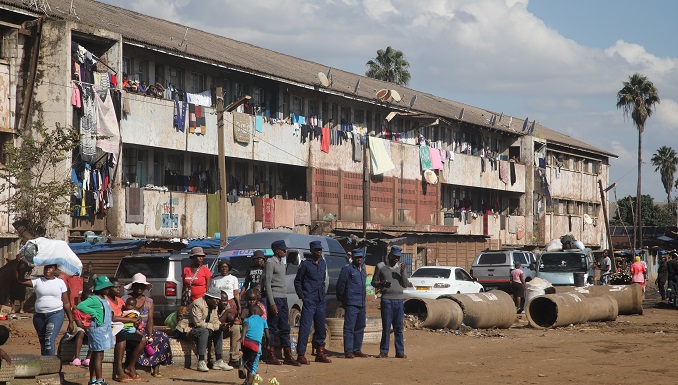
Theseus Shambare
Society Reporter
A JOURNEY to Mbare flats unveils the bitter reality of a relentless bedbug infestation, where the scourge of these bloodthirsty creatures has transformed sleep into a rare commodity.
Residents struggle in vain against the unyielding onslaught of these tiny predators, their skin stained with itchy bites and their spirits broken.
The recent intervention by the Harare City Council’s pest control unit, prompted by desperate cries for help, offers a fleeting respite. However, the underlying issues that allowed this crisis to fester remain deeply entrenched.
The red marks etched on the arms of Mai Tendai, a Matapi resident of over 20 years, speak volumes of her nightly ordeal.
“Every night is torture,” she said, her voice heavy with weariness. “You feel them crawling, biting. My children are constantly disturbed. We have tried everything, but these creatures just keep coming back.”
While Harare mayor Jacob Mafume’s assurance of a “scheduled pest control programme” offers a fragile thread of optimism, the on-the-ground reality in Mbare is far more complicated than what meets the eye.
Roots
The explosion of Mbare’s bedbug population is the result of many issues.
As public health experts worldwide have noted, the past few decades have witnessed a significant rebound in bedbug numbers, driven by increased international travel.
These tiny hitchhikers readily latch onto luggage, clothing or even hair, crossing borders with ease.
Rapid urbanisation, a defining feature of many world cities, including Harare, also plays a crucial role.
Overcrowding, a reality within the cramped confines of the Mbare flats, provides an ideal breeding ground for these resilient insects, allowing infestations to spread rapidly from one dwelling to another.
However, a critical element fuelling Mbare’s crisis is the growing resistance of bedbugs to common pesticides.

Decades of often indiscriminate and potentially ineffective use of chemical treatments by both residents and the council have inadvertently driven the evolution of bugs with genetic mutations that allow them to survive these toxins.
“Bedbugs are incredibly adaptable. Their rapid reproduction cycle allows them to quickly develop resistance to chemicals they are repeatedly exposed to. What might have worked a decade ago is now largely ineffective,” explained Dr Simba Ratisai, a public health entomologist.
Locally, the dilapidated state of the Mbare flats provides a haven for these nocturnal pests.
Cracks in the walls, loose floor tiles and worn-out mattresses offer countless crevices where bedbugs can hide during the day, safe from cleaning efforts.
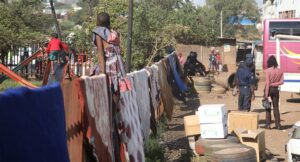
The high population density within the flats further exacerbates the problem, making containment and eradication incredibly challenging.
Limited financial resources for many residents also restrict their access to professional and potentially more effective pest control measures.
Futile battle?
Memories of past pest control efforts in Mbare are hazy and often tinged with a sense of futility.
Baba Jomo (Tapiwa Nyarugwe), a resident of Matererini flats since the 1970s, recalls sporadic fumigation drives by the council, often in response to widespread complaints.
“They used to come with their spraying machines. It would work for a little while, maybe a few months, but then the tsikidzi would be back, stronger than before,” he narrated.
These past efforts likely relied on broad-spectrum insecticides, the repeated use of which inadvertently contributed to the selection for resistant strains.
Residents often resorted to their own methods, using readily available, but sometimes ineffective or even harmful chemicals, further complicating the issue and potentially accelerating resistance.
The lack of a coordinated and scientifically informed approach in the past has undoubtedly contributed to the scale of the current crisis.
Faced with increasingly resistant bedbug populations, the City of Harare’s current strategy appears to be a continuation of chemical spraying, albeit with promises of a more “scheduled” approach.
However, there is a clear lack of information regarding any significant shift towards alternative, non-chemical methods or a comprehensive integrated pest management plan.
When contacted, a council pest control official who declined to be named acknowledged bedbugs in Mbare had become resistant to chemicals.
“We are aware that some of the older chemicals are not as effective as they used to be. We are looking into other options, but resources are limited and the scale of the problem in Mbare is immense,” said the council official.
There is little public information about collaboration with national health authorities or research institutions to identify more effective and sustainable solutions.
The focus seems to remain on reactive measures rather than proactive prevention and community education.
Ray of hope
Residents hope the Mbare urban renewal plan, if implemented quickly, would lessen their burden.
Announced with much fanfare about five years ago, the initiative was touted as a comprehensive solution to Mbare’s myriad problems, including the dilapidated housing infrastructure that provides a perfect breeding ground for pests.
The vision included modern housing upgrades, improved sanitation, decongestion of the overcrowded flats and the development of essential social amenities.
Overcrowding/travel
Mbare flats were originally designed as accommodation for single men. Today, they house multiple families in single rooms, leading to severe overcrowding.
This high population density not only strains the already inadequate infrastructure, but also creates an ideal environment for bedbugs to thrive and spread rapidly.
“As a long-term solution, the City of Harare should consider using other underutilised council properties to temporarily house tenants from the hostels to pave the way for phased rehabilitation and renewal of the hostels,” suggests Precious Shumba, the Harare Resident Trust director.
“This should become part of the urban renewal agenda, replacing broken down pipes, upgrading the water and sewer pipes, repainting and plastering of the walls, revamping the bathrooms and toilets and ending the illegal occupation of the flats by people who forced their way in without any legal documentation.”
While acknowledging the issue of overcrowding, the council has offered no concrete plans for managing or reducing the number of occupants.
Globally, reports of significant infestations have been reported in countries like France, the Democratic Republic of Congo (DRC) and some parts of South Africa.
“There is high mobility of people coming and going from the flats and worst of all, clothing bales are headquartered in Mbare, especially Matererini, Matapi, Tagarika and Shawasha hostels.
‘‘There has not been any control of the trading in second-hand clothes and public transport has continued to move people from Mbare and all over the country,” added Shumba.
Screening luggage or individuals at borders for bedbugs is a logistically complex and a resource-intensive undertaking.
However, public health campaigns targeting travellers, providing information on how to identify and prevent the spread of bedbugs, could be a valuable first step.
Collaboration with international health organisations to share knowledge on best practices and develop regional strategies for managing a bedbug resurgence could also be beneficial.
Decay
The bedbug crisis is not an isolated incident; it is a symptom of a broader failure by the Harare City Council to prioritise the basic living conditions and public health needs of Mbare’s residents.
“We feel forgotten here. They make promises that are often not fulfilled. We are living like animals, bitten day and night. Is this how the heart of Harare is supposed to be?” queried Margret Mapfumo, a community elder in Matererini.
Beyond Mafume’s initial statement, substantive engagement from the council on a long-term, effective solution to the bedbug crisis and concrete timelines to deal with the infestation remains elusive.
The resilience of these pests, amplified by dilapidated infrastructure and ineffective past interventions, demands a comprehensive and scientifically informed strategy that goes beyond superficial spraying.
Renewal/hygiene
On the sidelines of the launch of “Operation Chenesa Harare”, a cleanup blitz, the Minister of National Housing and Social Amenities, Daniel Garwe, on Wednesday unveiled ambitious plans.
“Not only in Mbare, but in the majority of our high-density settlements, it is overcrowded,” he noted.
He further announced President Mnangagwa’s directive for an “urgent comprehensive transformation of urban areas”, with Mbare slated to witness the construction of new high-rise flats alongside the refurbishment of existing ones.
“Mbare will be a place to be,” declared Minister Garwe, envisioning the achievement of Vision 2030 through this urban regeneration.
He outlined a two-pronged strategy.
“Building better backwards talks in terms of refurbishing the existing flats. Building better forward means bringing our developers to build new blocks of flats so that we decongest the existing infrastructure.”
The immediate priority, he stressed, was vertical construction.
“We are all aware that three weeks ago, there was an outbreak of bedbugs, called tsikidzi, here in Mbare,” Minister Garwe said, detailing the multi-ministerial effort.
His counterpart, Minister of Information, Publicity and Broadcasting Services, Jenfan Muswere, acknowledged the City of Harare’s initial efforts, but emphasised the need for a more robust response.
“Despite their valid efforts, it is clear that additional support is needed to effectively tackle this problem,” he said, calling for collective action.
Minister of State for Harare Metropolitan Provincial Affairs and Devolution, Senator Charles Tawengwa, shared his sentiments.
“Bedbugs cannot be eliminated by a single entity as they require a whole-of-society approach,” he said, urging residents’ cooperation in the fumigation.
Harare City Council director of health services Dr Prosper Chonzi assured residents of the enhanced efficacy of the current fumigation.
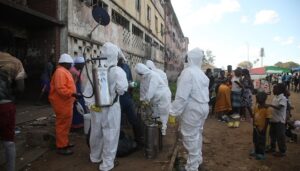
“The first time we came, we harvested some of these bedbugs and sent them for sensitivity testing. We have now brought chemicals that are stronger and that would knock off any of these bedbugs in a matter of minutes,” he said.
The council has initiated the first of three fumigation cycles.
It has since issued a statement warning residents that are refusing to comply with the ongoing fumigation exercise for one reason or another.
“We have noted with concern reports that some occupiers of Mbare flats are refusing to open their doors to City Health workers who want to fumigate their premises against bedbugs.
“We encourage the residents to allow health workers immediate access to the premises or risk enforcement using the police. This will also mean cancelling the current leases since the apartments are owned by the City of Harare,” reads the statement.
The local authority added that the “City of Harare will use every available means to gain access for fumigation purposes to protect every resident in Harare”.
The deep-seated issues of overcrowding, dilapidated infrastructure and the potential for reinfestation through the constant flow of people and second-hand goods remain formidable challenges for Mbare and most high-density areas.
Most residents ask if this multi-pronged intervention, combining immediate pest control with long-term urban renewal, will finally break the decades-long siege of bedbugs and neglect?
X: @TheseusShambare



 Online Reporter