

 dyton mupawaenda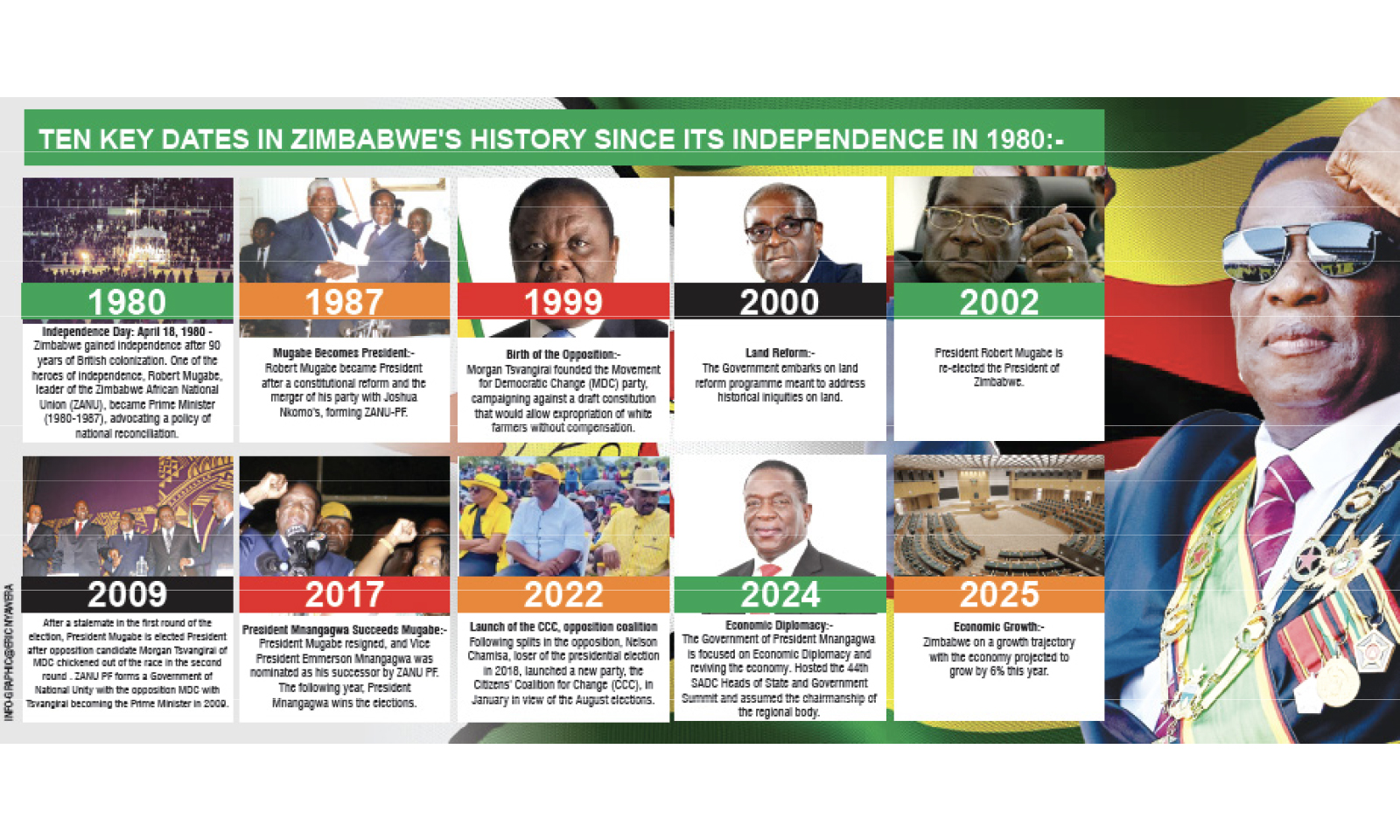
Zimpapers Politics Hub
AS Zimbabwe approaches its 45th Independence Day anniversary tomorrow, the nation reflects on a history marked by profound revolutionary achievements.
After achieving independence in 1980 following almost a century of colonial rule as Southern Rhodesia, ZANU leader Cde Robert Mugabe, became Prime Minister, later assuming the Presidency in 1987 after the signing of the historic Unity Accord and merging with the late former Vice President Joshua Nkomo’s party ZAPU, to form ZANU PF.
In a decisive stand against historical inequities, around 2000, Cde Mugabe launched the revolutionary land reform programme, reclaiming and redistributing land to the majority black Zimbabweans. This landmark initiative irrevocably changed the nation’s economic and social structure, empowering a large part of the population with the foundation for agricultural enterprise and economic independence.
The late 1990s saw the emergence of Mr Morgan Tsvangirai’s Movement for Democratic Change (MDC).
Following the 2008 presidential election which did not have defined outcome, a Government of National Unity was formed in 2009, with Cde Mugabe as President and Mr Tsvangirai serving as Prime Minister.
A defining moment arrived in November 2017 with Cde Mugabe’s resignation, marking the end of an era.
Following the resignation, the governing ZANU PF party nominated former Vice President Emmerson Mnangagwa as his successor. This appointment was subsequently affirmed electorally when President Mnangagwa resoundingly won the 2018 presidential election.
President Mnangagwa has made multiple achievements that have set the country on the path to achieve an upper-middle-income economy by 2030.
Through a series of impactful achievements across key sectors, President Mnangagwa’s administration has generated clear momentum, purposefully steering the country towards the transformative goal of becoming an upper-middle-income economy by 2030.



 Online Reporter