

 admin
admin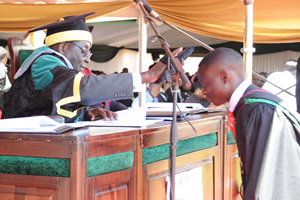
graduation ceremony since the establishment of the institution nearly six years ago.
The Head of State and Government and Commander-in-Chief of the Zimbabwe Defence Forces, who is also the Chancellor of the Great Zimbabwe University, conferred the degrees and diplomas at a colourful ceremony graced by some of Zimbabwe’s eminent academics.
The graduates completed degrees and diplomas in Arts, Commerce, Social Sciences and Education.
There was concern over the low number of graduates this year, a scenario university authorities attributed to dropouts in 2008 when the country faced economic hardships.
This year’s graduation ceremony was particularly crucial as it saw President Mugabe capping the inaugural group of 20 graduates who completed degree programmes in XiChangana and TshiVenda languages.
The study of the languages is part of the institution’s thrust to fulfil its mission to become a niche for arts and social studies.
The languages were offered through close co-operation between GZU and the University of Venda in South Africa.
More than half of the graduates were women.
GZU Vice Chancellor Professor Obert Maravanyika said the occasion was historic because of the conferment of degrees on the first graduates in XiChangana and TshiVenda.
“I would like to extend a special welcome to the delegation from the University of Venda, a special friend of GZU who have supported us immensely in our languages programme by providing lecturers in XiChangana and TshiVenda,” he said.
“This programme is a historic achievement in that this is the first instance in the country that these two languages have been taught at any level higher than primary school and today we proudly present the first crop of graduates in XiChangana and TshiVenda.”
Prof Maravanyika said this year’s graduates deserved special praise for persevering to complete their studies even when the economic situation did not permit as evidenced by a high number of dropouts in 2008.
He said the institution continued to be affected by a number of challenges, principally learning and office space.
But he noted that the university had become a model for other institutions of higher learning after successfully building prefabricated structures to ease the shortage of office and learning space.
Prof Maravanyika said there was need for funding to resume work on the Fine Arts and Physics blocks, which was stopped in 1997.
He said the university continued to strive to become a centre of arts and cultural studies as evidenced by the setting up of the Institute of Cultural and Heritage Studies.
The institute will spearhead research, dissemination and documentation of tangible and intangible cultural and heritage studies.
Prof Maravanyika said the university had completed drafting the masterplan for the main campus to be built near the Great Zimbabwe monuments.
He said the university was breeding cattle at its ranch in Mwenezi to achieve self sufficiency.
Sales from the ranch are expected to begin in a year’s time.



 Online Reporter