Sikhumbuzo Moyo, [email protected]
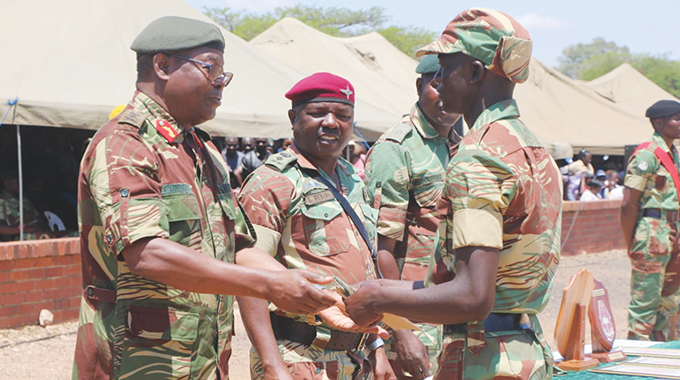
ZIMBABWE National Army (ZNA) Commander Lieutenant General Walter Asher Tapfumaneyi has challenged newly trained soldiers to uphold the Zimbabwe Defence Forces’ (ZDF) legacy of professionalism, discipline and service to the nation.
He was speaking yesterday during the graduation ceremony of 495 recruits from Intake 39A/01/26 at Imbizo Recruit Training Depot (RTD) on the outskirts of Bulawayo.
Of the 495 graduates, 122 were female.
Lt-Gen Tapfumaneyi said the eight-month training programme had equipped the recruits with military skills while exposing them to the country’s history, liberation struggle and national aspirations through a civil-military relations package.
He said understanding Zimbabwe’s history was critical in preparing the recruits to serve the country and uphold the values established by the country’s founding military leaders.
“Understanding the country’s history, including its liberation struggle and national aspirations is essential in preparing soldiers to uphold the legacy left by our forebears,” said Lt-Gen Tapfumaneyi.
He said the ZDF remained committed to defending the country against internal and external threats, safeguarding national interests and resources and protecting Zimbabwe’s territorial integrity.
“Above all, the army is the last line of defence. It is incumbent upon us to defend the gains of our hard-won independence, our people, national interests, resources and territorial integrity at all costs,” said Lt-Gen Tapfumaneyi.
He said joining the army came with the responsibility of serving the nation and abiding by the Constitution of Zimbabwe and military rules and regulations.
“To you graduands, as you pass out today, you are now part of a unique and rare breed of military personnel who have chosen to sacrifice their lives in serving their beloved nation. I therefore challenge you to inherit and take over this rich and fine legacy to posterity,” said Lt-Gen Tapfumaneyi.
He described the graduation as a landmark achievement for the recruits after completing an intensive eight-month programme that transformed them from civilians into trained military personnel.
Lt-Gen Tapfumaneyi said the recruits had been drawn from all provinces, reflecting the national character of the ZNA.
“The young men and women on parade were recruited from all the provinces of our great nation, which clearly defines the national character of the ZNA. This inclusive approach resonates well with
Commander-In-Chief of the ZDF President Mnangagwa’s clarion call for ‘not leaving anyone or any place behind,’” he said.
The ZNA commander thanked stakeholders for supporting the recruitment process, saying the response demonstrated the relationship between the defence forces and the people.
“Indeed, this strong bond of relationship is guided by the fish and water concept where the defence forces effectively execute their role with the support of the population, the army being the fish while the population is the water,” said Lt-Gen Tapfumaneyi.
He said the Basic Individual Training Phase laid the foundation for military duties by developing the recruits’ physical and mental capacity while instilling discipline and military bearing.
The recruits underwent physical training, drill, memory training and other exercises designed to promote discipline, uniformity and adherence to military instructions.
They were also trained in basic military skills, including fieldcraft, map reading, obstacle crossing, weapon handling and range work, voice procedure, first aid, parades and inspections.
Lt-Gen Tapfumaneyi said the skills were progressively integrated to prepare the recruits for different operational situations.
“To conclude Phase One training, recruits are subjected to military sports competitions as a way to confirm training progression,” he said.
Lt-Gen Tapfumaneyi said Phases Two and Three focused on tactical and collective training, with recruits being introduced to combat skills and progressive training.
The training scenarios included defensive and offensive operations conducted within a battle group setting.