Vusumuzi Dube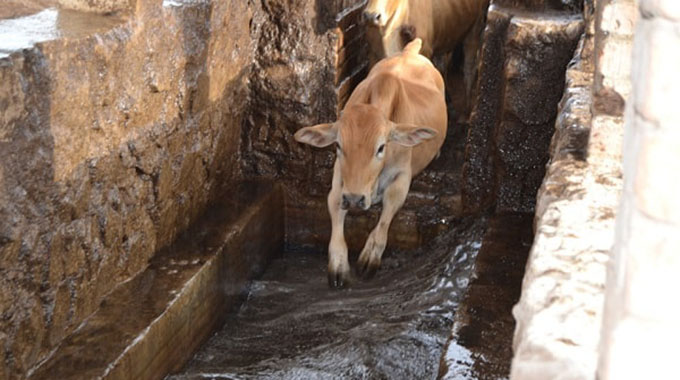
Rutendo Nyeve, Sunday News Reporter
A total of 5 000 dip tanks have been earmarked for revamp under the Accelerated Dip Tank Rehabilitation Program this year with more than 300 already completed ahead of the approaching summer season, the Directorate of Veterinary Services (DVS) has said.
The DVS has also assured the nation that there is adequate dipping chemicals ahead of the summer season when major animal health challenges are on the increase with outbreaks of vector-borne diseases and specifically tick-borne infections topping the list.
In a statement on Tuesday, DVS said in the wake of the upcoming summer season, it is mandated to prevent the entry and spread including controlling animal diseases of zoonotic and economic importance to safeguard animal and human health and welfare as well as facilitating trade in live animals and animal-derived products.
“In this regard, DVS has stocked adequate dipping chemicals for the entire country to ensure weekly dipping during the summer season. DVS has also adequate stocks of tick grease, for distribution to cattle farmers under the Presidential Blitz Tick Grease Program, to complement cattle dipping targeting one million households in the upcoming summer season.
“The Directorate will also be carrying out an Accelerated Dip Tank Rehabilitation Program before the rainy season, to revamp the country’s dipping infrastructure. In 2024, a total of 5000 dip tanks have been earmarked for rehabilitation with 396 having been completed,” said DVS.
Currently, the Directorate of Veterinary Services (DVS) said it is producing three tick-borne disease vaccines, namely BOLVAC (January Disease), Gall Sickness and Redwater. These vaccines are being used to vaccinate cattle under the Integrated Tick and Tick-Borne Disease Strategy.
“For the 2024/2025 summer season DVS is targeting more than 350 000 doses of January Disease vaccine (BOLVAC), 100 000 doses each of the Redwater and Gall Sickness vaccines. DVS plans to upscale the production of these three tick-borne disease vaccines in order to increase vaccination coverage.
“The Directorate will continue carrying out Tsetse fly and Trypanosomiasis disease surveillance targeting 12 500km2 in the tsetse infected and high-risk areas this summer season. A total of 17 800 tsetse targets and tsetse odour sachets will be deployed 445 kilometres long from Kariba Lakeshore in Mola to Mututa Basin in Mbire District.
“A total of 4 200 square kilometres has been targeted for the progressive tsetse trypanosomiasis elimination this summer to reduce the burden to affected communities
barrier Laboratory diagnostic services are an important component under DVS, playing a key role in the screening and confirmation of animal diseases, particularly during the rainy season, when the incidence of vector-borne diseases which include TBDs, Parasitic infections, Bacterial and Viral diseases,” said DVS.
DVS said it is therefore targeting to test a total of 20 000 animal samples by end of 2024, having so far tested nearly 14 000 samples and is prepared to offer its disease diagnostic services to all livestock farmers in the 2024/2025 summer season.
Turning to the upcoming bulling season in Zimbabwe which spans from November 2024 to April 2025, DVS said this is the optimum period for cattle breeding activities, to increase the national herd as well as improving the genetics of the local cattle populations.
“In this regard, DVS will be producing cattle semen straws for artificial insemination at its Mazowe Bull Centre. For the 2024/2025 breeding season, DVS is targeting to produce a total of 100 000 cattle semen straws of various cattle breeds by December 2024,” said DVS.
In recent years, tick-borne diseases have accounted for more than sixty 60 percent of annual livestock mortalities, with January Disease accounting for more than 75 percent of these mortalities. The other three major tick-borne diseases causing animal deaths are Gall Sickness, Redwater and Heartwater. It is therefore imperative that DVS formulates various control strategies to address tick borne diseases to reduce their impact on animal health and production.
@nyeve14


 Online Reporter