
Emmanuel Kafe
Check Point Desk
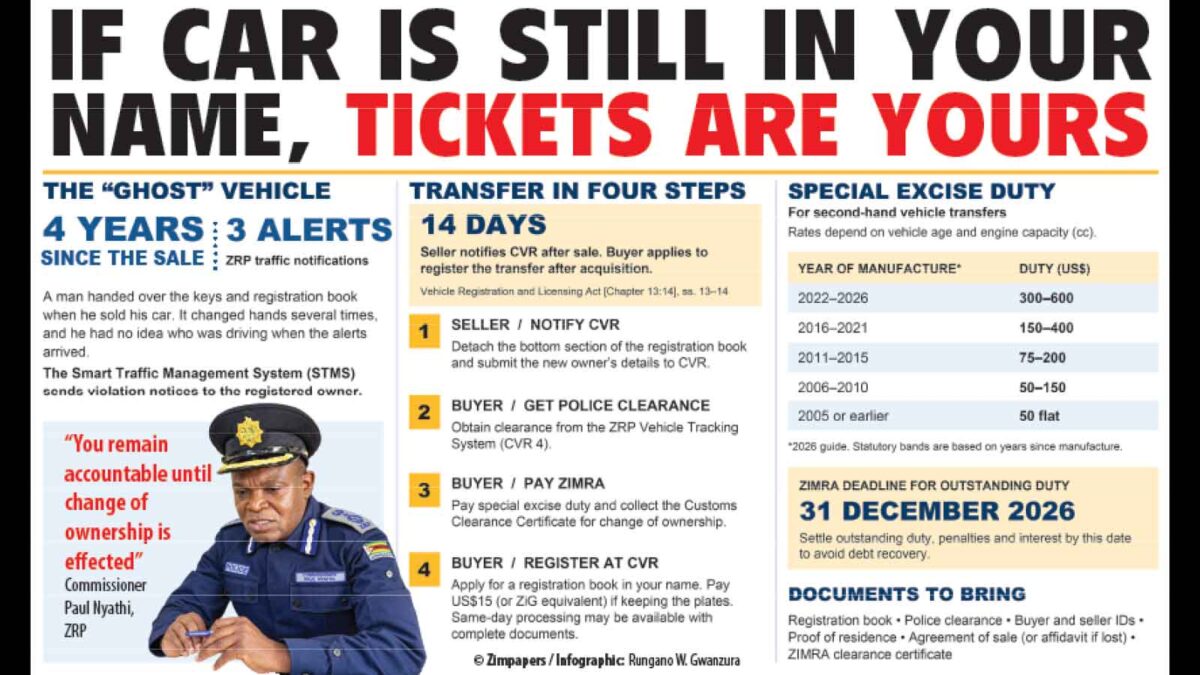
FOUR years after selling his car, Enock Mushambi thought he had severed every connection with it.
Money had changed hands, the vehicle registration book had been handed over, the keys were surrendered and the car had driven out of his life.
Or so he thought.
That changed when his phone lit up with three Zimbabwe Republic Police (ZRP) traffic violation notifications.
“I was shocked when I received three traffic violation notifications on my phone for a vehicle I sold four years ago. I could not understand how I was being notified of offences committed by a vehicle I no longer owned or drove,” he said.
What followed was an unsettling realisation: while he had moved on, Government records had not.
As far as the authorities were concerned, he was still the vehicle’s registered owner because he had never completed the formal change-of-ownership process.
In the four years since the sale, the vehicle had changed hands multiple times, making it increasingly difficult for him to establish who was now behind the wheel, let alone who was committing the offences landing on his phone.
Desperate for answers, Mushambi went to the Central Vehicle Registry (CVR), hoping to trace the current owner and finally disentangle himself from a car he had disposed of years earlier.
Instead, he was referred to the ZRP Vehicle Tracking System for assistance.
A sale he had considered history had suddenly become a present-day headache, with traffic offences committed by someone else threatening to follow him.
He is not alone in this predicament.
The introduction of the Smart Traffic Management System (STMS), which identifies vehicles involved in traffic violations and sends notifications to their registered owners, is exposing a costly oversight in Zimbabwe’s second-hand vehicle market: handing over a car and registration book does not automatically mean handing over legal responsibility.
Motorists who sold vehicles months or even years ago are now discovering that an unfinished change-of-ownership process can keep them legally tied to vehicles they no longer possess, control or even know their whereabouts.
Scramble to regularise vehicle ownership records
For motorists who thought selling a vehicle meant closing that chapter of their lives, STMS is proving to be an uncomfortable wake-up call.
Across CVR and Zimbabwe Revenue Authority (ZIMRA) offices, motorists are turning up to regularise ownership records, with some desperately trying to complete transactions that have remained unfinished for months or even years.
For some, the trigger has been traffic violation notifications suddenly landing on their phones for vehicles they sold long ago.
Others are moving quickly to avoid finding themselves in the same predicament as Mushambi, whose four-year-old transaction has come back to haunt him.
The anxiety is understandable.
A vehicle may have passed through several owners, changed locations and accumulated traffic offences, yet the name appearing in Government records could still belong to the original seller.
In some instances, the original seller may have lost contact with the buyer, while the current driver may have no idea that the vehicle is still registered in someone else’s name.
While motorists appear increasingly eager to put their records in order, Government maintains that there has been no corresponding surge in transactions.
Ministry of Transport and Infrastructural Development Permanent Secretary, Engineer Joy Makumbe, said CVR had not recorded an increase in average weekly change-of-ownership transactions following the introduction of STMS.
She added that the ministry was working with ZIMRA to integrate change-of-ownership transactions, a move expected to reduce paperwork, streamline the process and guard against counterfeit documents.
The legal obligation many motorists ignore
In response to questions from Zimpapers Check Point Desk, Eng Makumbe noted that both the seller and buyer were legally required to notify the Registrar of the change of ownership within 14 days, as provided for under the Vehicle Registration and Licensing Act (Chapter 13:14).
“The seller tears off the bottom part of the registration book and submits the details of the new owner to CVR,” she explained.
Upon receiving the notification, the registry temporarily deregisters the vehicle while awaiting the new owner to complete the transfer process.
The buyer must then obtain police clearance through the ZRP Vehicle Tracking System before proceeding to ZIMRA to settle the applicable tax and obtain a new customs clearance certificate for change of ownership.
After obtaining ZIMRA clearance, the buyer returns to CVR to apply for a new registration book bearing their name.
Eng Makumbe said CVR processing takes place on the same day once all requirements have been met, with the registration fee pegged at US$15 or its ZiG equivalent.
For motorists who have allowed years to pass without completing the process, however, the consequences can be far more complicated.
Asked whether a former owner could be held responsible for offences committed using a vehicle they had sold, Eng Makumbe was unequivocal.
“Yes, the registered owner is liable for all offences committed by a vehicle registered in his or her name,” she said.
She added that the Ministry had no mandate to resolve disputes between buyers and sellers, emphasising the need for parties to comply with existing regulatory requirements.
National police spokesperson, Commissioner Paul Nyathi, has also warned motorists against assuming that handing over a vehicle automatically ends their legal responsibilities.
“The seller remains accountable; even if you say ‘I have sold it,’ you remain accountable until change of ownership is effected,” Comm Nyathi said.
He noted that with the rollout of STMS, it is becoming increasingly difficult for motorists to escape accountability simply because a vehicle has changed hands informally.
“Once the system becomes fully operational on all phases, what it also entails is that people will be made accountable for their dues, whether it is dues to the State, local authority or any other misdemeanour which you committed.
“The system is all-encompassing,” he said.
For a motorist like Mushambi, this means the distinction between the person physically driving a vehicle and the person officially registered as its owner carries serious consequences.
A buyer may have taken possession years ago, but until the records are updated, the seller’s name remains attached to the vehicle.
The cost of fixing an old mistake
While CVR administers the registration process, ZIMRA handles the applicable tax requirements.
ZIMRA spokesperson, Mr Gladman Njanji, said the applicable rates were outlined in a recent public notice titled “Special Excise Duty Rates on Change of Ownership of Locally Registered Motor Vehicles.”
In the notice, ZIMRA advised motorists that the special excise duty payable is determined by the vehicle’s year of manufacture and engine capacity.
For motorists regularising transactions involving relatively new vehicles, the financial implications can be substantial.
Vehicles manufactured between 2022 and 2026 attract duty ranging from US$300 for engines up to 1 000cc to US$600 for vehicles with engines above 2 000cc.
Those manufactured between 2016 and 2021 attract between US$150 and US$400, depending on engine capacity.
For vehicles manufactured between 2011 and 2015, the rates range from US$75 to US$200, while those manufactured between 2006 and 2010 attract between US$50 and US$150.
Vehicles manufactured in 2005 or earlier attract a flat fee of US$50, regardless of engine capacity.
ZIMRA further clarified that the special excise duty is payable in United States dollars unless the original transaction was concluded in local currency.
“The special excise shall be payable in United States dollars unless the transaction was concluded in Zimbabwe dollars, wherein the equivalent amounts in Zimbabwe dollars shall be applied at the prevailing exchange rate on the day of payment,” Mr Njanji said in the statement.
Motorists must also produce supporting documents before proceeding with the transfer, including the vehicle registration book, police clearance, identification documents for both the buyer and seller, proof of residence and an agreement of sale containing the details of both parties and the vehicle.
“Where the original agreement of sale has been lost, an affidavit sworn before a Commissioner of Oaths may be required.
For those who sold vehicles years ago and no longer have contact with the buyers, assembling these documents can prove particularly challenging.
Payment deadline
Motorists with unpaid special excise duty bills linked to second-hand vehicle transfers have until December 31, 2026, to settle what they owe to ZIMRA, after which the authority will pursue debt-recovery measures against defaulters.
“A grace period up to December 31, 2026, is granted to settle outstanding amounts, including penalties and interest,” said Mr Njanji.
The notice, issued on November 3, is directed at clients who have already received assessments for special excise duty, but have not paid, rather than serving as a general waiver of the tax on all vehicle sales.
Motorists with an outstanding bill are being urged to verify their status with ZIMRA and pay before the end-of-year cut-off.
A sale is not complete until records change
The lesson emerging from the experiences of motorists caught up in ownership-transfer complications is straightforward: a private agreement between a buyer and seller does not automatically update Government records.
For sellers, notifying CVR and retaining proof of the transaction is essential, while for buyers, completing the transfer is equally important to avoid the administrative and legal complications of driving a vehicle still registered in someone else’s name. For Mushambi, the vehicle may have disappeared from his driveway four years ago, but its official connection to him never did. He handed over the keys, yet his name remained on the books.
Now, with technology increasingly capable of identifying vehicles involved in traffic offences, an unfinished transaction from four years ago has returned with consequences he never anticipated.
In the age of smart traffic monitoring, selling your car may be the easiest part of the transaction, while getting your name off it is the most important.