Online Reporter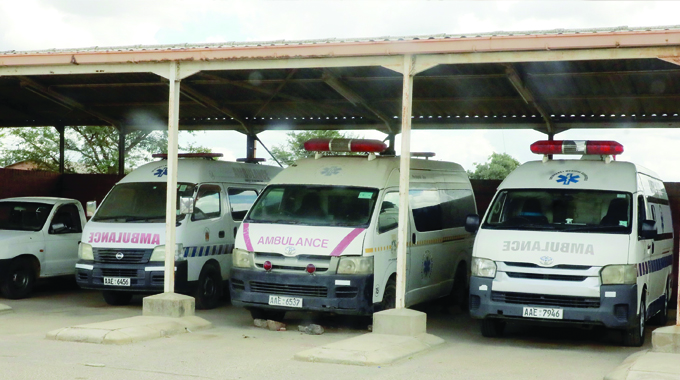
Andile Tshuma and Raymond Jaravaza, Chronicle Writers
ONLY seven ambulances are operational in Bulawayo out of an estimated fleet of 30 required to render efficient emergency services, forcing residents to turn to private operators whose service cost is often beyond the reach of many.
Council ambulances charge US$11 or the equivalent of the local currency while private ambulance services cost upwards of US$30.
Bulawayo needs 30 ambulances for efficient and timely emergency services that covers all the 28 wards in the city.

An efficient public ambulance service plays a crucial role in providing pre-hospital care, rapid patient transport and emergency medical response for all the city’s residents.
However, Bulawayo City Council (BCC) Chamber Secretary, Mrs Sikhangele Zhou, has revealed that the city’s ambulance services is heavily stretched as it is operating with a depleted fleet.
“Our ambulance section has inadequate ambulances. We have resuscitated two old ambulances to bring the number of operational ambulances in the city to only seven,” she said.
“Five of the ambulances have state-of-the-art equipment with life support systems but the two old ambulances that were resuscitated are not that well equipped.
“The two ambulances only have the bare minimal equipment and are only used to transport stable patients to hospital. The city needs 30 ambulances against the seven that we have at the moment,” said Mrs Zhou.
She was speaking during a recent passout parade for fire fighters at the Bulawayo Fire Brigade where she stated that council is sometimes forced to refer residents to private ambulance services when they are overwhelmed, an alternative that residents resist.
“We urge residents to accept that sometimes we may refer them to private ambulance services when we are overwhelmed but they sometimes object to that,” said Mrs Zhou.
“Residents must understand that the decision to refer them to private ambulance services is not because we don’t want to assist them but all our ambulances will be out on duty and it would take longer to attend to new cases.”
She said last year council made a provision to acquire four ambulances but the procurement process failed after the bidder who won the tender failed to deliver.
“Council will continue to budget for more ambulances in the future,” said Mrs Zhou.
Minister of State for Bulawayo Provincial Affairs and Devolution, Judith Ncube, said Government was exploring ways to chip in and boost the city’s emergency service capabilities by acquiring more ambulances to add onto the existing fleet.

“Last year I led a delegation to Belarus with the City Director of Health Services, Dr Edwin Mzingwane, and he identified areas where Bulawayo needs assistance such as ambulances and fire tenders,” she said.
“Upon our arrival back in Bulawayo, we submitted our report to Central Government and we are waiting for a response. It’s a cause for concern that Bulawayo is operating with just seven ambulances,” said Minister Ncube.
She noted that private ambulance services are expensive and beyond the reach of many residents hence the need to revive council ambulances as they provide a vital service.
Bulawayo United Residents Association (Bura) chairman Mr Winos Dube said residents have resorted to hiring private vehicles to ferry loved ones to hospital.
“It’s sad that in times of emergency residents now resort to asking neighbours to rush their relatives to the nearest hospital because council ambulances take too long to attend to calls or they never come.
“Some emergencies require an ambulance. For example, serious injuries or in the case of victims of crimes like stabbings. Hiring a vehicle from a neighbour or friend in those situations is an option,” said Mr Dube.
Turning to the costs of private ambulance services, Mr Dube said vulnerable members of society such as pensioners, the elderly and child headed families rely heavily on council ambulances that are not only cheap but also offer reasonable payment plans.
“Private ambulance services demand hard cash up front and a majority of residents cannot afford those charges,” he said.
“Residents don’t always have cash lying around for emergencies but council ambulances can rush a loved one to hospital and payments can be made later,” he said.
Civic society leader, Mr Thembelani Dube, a former administrator with the Bulawayo Progressive Residents Association (BPRA), urged council to improve financial discipline to set aside funds for the procurement of essential service vehicles such as ambulances.
“Sticking to budget allocations, especially in the health sector, could help council procure essential equipment and ambulances. The health of residents should be prioritised. Not all residents can afford private ambulance services,” said Mr Dube.
He noted that council has a provision that allows ambulance service charges to be billed on monthly utility rates.

Last September, a Belarusian delegation visited major referral hospitals in the city to explore avenues for collaboration in health care.
The visiting delegation was led by Mr Dzmitry Serhamasau, a representative of the Belarus Ministry of Health, and they toured Ingutsheni Central Hospital, Mpilo Central Hospital, United Bulawayo Hospitals (UBH), Joshua Mqabuko Nkomo Ekusileni Medical Centre and Mzilikazi Clinic.
Zimbabwe and Belarus signed a Memorandum of Understanding (MoU) covering key sectors, including health, education, agriculture and trade.
The tour of the referral hospitals was meant to deepen the collaboration between the two countries in the area of health, positioning the city’s public health sector for significant transformation through medical personnel exchange programmes and health care investments.