admin
admin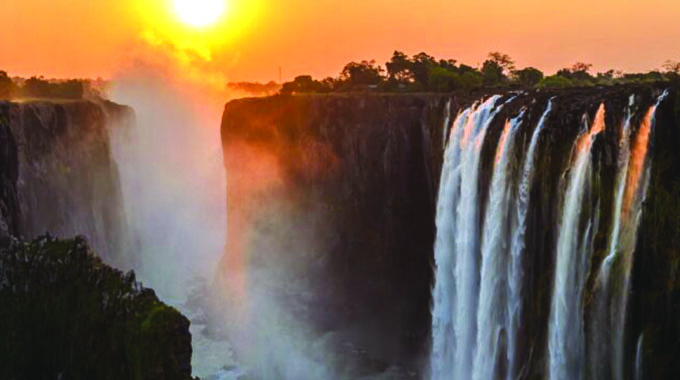
Isdore Guvamombe
Reflections
Zimbabwe is a tapestry of tourist attractions from man-made ones to those sired by natural phenomenon.
Today, as the festive season beckons, I start a journey to give snippets into my experiences at the country’s tourism offerings. At the end, the choice will be to the best of a tourist’s desires. But Zimbabwe has something for everyone.
Gonarezhou
Incredible! Under the blistering heat, a breeding herd of elephants blocks the way and a cow nudges its calf under a huge baobab tree on the roadside. An irritated bull tells off a wandering calf in a no-nonsense mood, with a shriek but firm voice.
The elephants tolerate our presence for a few moments but as soon as their snorkelling trunks sniff our presence, they retreat in polite disgust.
A few metres away, giraffes forage the bush, heads up in indignation above stunted mopane bush shrubbery. The mopane bush shrubbery is level at about two metres high, on a browse line that looks as neatly trimmed as a schoolboy’s new haircut.
At sunset, a lion roars, sending shivers down the spines of every living species there, particularly the impala that scamper for dear life and the big baboon that strides to a huge tree in a hunched and swaggering gait. Stubbornly looking back the huge baboon barks a loud “boohoo!” as if shouting obscenities to the king of the jungle, before climbing up the tree.
Thereafter, three lions scramble out of the silhouette mopane shade, but immediately melt into the thicket of trees so fast and silently that not all of us are lucky to see their frosty-brown faces or blurs of tails.
The impalas, kudu and waterbuck bound swiftly out of sight for, behold, the king of the jungle has spoken!
Then there is the appearance of python-like roots of sausage trees alongside the dry banks of Mwenezi River, the main source of water in the jungle.
The Mwenezi River itself turns silver and gold with strips of sand and smoothened rocks between steep banks and quiet deep blue pools.
This is Gonarezhou, Zimbabwe’s gateway to the Great Limpopo Transfrontier Park and epicentre of jungle life, where untamed wild animals roam wild and free.
Hwange National Park
We are driving from Main Camp to Nyamandlovhu Aquifer on an ordinary September afternoon and Hwange National Park is tinder dry, as usual.
After, day after day of cloudless skies, the fierce sun has sucked moisture from the landscape, baking the earth into a dusty grey cake, leaving the grass withered and as brittle as straw.
At about 20 to 30 elephants, this is one of the smallest herds of Hwange, for, here it is common to come across more than a hundred elephants in a herd. This is called a “Super Herd”.
Hwange National Park — Africa’s third largest wildlife sanctuary after Kenya’s Serengeti and South Africa’s Kruger national parks —is firewood dry, despite having one of the largest elephant populations in Africa, south of the Sahara.
But there is the other side of Hwange National Park that many people don’t know.
Covering roughly 14 650 square kilometres, Hwange is the pride of Zimbabwe but has almost treble the elephant population required for sustainable environment management.
Majestic Victoria Falls
The Victoria Falls are still majestic, refreshing and unparalleled.
On the bank, a crocodile — that huge monster of a reptile smashes through the thick riverine undergrowth, like a turbo-charged engine towards the water, splashing into the river in sudden sluggishness, before disappearing into the raging waters.
An array of high-powered boats puff, hobble and nod on the instigation of the waves and the high currency, much to the delight of the passengers, while canoes ward off the deadly waters.
The boats range from those carrying eight people to those double decks carrying up to 120 people. Here tourists have the highest chance of seeing the crocodiles and hippos at close range.
That huge hippo yawn is almost the preserve of the Zambezi River. The sunset cruise, which is a must, gives away the silhouette ghost of sunset, where acres and acres of camera space have been gobbled in pictures to avert ephemeral memories.
Meanwhile, the Zambezi River continues carrying heaven’s vomit to the Indian Ocean, unperturbed by the events.
Then there is the dinner cruise, on the water of the mighty Zambezi, Africa’s fourth largest river, after the Congo, Nile and Niger. The Victoria Falls, the inexplicable geomorphological splendour is located almost half the length of the river and here, nature’s generosity slashes mother earth into falls were millions of gallons of water plunge about 700 metres into an abyss of a plunge pool aptly named, the boiling pot.
A spitting distance from the falls is the Big Tree, the 1 500-year-old baobab tree under-which colonial expansionist and explorer David Livingstone spent his night, a day before he was led by Sussi and Chuma to the falls.
Legend has it that the Big Tree, which was later to hog Zimbabwe’s 10 cent coin, was the epicentre of the BaTonga, BaNambya and BaToka’s rain-making ceremonies and traditional beer-drinking binges.
The ever cascading rain drops from the Rain Forest are an endorsement of the spirits of the land of BaNambya, BaTonga and BaToka.
Down the falls, there is little food for the fish and no crocodile survives the 700-metre plunge so a lot of activities have been arranged over the years, where one is only afraid of the water and the mythical Nyaminyami, the river god.
Here are the rapids, where helmeted, safety-jacket wearing water devils, do play in the frothing water. You will be able to go to the boiling point and view the falls from underneath, a privilege which many visitors to the falls do not enjoy. You are also able to see those doing gorge swing, bungee jumping and gliding.
Here again, the water moves at its fastest, at times going at 200km per hour, turning and twisting between stones and plunge pools and narrow gorges. In terms of international natural cataracts and these rapids are graded number six. Zambezi, just below the Victoria Falls, is rated up to five. This is called commercial suicide. You do it at the risk of your life.
The Zambezi has 24 cataracts. While down the river surfing or rafting, there is buzz of the helicopters, flying above the falls, aptly named the Flight of the Angels! There are helicopter rides each in Zambia and Zimbabwe. The flight above the falls is a must.
Then there is the Lunar Rainbow. For three days in a month, when there is no cloud, tourists are privileged to visit the falls at night. It is a marvel.
Moonlight slants down through the leaves and blossoms of the rain forest, making whimsical coloured patterns that flicker on the falls, giving birth to a rainbow.
Save for the plunge of the water, there is silence in their air, a faint warm breeze stirs the sleepy leaves, bringing with it fragrance of flowering grass and trees, and a breath of something languid, inducing idleness, voluptuousness and strangeness.
I have seen the green grass turning gold from the dainty patches of light that flicker and quiver as though they were living. Then there were fire-coloured butterflies, that made the grass under the trees look like it was about to catch fire.
The Victoria Falls is something else. It is a place where everyone, should enjoy themselves.
Meanwhile, the Zambezi River remains quiet. Silent. Gagged! The steady inflow is increasing.
To be continued next week.


 Online Reporter