

 admin
admin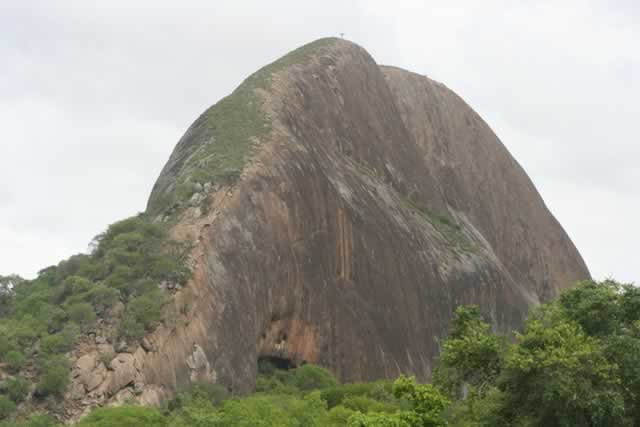
Edmore Maziofa Features Correspondent
The gaping hole in the face of the rocky outcrop should have been as breathtaking as a mystery of what grows and goes on within the belly of the mountain.
The cave is on Mushonganeburi Mountain, a granite protrusion just 40km west of the 424km peg along the Harare-Bietbridge highway in Mwenezi District.
The mouth of the cave spans 16 metres wide and rises six metres and halfway across the cave, another tunnel heads east.
This tunnel is charcoal black inside and has never been fully explored.
Inside, archaeological relics tell of past habitation, crafts, tools and other paraphernalia of an earlier era.
Unfortunately, this potential opening into the past is being precluded by neglect and vandalism.
At the entrance of the cave, one will be welcomed by urine stink as visitors no longer leave the cave to relieve themselves after entering.
The once sacred place has not been spared of pillage by unknown people and all its historical artefacts such as grain have been stolen or plundered.
Pottery remnants are scattered all over the vicinity while rapoko and millet grain swell ubiquitously.
Litter is now a common sight as people use this once important shrine as a place to relax.
Authorities are not lost to the significance of this place but then Mushonganeburi’s value has not been adequately tapped.
“This type of a monument falls into class two category where there are very limited developments and people don’t pay to see it.
“There are no camping sites and these should be visited twice per year by our officials to monitor if there are any problems.
“Beside that, they are all as equally important as other such places in the country, the local people should respect these places,” said Mr Munyaradzi Sajia, an archaeologist at Great Zimbabwe.
“Class one monuments are those that people pay to view; the likes of Great Zimbabwe, Domboshawa and Ziwa monuments.
“There is also class three of monuments and these are the ones that are difficult to access and we visit them once per year to monitor any environmental disturbances,” added Mr Sajia.
Mushonganeburi, like any other heritage site, has its own folklore which people in the surrounding communities talk of.
“We used to hear drumbeats at night and sometimes fire could be seen from the main entrance at night. Everybody understood, it only meant one thing; ancestors from the past were performing their rituals and should be left alone, but now all that is gone. It is sad,” said one local, Mr Jonas Moyo.
Villager after villager interviewed by The Herald lamented the deplorable state of the monument.
Several concerned stakeholders say there is need for a rehabilitation and reconstruction of Mushonganeburi cave objet d’art and the creation of historically accurate copies of either a specific historic property that no longer exists or an example of one from a chosen historical period.
It also involves the use of traditional techniques and materials, but the materials will be new, and therefore different from the actual materials that would be found in an original structure but resembling the original artefact.
This will preserve the past and perpetuate cultural heritage.
Drew Bettina once said: “The past reminds us of timeless human truths and allows for the perpetuation of cultural traditions that can be nourishing; it contains examples of mistakes to avoid, preserves the memory of alternative ways of doing things, and is the basis for self-understanding . . .”
Thanks to National Museums and Monuments of Zimbabwe with its recently launched Strategic plan 2012-2015, which will run through a four-year period, one of the main objectives is to improve preservation and conservation of national monuments by 15 percent and collection by 10 percent by 2015.
An opportunity is also found in the International Museum Day that is organised worldwide in May.
This day is an occasion to raise awareness on how important museums are in the development of society.
This stresses the importance of preserving monuments for the benefit of future generations.
It should be understood that safeguarding historical monuments also help in keeping communities beautiful and vibrant while giving people a sense of belonging.
It connects people with their past, and with one another as well as stabilises older communities and bring new generations together.
It is said life must be lived forward, but it can only be understood backwards.
Feedback: [email protected]



 Online Reporter