Online Reporter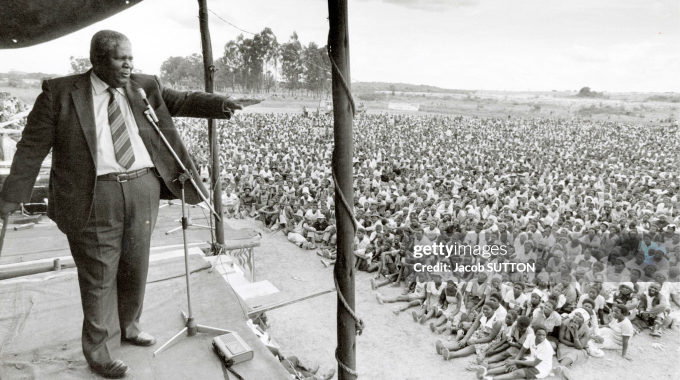
Yoliswa Moyo, Features Editor
GROWING up in the Matobo foothills of Chief Bango’s village, just a young boy herding his father’s cattle, there was no telling that he would later carry the hopes and aspirations of his people.
Taking a carpentry course, working as a driver, trying his hand in animal husbandry and later becoming a school teacher were all part of the story of what lay ahead.
After a stint in South Africa where he studied social work and met celebrated leaders like Nelson Mandela, a trade unionist was born. He would later become Father Zimbabwe — a magnanimous figure carrying the dreams and aspirations of his countrymen.
The late Vice-President, Dr Joshua Mqabuko Nkomo spent most of his life fighting for freedom, better quality of life for all citizens and an end to human rights violations.
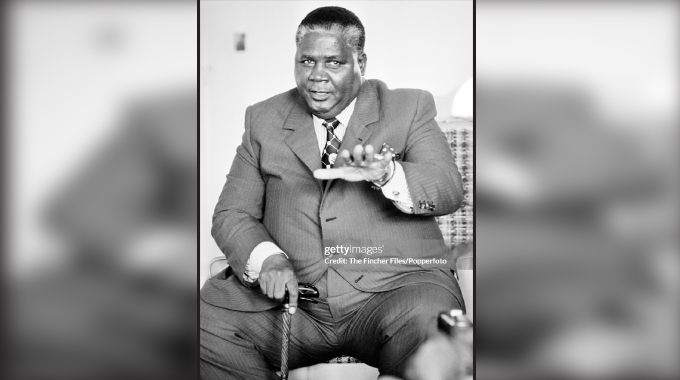
Dr Joshua Mqabuko Nkomo
In his autobiography, The Story of My Life, Dr Nkomo says from his earliest youth, he “thirsted for freedom.”
“When I became a man, I understood that I could not be free while my country and its people were subject to a government in which they had no say. In middle life I fought for national independence and I was 63 years old when, in 1980, Zimbabwe emerged as the last of Britain’s colonies to win nationhood,” he says.
Because of his anti-tribalist approach to the liberation of the country, Dr Nkomo earned the respect of his countrymen, both young and old.
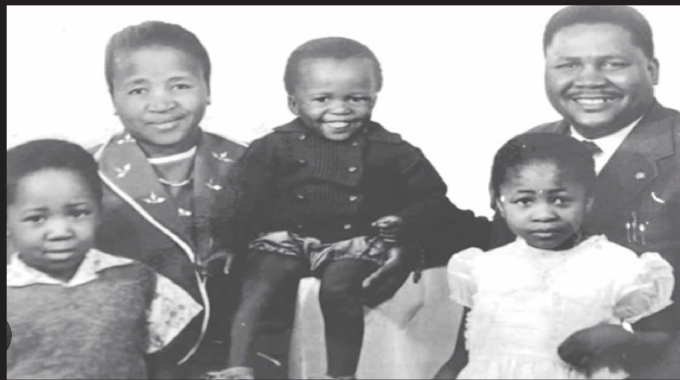
“I have been called Father Zimbabwe. Whether I deserve that title is not for me to say. But by a dozen years in prison and half as many in exile, I believe I have earned the right to speak up for freedom,” says Dr Nkomo.
He said Zimbabwe’s war of independence was long and cruel because it was unnecessary.
“The white people of Southern Rhodesia, outnumbered at least 20 to one by the blacks whom they refused to acknowledge as their fellow citizens, must have known in their hearts that they could not in the long run perpetuate their rule. The British government had the constitutional duty to make the settlers obey the law but declined to do so. We had no alternative to taking up arms,” says Dr Nkomo.
By their prolonged resistance, the settlers fostered bitterness not only between themselves and the black majority but also between the various African factions struggling for justice in prison or in exile, he says.
Dr Nkomo says the colonial government could not afford to kill them but needed to halt their efforts to take back the country and they did this by confining them to restriction camps.
“Ian Smith’s illegal government knew they could not break our spirit. They feared to kill us since that would alienate the few friends they had in the world. They wanted us and the cause we stood for, out of the way. So they shut us up to rot quietly in Camp 5 of the Gonakudzingwa protected area in Gonarezhou Game Reserve.
“There were four of us at the start; Joseph Msika, Lazarus Nkala, Stansilas Marembo and myself. About four months later, the guards discovered that Stansilas was missing; he had gone on a visit to Camp 2.
The police, using tracker dogs, found him and he was taken away for detention at Gweru Prison. So we three were together for the next nine years,” says Dr Nkomo.
He says the objective was to cut them off from the world.
“To make it forget us and us forget it. But that was not easy. The radios were our life line. One was built into the top of a little bedside medicine chest that I made myself during the relatively relaxed initial period of restriction — a little Sanyo, using the same batteries as my pocket torch, so that I could buy replacements without difficulty.
“The other was hung on a pole fitted under the seat of our earth latrine and the guards never found it there,” says Dr Nkomo.
The other camps remained in occupation, a couple of kilometres away in the forest, he says.
“The paths were patrolled not only by the usual wild beasts but also by our own fierce looking dogs. It was the dogs that enabled us to keep in touch with the other prisoners. Each camp put out food for the dogs at fixed but different times of the day so they made a regular circuit of the camps. We fixed up little pouches behind their collars, so messages passed from one camp to another.
“It was a tragedy for us when the police shot the dogs — but that was not because of the message system, which the guards never discovered. It was because of the names we had given the animals,” says Dr Nkomo.
He continued: “There was Ian Smith, after the illegal prime minister, a female dog called Janet, after his wife, and an ugly beast called Van der Byl. A big fat dog we called Dupont, after the pompous man who became president of their illegal state — and there were others named after other ministers. When the police came round to inspect us, we would call “Smith, Smith” and the dog would come running up to be patted.”
The late nationalist says the conditions in the camp were reasonably tolerable.
“The food was the sort of plain diet given to African farm workers — plenty of sadza and some of the sort of low-grade beef that they called ‘boys meat’ because it was especially for black servants. In winter, the camp was cold and in summer the heat was frightful.
“The shade trees had been cut down for a kilometre around the huts, for security, and the only shade was under our grass-roofed shelter. Few used to move around it as the sun shifted,” says Dr Nkomo.
As the years went by, he says, some of the prisoners started to grow tense, fighting over some of the silliest things.
“Even the mildest people grew tense in prison. Another time, in the early darkness of a very hot night, we heard a loud noise of fighting from the nearest of the other camps. It went on for some time and then the sky lit up as the thatched roofs of the shelters caught fire. Then came the sound of gunfire and sudden silence.
“The row died down as suddenly as it had started; perhaps the violence had done people good in some way. But the remarkable thing was the effect on the senior police officer in charge of the camps. I had seen him, of course, but only on routine business; we had never talked.
“This time he came to me and said; ‘I’m very sad today and I come to you today, Nkomo, as leader of these people. I am here guarding you not because it is a pleasure, but because it is my job. Many of us white people are carrying on with our jobs because we believe at the end of it all there will be peace in the country.
“We know that in the end you will succeed and you will run this country. But after the violence last night, I wonder whether after all this suffering you will be able to work together. If you can’t work together, it is not just you, the black people who will suffer. We whites too will suffer,” says Dr Nkomo.
Father Zimbabwe remained under restriction for about 10 years, although not always in the same place or under the same conditions.
From 1969, he was permitted three-monthly visits from his wife, Mama Johanna Nkomo (neeFuyana) and his children.
During these 10 years, he came before the public eye on three occasions only. Firstly, when he was flown to Salisbury on October 29, 1965 to discuss the situation with Harold Wilson, the Prime Minister of Britain, during the latter’s pre-Unilateral Declaration of Independence visit to Salisbury now Harare.
The second occasion was in November 1968 when he was called to Salisbury to meet George Thompson, the Commonwealth Secretary, and Labour Party MP Maurice Foley, in the course of the further negotiations that followed the talks between British Prime Minister Harold Wilson and Ian Smith, the Rhodesian Prime Minister.
His last emergence was on 10 February, 1972 when he was interviewed by members of the Pearce Commission.
In some sections of history, Dr Nkomo says during his long period in restriction, he thought deeply of the future course of nationalism. In one respect, his attitude, if anything, hardened.
On the question of majority rule, he became unwilling to accept any compromise as he said, “I would be silly to get anything short of majority rule after suffering all these years.”
In pursuit of independence, Dr Nkomo received a proposed parliamentary structure which was a highly complex one with provisions for 50 ‘A’ Roll and ‘B’ Roll seats, together with a cross-voting system which would leave each roll to have a 25 percent influence on the other.
There was an immediate adverse reaction to the agreement. Dr Nkomo, although stoutly defending his action and that of his fellow-delegates, soon came to realise the strength of the opposition.
He further found his stance weakened by the arrival of a telegram from Leopold Takawira, in London, in which such phrases as “diabolical and disastrous”, “treacherous to three million Africans” and “untold suffering” were allegedly employed.
The following day, Dr Nkomo flew to London. After discussions with Secretary of State for Commonwealth Relations Duncan Sandys, Takawira and Enoch Dumbutshena, he issued a statement to the press in which he repudiated the constitutional agreement.
In explaining his change of attitude, he remarked, “a leader is he who expresses the wishes of his followers; no sane leader can disregard the voice of his people and supporters.”
Towards the end of October 1975, he started a series of meetings with Smith designed to prepare the ground for a full constitutional conference.
In early February 1976, he travelled to London where he had talks with James Callaghan, then Foreign Secretary. On February 27, when the talks had reached what he described as a crucial stage, he met Lord Greenfield, who had been sent out from London to gain first-hand knowledge of the situation.
It was at this time that he admitted that the nationalist movement was receiving aid from eastern countries because the “western countries wouldn’t agree to help.”
When the talks with Smith collapsed on 19 March, Dr Nkomo said the breakdown had been on “the single fundamental issue of majority rule.”
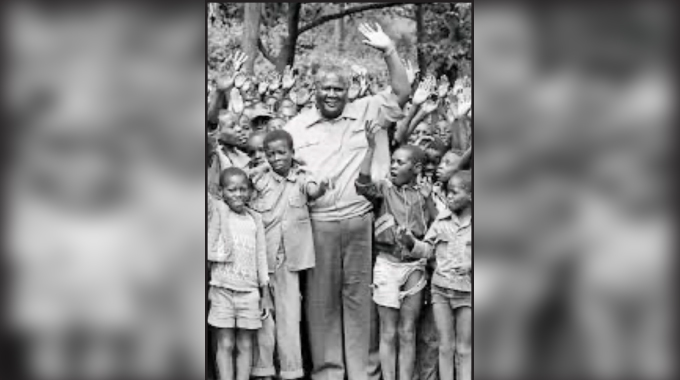
However, it wasn’t too long before the country attained its independence on 18 April, 1980.
Dr Nkomo worked tirelessly to unite all Zimbabweans, transcending tribal divisions.
His stance against tribalism was clear.
“We are one people. You have got to accept that principle. We are one nation. There is no question of (one tribe) swallowing another.”
His love for the people, which ran ocean deep and his immense sacrifices for national unity and peace remain etched in the hearts and minds of many.
His was a lifetime of steadfast national service.
Dr Nkomo died on 1 July, 1999; his spirit remains an enduring inspiration, guiding future generations towards a brighter future.