Chronicle Editor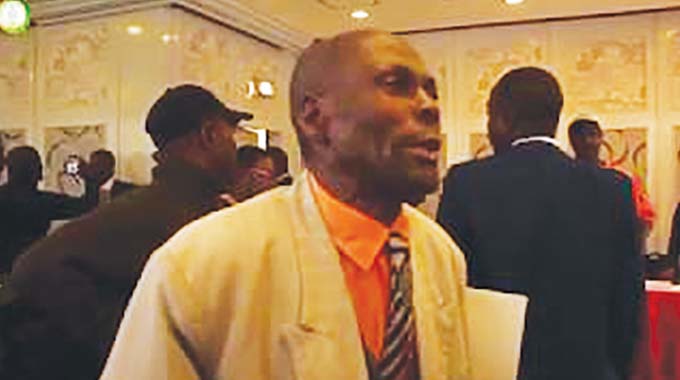
Kennedy Mavhumashava – [email protected]
MR Egypt Dzinemunhenzwa, the veteran politician from Wedza, Mashonaland East, takes himself very seriously but to many, his political value is just the comic relief he delivers.
He has contested in perhaps every presidential election since the late 1990s except in July 2018 when some “disloyal” members of his Forces for the Liberation Organisation of Africa National Party “deserted” him at the last minute. In anger, he shelved his presidential ambitions but could not let an election pass without an appearance on the ballot paper. Instead, he successfully filed nomination papers for Wedza North National Assembly seat.
Pitted against Cde David Musabayana of Zanu-PF and MDC Alliance’s Mr Tichaona Makara, Mr Dzinemunhenzwa polled 303 votes.
“This is the only time I will contest for such a seat,” he said after filing his papers at the Nomination Court in Marondera on June 15, 2018.
“Come next elections, I will be back as a presidential candidate for my party and we will win without doubt.”
Will he, as he promised five years ago, show up at the High Court in Harare today when prospective presidential candidates file their nomination papers? With the US$20 000 or ZWL$136 million nomination fee?
President Mnangagwa will, for the second successive harmonised election, lead the race to State House again today. Justice, Legal and Parliamentary Affairs Minister, Ziyambi Ziyambi filed his nomination papers five years ago and he could be picked to perform the honours again.
Mr Nelson Chamisa, of the Citizens Coalition for Change (CCC), Professor Lovemore Madhuku of the National Constitutional Assembly (NCA), Mr Douglas Mwonzora of the MDC-T, Mr Robert Chapman of the Democratic Union of Zimbabwe (DUZ) and Ms Elisabeth Valerio of the United Zimbabwe Alliance are likely to file their papers. It is possible that a few more individuals might turn up too.
Zanu-PF formally picked President Mnangagwa as its presidential candidate at its congress in December last year and conducted its primaries in March this year. A number of seniors lost to their juniors in the internal elections, an indication of strong internal democracy in the revolutionary party.
The winners got their campaign vehicles soon after their election.
Primaries were also conducted for local government representatives as well.
Both categories of party representatives as well as senatorial, women and youth quota representatives will be at their provincial magistrates’ courts and local council chambers to present their papers today.
CCC did not conduct primaries to come up with candidates, but has been using what it said is a consensus approach that, some observers say, has caused much confusion in the formation. By last weekend, the party had not finalised its candidate list. Some seats, according to reports, featured two or more aspirants.
Mr Mwonzora and Prof Madhuku are likely to successfully file their nomination papers for the presidential election, and have a number of representatives at parliamentary and local government levels. It, however, will be an immense task for them to be able to muster enough support to be represented 100 percent nationally.
Those wishing to run for parliament pay US$1 000 (or equivalent in local currency) and register at provincial magistrate courts. Political parties will pay US$200 per list at provincial magistrate courts to register aspiring Senators (women and youth quota) and Metropolitan Provincial councils.
For one to be a presidential candidate he or she must be a citizen of Zimbabwe, a registered voter, 40 years of age and above and be nominated for by at least 10 registered voters from each of Zimbabwe’s 10 provinces.
For one to be a constituency National Assembly candidate they must be a citizen of Zimbabwe, a registered voter, 21 years of age and above and be nominated by at least five (5) registered voters from the contested constituency. For one to be a local authority candidate one must be a citizen of Zimbabwe, be a registered voter, be 21 years of age and above and be nominated by at least five (5) registered voters within the ward being contested.
A total of 23 figures contested for the presidency in 2018, four of whom were women — Dr Thokozani Khupe (MDC-T), Ms Violet Mariyacha (United Democracy Movement), Cde Joice Mujuru (People’s Rainbow Coalition) and Ms Melbah Dzapasi (#1980 Freedom Movement Zimbabwe).
That was the first time in the history of the country that so many women sought election to be president.
Cde Mujuru is back in Zanu-PF while Dr Khupe has switched to CCC.
After today, campaigning for the August 23 election will begin formally and much more earnestly. The parties will be out to secure the support of about 6 million registered voters in the country.
The ruling party will this week launch its campaign and unveil its manifesto at what is set to be a huge rally in Chipinge.
In 2018 President Mnangagwa polled 2,5 million votes to clinch 51 percent of the ballot while his closest challenger, Mr Chamisa, then leading MDC Alliance got 2,1 million votes or 45 percent of the ballot.
Zanu-PF, which is seeking 5 million votes in the August poll, has a more than two thirds majority in Parliament and a much wider majority at local government level.



 Online Reporter