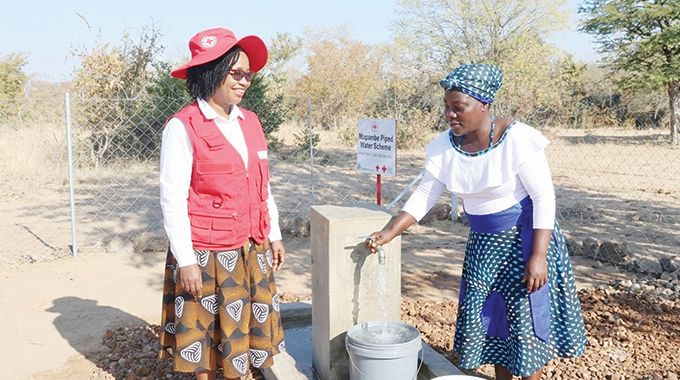
Theseus Mauruki Shambare recently in Binga
FOR years, the sound that defined mornings in Mupambe Village under Chief Saba in Binga was not the laughter of children preparing for school or the voices of farmers heading to their fields.
It was the sound of footsteps.
The footsteps of women and girls walking in search of water.
Before sunrise, long before the heat of the Zambezi Valley became unbearable, women would leave their homes carrying empty containers, while others relied on donkey-drawn carts to transport water from distant sources.
For many households around Mupambe, the nearest reliable water point was nearly 10 kilometres away.
The journeys were long, exhausting and often unsafe.
For women like Ms Lambiye Munkuli, fetching water became a daily test of endurance.
“There were times when women were at risk because of moving around in the darkness,” she said.
Village head Mr Jairos Mupande said some of the safety incidents reported along water routes were treated as criminal matters and referred to the police.
“When cases were reported, they were taken to the police because they were criminal issues,” he said.
A fragile system under climate stress
In Mupambe, climate change did not only intensify hardship — it exposed the weakness of already strained water infrastructure.
As droughts became more frequent and rainfall increasingly unpredictable, traditional water sources began to fail.
The Zoyebe Deep Well and sand abstraction points along the Lubanda River, once critical lifelines, became seasonal and unreliable.
The village’s old borehole, a manual system, frequently broke down due to its depth and mechanical strain.
At times, it remained non-functional for up to six months awaiting repairs.
“When there is no water, everything stops,” Ms Munkuli said.
The burden on women and girls
As water became scarce, women carried the greatest burden — walking long distances, managing households and securing water for survival.
For girls, the crisis followed them into classrooms.
Sixteen-year-old Thandiwe Moyo, a learner at Mupambe Secondary School, said water shortages made menstrual hygiene difficult.
“When there is no water, it becomes very hard for us girls,” she said.
“You worry about staying clean and comfortable in class. Some girls even stay away from school during their periods because they cannot manage without water.”
Livelihoods under threat
Water insecurity also threatened the economic backbone of the community — livestock.
For many households in Binga, cattle represent wealth, food security and a survival buffer during droughts.
Between November and December 2023, Zimbabwe recorded 7 004 cattle deaths due to drought-related causes, with Matabeleland among the worst affected regions.
Binga lies largely in agro-ecological Regions IV and V, where rainfall averages 350mm to 450mm annually, making communities highly vulnerable to climate shocks.
A climate-smart intervention
A major intervention by the Zimbabwe Red Cross Society, supported by the Finnish Red Cross and Danish Red Cross, has transformed a failing borehole into a solar-powered, mechanised water system.
Zimbabwe Red Cross Society, working with partners, installed a pipeline network supplying Mupambe Primary School, Mupambe Secondary School and surrounding villages.
The Climate-smart Resilience Programme, launched in 2022, aims to help communities shift from crisis response to long-term climate adaptation. The system now serves multiple villages including Kakonde 1, 2, 4, 5, 8, 9, Mupute 6, Nkombo 5 and Nkombo 6.
For Ms Emelia Mudenda, the change is not only about access but dignity.
“Water is life. When water is far away, women suffer the most because we are responsible for the home,” she said.
Schools and restored daily life
Mupambe Primary School, with 574 learners, and Mupambe Secondary School, with 193 learners, now have reliable water access.
Teachers say this has improved hygiene, reduced absenteeism linked to sanitation challenges, and created a safer learning environment for girls.
“Things have changed. The situation is now conducive for girls and that is ‘leaving no one behind’,” said Mupambe Secondary School head, Mr Eliot Mudenda.
Women at the centre of resilience
The project also highlights women’s leadership in climate adaptation.
ZRCS field officer Mrs Spiwe Nyathi-Sibanda played a key role in ensuring implementation remained focused on intended beneficiaries despite reported attempts to divert the project.
Binga District Development Coordinator Mr Land Siansole Kabome praised her commitment.
“This woman is devoted to her humanitarian work,” he said.
Mr Kabome said the project faced hurdles, including attempts by some individuals to divert efforts away from the intended beneficiaries.
“She stood her ground and came to my office. I unleashed my workforce and we made sure the people of Mupambe got potable water, our schools got to work and their gardens get to flourish,” he said.
For Mrs Nyathi-Sibanda, the work is driven by the principles of service.
“Red Cross work is anchored in voluntary work. It pains whenever you see humanitarian work facing hurdles,” she said.
Her story reflects a growing reality in climate adaptation — women are not only among those most affected by climate change, but they are also leading responses to it.
The Mupambe intervention is therefore not only about pipes, pumps and solar power.
It is about changing the relationship between women and water. It is about restoring hours previously lost to searching for a basic necessity.
At the handover of the Mupambe Water Scheme, Finnish Red Cross Programme and Finance Officer Ms Loice Munhenga, like Mrs Nyathi-Sibanda, also stood out as an empowered woman, a mother and a committed humanitarian, highlighting the importance of protecting livestock as a pillar of community resilience.
“Livestock is the community’s cornerstone of wealth and livelihoods and therefore needs to be protected from diseases. A healthy herd ensures that our wealth is securely preserved at family, community and national level,” she said.
Ms Munhenga said her humanitarian work is driven by a deep commitment to families and communities, especially mothers and children who bear the brunt of water scarcity and climate shocks.
A shift in daily reality
With solar-powered water now flowing, the transformation is visible in everyday life. Women no longer walk 10 kilometres for water. Girls spend less time worrying about hygiene at school.
Households are reviving gardens and small livelihoods that had collapsed under water stress.
Village leadership says the intervention has eased long-standing pressure on households and improved safety, particularly for women and girls.
From survival to dignity
For Mupambe, water insecurity was never just a service gap — it shaped education, safety, health and survival.
The new system does more than supply water.
It restores time.
It reduces risk.
It strengthens livelihoods.
And it reshapes resilience in the face of climate change.
For women who once walked before sunrise carrying empty containers across dry land, the change is quiet but profound.
Water is now closer.
Life is lighter.
And the footsteps that once defined Mupambe mornings are fading into memory.