Online Reporter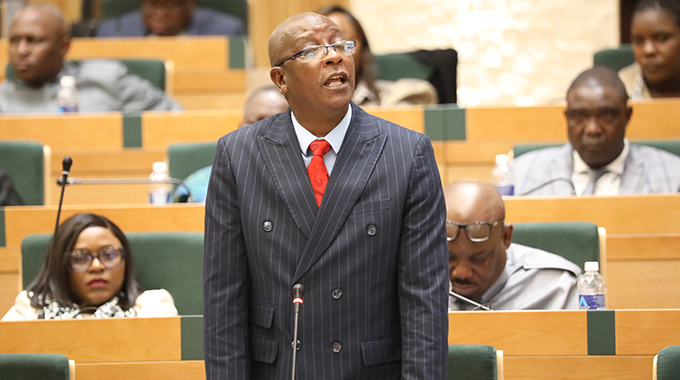
Introduction
Mr. Speaker Sir, I rise to reply to the Second Reading debate on the Constitution of Zimbabwe (Amendment No.3) H.B.1. Bill, 2026. Before doing so, may I thank Honourable Members for their spirited and constructive engagement of the Bill. Over seven sitting days, members from every province and both sides of the aisle rose to engage the Bill, with the energy that does credit to Parliament. Whatever our differences, the people of Zimbabwe have watched their representatives debate the supreme law of the land with seriousness, and that in itself vindicates the institution which this Bill proposes to trust as the forum for selecting the country’s head of state and government. I’m also grateful for the invaluable, technically grounded, contributions by my colleagues Honourable Kazembe Kazembe, Minister of Home Affairs and Cultural Heritage; Honourable July Moyo, Minister of Energy and Power Development; and Honourable Virginia Mabiza; the Attorney General.
Mr. Speaker, let me share with the Honourable House the shape of its own debate, as it unfolded over a historic course of seven sittings. A record breaking 182 members made substantive contributions. Of these, 111 supported the Bill as a whole. A further 31 supported the Bill while raising reservations on specific provisions; 10 members raised issues without taking a final position, and 30 opposed the Bill in its entirety.
All told, 139 of the 182, were positively disposed towards the Bill. Two in three Members of this entire Honourable House rose to debate this Bill. This compares very well with CAB1 and CAB2. At the Second Reading of CAB1 in 2017, 19 members rose on the record before the Honourable House; while CAB2 in 2021 had 18. This Bill, Mr. Speaker, by the parliamentary record itself, is the most debated constitution amendment in the country’s constitutional history.
The provisions that attracted the most comment were the election of the President through Parliament; the distinction between the length of the term and the term limit; the future of the Gender Commission; and the political status of traditional leaders. I will address each in its place.
Reflections on the Joint Committee Report
Mr. Speaker Sir, I turn first to the report of the Joint Committee, presented by Honourable Zvobgo, its Chairperson. I thank him and every member of that Committee for a report of genuine quality. The report is thorough, it is candid, and it carries the voice of the people in numbers that deserve to be read into the record; once more. The Committee received 540,037 submissions on this Bill. Of these, 537,102 were in support and 2,935 were against. The provincial public hearings drew 54,231 citizens through their doors.
Mr. Speaker, as I mentioned a little while ago, no amendment has been interrogated by so many of its citizens; in the recent constitutional history of the country. The Joint Committee did not simply count these voices; it weighed them, clause by clause. In the main, the Committee recommended the adoption of the Bill’s provisions, and in respect of certain provisions it recommended refinements: for example, that the electoral commission retain the accreditation of observers; that the hierarchy of our two apex courts be better clarified; that the traditional leaders provision should not be adopted; that the leadership terms of the National Council of Chiefs be aligned to the new seven-year national electoral cycle, and that the Gender Commission remain in place. Government has studied each of these recommendations with the seriousness they deserve, and I will respond to each in the cluster to which it belongs; and more specifically during the Committee Stage. The report of the Joint Committee is compelling evidence of what consultation means: not a ritual to be performed and forgotten, but a discipline that binds the framers of a Bill to listen to those who examined it.
Mr. Speaker Sir, mark well what was not said. Members questioned the manner of the hearings; but not one rose to say that the Committee’s report was false, or its figures wrong. The very members who challenge me, left the central record untouched. Their silence upon it is its endorsement, and it is the full answer to those who cry from outside this Honourable House that the figures were cooked, while saying nothing against them within it.
And for support that named no single clause but embraced the entire Bill, I thank Honourable Mangondo, Honourable Tavaziva, Honourable Mapfumo, Honourable Marange and Honourable Dzidzai Butau.
Debate on Core Amendments
Mr. Speaker, I come to the debate on the Bill’s core amendments, which drew the heaviest debate: the election of the President through Parliament and the length of the national electoral cycle. I thank Honourable Matema for opening that debate with the reminder that this is not foreign terrain for Zimbabwe, because Parliament elected the President and the Prime Minister in this country before 1990. In the same vein, I thank Honourable Chiduwa for situating the Bill’s reforms in the honest company of other nations that have amended their constitutions far more often than we have. In particular, I thank Honourable Togarepi for the clearest statement of the distinction on which so much of this debate turns. Also, I thank Honourable Mutodi for contrasting the histories of our deeply disputed presidential elections with the quiet of our parliamentary ones. And I thank Honourable Sibanda, who rose from the opposition benches to eloquently endorse the spirit of these reforms. That took conviction, and the Honourable House noticed.
On entrusting the election of the President to Parliament, I thank also Honourable Machangu, who cited Professor Madhuku’s endorsement of Parliament as the electoral college. I’m also grateful to Honourable Mpasi, Honourable Jaravaza and Honourable Batitsa, and Honourable M. Nkomo, Honourable Munemo and Honourable Murambiwa, who spoke to the same purpose. And for support that embraced the whole of the Bill, I thank in particular Honourable Matangira, Honourable S. Dube, Honourable Zhanda, Honourable M. Ziyambi and Honourable Chikwinya.
I thank too, for the same wholehearted endorsement of the Bill, Honourable J. Tshuma, Honourable Maunganidze, Honourable Maoneke, Honourable Mukungunugwa and Honourable Zemura.
Response to Specific Concerns
Mr. Speaker Sir, before I address notable issues raised by some Honourable Members, let me say something, with all due respect, about the manner of their concerns. Listening to some contributions, one would be forgiven for thinking the Honourable Members concerned were absent when I presented the Second Reading Speech; or that they were unaware that the speech exists at all, printed in the Hansard for any member who cared to read it. This is because they responded out of context, and Honourable Members know that context is everything.
The context of this Bill is historical and constitutional: it is the mischief that the Bill seeks to remedy, and I gave that mischief a name and a number in my Second Reading Speech. I outlined five afflictions that have gripped our public life since the introduction of direct presidential elections in 1990: the perennially disputed presidential contest, with the political violence and lost investment that trail it; the policy paralysis of a nation trapped in permanent election mode; the corruption that instability feeds, and that every cycle renews; the politicisation of a public service that should be neutral, professional and continuous; and the polarisation of a society asked, again and again, to divide itself against itself. Five afflictions, Mr. Speaker Sir. Not one, or two, or three or four. But five, interlocking and documented. That is the mischief, and no one needed the help of a lawyer or a rocket scientist to grasp it, because I gave it, in this Honourable House, from this floor.
Yet not one of the 30 members who opposed this Bill in its entirety engaged all the five afflictions. Most seized upon one, declared the Bill to be about nothing else, and rejected the whole on the strength of that one part. Honourable Gumbo, to take one example, built his entire bombastic rejection of the Bill on elections and elections alone; as though I had stood on this floor and named dysfunctionally disputed elections as the only affliction bedevilling our country. The other four he left standing exactly where I placed them, unanswered to this day. According to Honourable Gumbo, all that needs to be done is to observe the rule of law. With respect, Mr. Speaker, that’s a simplistic view. Where it is demonstrated that there’s a lacuna in the law or there’s a structural mischief that enables bad behaviour in the body politic; it is imperative for Parliament to intervene. The important point that Honourable Gumbo and his associate miss is that it is the constitutional duty of this House to make the law.
Some Honourable Members came to debate; if I may say so kindly, Mr. Speaker, with preconceived ideas, and a preconceived idea is a speech written before the other side has spoken. And the irony should not escape the Honourable House: the very members who ignored four of the five afflictions, now present themselves as the guardians against polarisation and corruption; the very afflictions this Bill precisely exists to remedy.
Mr. Speaker Sir, weigh what it means to reject this Bill in its entirety. Among its provisions is one that does no more than delete a single word a previous amendment left behind when it abolished the office of first Vice-President, and one that ends a Commission the Constitution itself had already time-limited, as I shall come to shortly. The Zimbabwe Council of Churches (ZCC), the Zimbabwe Heads of Christian Denominations (ZHOCD) and the Zimbabwe Catholic Bishops’ Conference (ZCBC) rejected this Bill wholesale in their written submissions to Parliament; and Honourable Engineer Mhangwa on this floor took up that cry as his own. To reject a Bill in its entirety when it includes clauses that merely complete what the Constitution and a previous amendment had already settled is not to defend the Constitution. This is not pedantry; it is the tell. Such a rejection was never about the Constitution at all.
Mr. Speaker, let me dwell a moment on Honourable Ngadziore, whose contribution illustrates a trait that marred too many of the rejections we heard during the debate. He told the Honourable House, emphatically, that South Africa cannot be our comparator because it elects its Parliament by proportional representation while Zimbabwe, in his words, has a first past the post system. He was so certain about this that he rose on a point of order and demanded a colleague withdraw.
The record does need correcting, Mr. Speaker, but not as he supposed. Zimbabwe does not have a first past the post system. It has a hybrid system in which constituency seats are filled by first past the post, while a substantial body of seats are filled by proportional representation. The proof required no textbook; it was standing in the Chamber. The Honourable Member himself sits in the Honourable House by virtue of the very proportional representation he told us this country does not use. He rose to correct another on a fact his own seat disproves.
And he was not alone, Mr. Speaker Sir. Member after member rose to perform against this Bill rather than engage it, purporting to be certain of things that are clearly not so, and pretending to correct colleagues who were in fact right. How a parliament is filled does not change what a parliament does. That was the simple matter before us, missed most loudly by those most eager to pontificate.
Honourable Hlatywayo made the same error, and the same answer meets it.
The question before us is not how a parliament is constituted. It is what a parliament does. In South Africa, however its members arrive in the chamber, those members elect the President. In Botswana, which uses the First Past the Post system, the presidency goes to the leader of the party that wins a majority of the directly elected National Assembly seats, and that system recently delivered a peaceful transfer of power. That is precisely the family of mechanisms this Bill proposes to join. How nations build or choose their legislatures differs the world over; ours, as Honourable Members know, is a hybrid of constituency seats and proportional seats, and every one of those seats is filled by the vote of the people. The function is the point, and the function is identical.
And since the comparative question has been put, Mr. Speaker Sir, let the Honourable House have the full comparative picture. Of the states around the world, 56 elect their head of the executive directly and 53 elect the same indirectly through their parliaments. Some Honourable Members opposite would have us believe the majority settles the argument. But examine the majority. It consists, overwhelmingly, of former military regimes, former one-party states, and systems in transition from authoritarian rule, where the strongman’s ballot was the favoured instrument of legitimacy. Now examine the 53. They include the most stable, most prosperous and most enduring parliamentary democracies on earth, and they include the majority of the Commonwealth of Nations, 34 of its 56 members. Honourable Butau pressed the point in plain terms, that the second-largest economy on earth is governed through its national institutions, not in spite of them.
And let the Honourable House note who keeps this company. South Africa sits among them, a nation whose freedom was won through one of the most protracted liberation struggles of our continent. Angola, whose liberation war was among the longest and deadliest in Africa, sits among them. These nations did not come by the people’s voice cheaply; they bled for it. Yet their liberation movements, in government, entrust the election of the president to the people’s representatives in parliament. Zimbabwe sat in this company before 1987.
So, Mr. Speaker Sir, this Bill does not march Zimbabwe out of the democratic mainstream. It walks it out of a club whose membership was built by dictatorships in transition, and back into the company of fellow liberation states and enduring parliamentary democracies whose stability we have every reason not just to envy but to join.
Mr. Speaker, Honourable Makumire invoked those who died for the principle of one person, one vote, and he named names that this Honourable House receives with respect. Let me say this plainly: nothing in this Bill touches the right of every adult Zimbabwean to vote. Nothing. Not one citizen loses a ballot. Every adult Zimbabwean will continue to register, to queue, and to vote, in every polling station, ward, constituency and every province, in every general election. Every seat in Parliament is filled by the people, and the President this Bill contemplates would hold office by the mandate of the people, expressed through every constituency and every province at once, carried by the representatives the people themselves chose. The people will elect the electors to produce a representative outcome that ensures peace, stability, unity and development. Honourable Mazhindu pressed the same concern in another form, urging that to have the Honourable House elect the President would diminish an Office whose legitimacy springs from the millions. The millions remain, Mr. Speaker, and it is they who elect the electors; an Office filled by the people’s own chosen representatives is not a diminished Office but a constituted one.
And let history complete the answer. The settlement our liberation struggle delivered in 1980 had Parliament electing the head of state, while the head of government was the leader of the political party that commanded the majority in Parliament. The executive presidency arrived only in 1987, in anticipation of a legislated one-party state that never came. So when an Honourable Member invokes our fallen heroes, let him invoke them accurately: the system this Bill proposes is the one the founding leaders of the liberation movement itself wrote at independence. That is not the betrayal of one person, one vote. It is its operation, restored to its founding form.
Honourable James and Honourable Kuka pressed the same sovereignty argument, and the answer is the same. Honourable James told us it is fundamentally undemocratic to expect Members of Parliament to decide a question of this weight. He made that argument as a Member of Parliament, standing in Parliament, and he will cast his vote on this very Bill expecting it to count. A member who argues that this Honourable House cannot be trusted with great questions should tell us what he believes his own seat is for. Sovereignty resides in the people, and the people exercise it both directly and through their elected representatives. Honourable Mhuri reminded the Honourable House of the text itself: the legislative authority of Zimbabwe derives from the people, and it is vested in their Parliament. We do not say a mayor lacks legitimacy because councillors elect him; Honourable Kuka’s own council elects its mayor in precisely this way. We do not say a Speaker lacks the authority of the people because this Honourable House elects him, or that the Chief Justice lacks the judicial authority of the people because the President appoints him. Representative election, or even delegated appointment, is not the dilution of the popular will. It is its constitutional form. Honourable Makuvire, Honourable Njanji and Honourable Mujeyi spoke to that same truth, that the people’s authority is exercised through the very House they elect.
Mr. Speaker Sir, Honourable Mushoriwa told the Honourable House that the 2013 Constitution was endorsed by 94.5 percent of those who voted, and that this Bill dishonours that mandate. That is a political statement. Nothing more. Meanwhile, I invite him to read what those millions endorsed. They endorsed a Constitution that contains, within its own, four corners; the procedure for its amendment in section 328. The people did not vote for a frozen document. They voted for a living Constitution, and they wrote the key to its renewal into the document itself. To use the procedure which the people ratified is not to dishonour their mandate. It is to obey it faithfully.
Mr. Speaker, not every member who rose in doubt did so without engaging the Bill. Honourable Nyathi engaged it in good faith, raising conditions rather than rejection and accepting the principle that Parliament may elect the President. That is the manner of debate this Honourable House should honour, and I thank him for it.
Mr. Speaker Sir, Honourable Mamombe placed her constituency’s opposition before the Honourable House, and I would meet her arguments with respect were they arguments about the Bill. But hear what she asked the Honourable House to weigh. She told us that the campaigns around this Bill, the advertisements on radio and television, the jingles and the songs, were centred on an individual, and on that she predicated her rejection of the Bill in its entirety.
Mr. Speaker, I have read this Bill many times. And I’m sure many Honourable Members have done likewise. There is no clause in the Bill about a jingle; no provision about a radio advertisement; and no section about a song. Nor does any of this appear in the Second Reading Speech I delivered from this floor, printed in the Hansard and available to every member who cared to read it. To conflate a tune on the radio with the supreme law of the land is to debate everything except the Bill before us.
And this is what disappoints, Mr. Speaker. The text of this Bill is published. The speech that explains it, mischief by mischief and provision by provision, sits in the Hansard. A member who wished to oppose this Bill on its merits had every word she needed before her. Yet some came to this floor heedless of both the text and the speech, and offered the Honourable House the jingles they say they had heard on the airwaves in the place of argument. The Honourable House deserves better, and so do the more than half a million citizens who took the trouble to read the Bill and tell us what they thought of it.
Mr. Speaker, Honourable Karenyi-Kore told the Honourable House that this Bill creates no job, lowers no price of mealie meal, builds no school and mends no hospital; and on that ground she asked whose problem it solves. Honourable Sithole pressed the same charge in his own words, asking what national crisis requires this reform. They spoke for the people of Chikanga and of Chitungwiza North with feeling, and the hardships they named are real and weigh on this Government daily. But the argument they share rests on a category error, and it goes to the very nature of the document the Bill is amending.
A constitution is not a grocery list, Mr. Speaker, and was never meant to be one. Honourable Karenyi-Kore told us as much herself: the price of oil, she said, has risen because of a war in Iran, and fertilizer because of another war in Ukraine. No constitution written in Harare moves those prices, and no amendment drafted in this Honourable House ever could. To expect otherwise is to misconceive what a constitution is for. It comes before jobs and hospitals; as the edifice within which that work is done, setting how power is held, how it is limited, and how it passes from hand to hand in peace. To fault it for not lowering the price of bread is to confound the foundation with the roof.
And so their question recoils upon them. They ask whose problem this Bill solves, and what crisis demands it; it solves the problem of a nation that cannot build because it is forever locked into a toxic election mode; the disputed power and instability that frighten away the very investment from which jobs are created. The mealie meal they speak of is milled in factories that need a stable and united country to run. This Bill does not put bread on the table with its own hands; it builds the peace and continuity in which the baker can. That is the proper work of a constitution, which this Bill is about.
Mr. Speaker, there were others who also rose to reject the Bill in its entirety, among them Honourable Zvaipa, Honourable Mureri, Honourable Chikombo, Honourable Chimbaira, Honourable Mavhunga and Honourable Hamauswa. I have weighed their contributions with the rest, and the answer I have given to the five afflictions answers them too.
Mr. Speaker, the loudest of those who would reject this Bill whole was Honourable Matewu, who called the election of the President through Parliament an assault on the sovereignty of the citizen, a snatching of the ballot from the people’s hands. I have answered that already: no citizen loses a ballot, and the people elect the very Members who would elect the President. This practice proposed in the Bill is not my invention, it is an international standard across constitutional democracies. But mark the irony. A Member who rose to defend democratic participation could not abide the most basic rule of participation on this floor, the ten equal minutes each Member is allowed. He disputed the clock, refused his seat, and in the end argued himself out of the Honourable House. A man who cannot keep his own place on this floor is poorly placed to lecture it on the will of the people.
Debate on Term Length or Electoral Cycle
Mr. Speaker Sir, Honourable Engineer Mhangwa made what is arguably the most engaging case against the longer term, highlighting that projects vary in length, that no fixed extension matches them all, and that the true obstacles to delivery are funding and execution rather than the calendar. I thank him for arguing the substance, and I answer the substance, to show him the fundamental point he misses. The case for a seven-year electoral cycle has never been that a road takes exactly seven years to build. It is that the present cycle devours the time in which anything is built. The first year after an election is consumed by transition and, too often, by vexatious litigation. The final two years are consumed by campaigning, and worse, by the fiscal indiscipline that campaigning invites. The Honourable Member is right that funding and execution matter. That is precisely the fundamental point. Funding and execution are the first casualties of perpetual election seasons.
On the case for the longer national electoral cycle, I am indebted to many. Honourable Kaitano set our open cycle against the term-limited offices of other nations; Honourable Dhanzi gave the seven-year horizon as the framing of a faith-community; and Honourable Mapiki put the cost of our permanent campaigning in plain figures. Honourable Gwabeni, Honourable Muringazuva and Honourable Mudowo made the case based on the fundamentals of planning, continuity and the stability that the young deserve. Honourable Mashavave set our open cycle beside the long-cycle democracies of Europe, and Honourable Matinyanya brought word that Mbare had asked for the two added years by name. Honourable Chihwa and Honourable Mandiwanzira pressed the case for continuity, and Honourable Shiriyedenga for a Constitution allowed to evolve with its people.
The seven-year cycle does not promise that projects will fit a template. It promises Government a sustained stretch of governing, and it promises the taxpayer relief from the most expensive habit in our public life, which is the permanent election mode.
I thank too Honourable Maburutse, Honourable Marikano, Honourable Murechu and Honourable Nyevera, who pressed the same case, and Honourable Makumbe and Honourable Matiza, who carried it from their constituencies. For their unqualified support, I thank also Honourable Kanupula, Honourable Tasikani, Honourable Mundungehama, Honourable Musiyiwa and Honourable Murwira.
For their support of the whole of this Bill, my thanks go also to Honourable S. Nyoni, Honourable Zevezai, Honourable Raradza, Honourable Mudekunye and Honourable Timburwa.
Honourable Chigumbu attributed to me the claim that a longer term cures electoral violence. I said no such thing, and I corrected the record when it was made. I invite the Honourable Member to debate the speech I delivered rather than the one he had already written his reply to, in advance of the Second Reading Speech. What I have said, and what the submissions of half a million citizens confirm, is that our presidential elections have repeatedly brought tension, perennial dispute and cost that our parliamentary and local government elections have not, and this Bill responds to that lived national experience in the national interest.
Mr. Speaker Sir, on the length of the term, Honourable Madzivanyika built his case on the wrong proposition that the provision fixing the duration of the term is itself a term-limit provision; and he misquoted the Constitutional Court’s binding decision in the landmark Mupungu case in purported support of his incorrect position. I corrected this on the floor, and I now place the correction on the record. The passage the Honourable Member quoted was an observation or illustration made by the Court in passing. It’s called Obiter Dicta. It was not the holding of the Court or its Ratio Decidendi. And the Honourable House should examine the very passage he relies upon. In it, the Court listed, by way of illustration, ten provisions of the Constitution as examples of term limits. Nine of the ten share the defining feature of every true term-limit provision on tenure; namely, an express cap or limit on how long a person may serve; a term non-renewable or renewable once only or limited to a stated maximum. The tenth, section 95(2), the provision that merely fixes the duration of the presidential term, carries no such cap and shares none of those defining elements. Its inclusion in that illustrative list was clearly a benign oversight, and nothing turns on it. The list was an aside, not the holding or the two-term rule, where the presidential term limit actually lives; and which should have been included in the list of examples given by the Court, section 91(2), which is untouched by this Bill.
What our Constitution does, and the Honourable House should hear this with care, is keep two distinct promises in two distinct provisions. One provision fixes how long a term runs. Another provision, untouched by this Bill, says no person may hold the office of President for more than two terms. Think of a doctor’s prescription, Mr. Speaker Sir. One line fixes the size of the dose. Another line says: no more than two doses. The doctor may raise the dose from five millilitres to seven, and the second line still reads exactly as it did. No patient in history has read a larger dose as a licence to take a third. So it is with this Bill. It lengthens the term from five years to seven. It does not amend, by a single word, the rule that limits every occupant to two terms. The cap stands.
And the proof that Parliament’s power over the cycle runs in both directions sits in Parliament’s own record: In 2007, Parliament amended the Constitution to shorten its own life by two years to harmonise our elections. Every member present voted for it, the opposition included, and not one asked for a referendum. The power that shortened the cycle then is the power that lengthens it now.
Honourable Gumbo and Honourable Muwodzeri argued that the saving provisions of the Constitution bar a sitting incumbent from any benefit. Those provisions speak to term-limit provisions, and for the reasons I have given, the length of the term is not a limit on the person. Honourable Madzivanyika went further and told this Honourable House that a referendum is required. He is wrong, and because that demand was made by several members, I will answer it comprehensively before I conclude.
Mr. Speaker, a word about the constitutional arguments themselves, for several members who are lawyers rose, in effect, to purportedly deliver rulings on the constitutionality of this Bill. Section 152(3) of the Constitution could not be plainer: The Parliamentary Legal Committee must examine every Bill, other than a Constitutional Bill, to determine whether its provisions, if enacted, would contravene the Constitution. So, the Constitution deliberately withholds even from Parliament’s own legal committee the power to sit in judgment on a Constitutional Bill. Why? Because when Parliament amends the supreme law of the land, Parliament is not subordinate to the existing text; Parliament, by special majority and special procedure, is the framer the Constitution itself appoints for the purpose. Yet some members rose in this debate as one-member law firms, claiming for themselves a jurisdiction the Constitution denies to the very technical committee of Parliament created for the task. Members are of course entitled to their opinions. But the judgment the Constitution asks for is the judgment of this Honourable House, voting by the majority the Constitution prescribes.
Debate on the Electoral Ecosystem
Mr. Speaker, I now turn to the debate on the clauses dealing with the electoral ecosystem. I thank Honourable Makombe, Honourable Pinduka, Honourable Mureyani, Honourable Masvisvi, Honourable Ndou, Honourable Mutokonyi, Honourable S. Ziyambi, Honourable Rungwave and Honourable T. Hungwe, who spoke to the practical sense of these reforms. To Honourable Muwodzeri and Honourable Gumbo, who described the transfer of voter registration to the Registrar-General as executive capture, I say this: the Registrar-General already holds the master record of every birth, every identity document and every death in this Republic. The duplication of that record by a second institution is precisely what has haunted our voters’ roll with the names of the deceased. Consolidating registration where the civil registry lives; while the electoral commission retains the conduct and supervision of every election and referendum, is not capture. It is coherence. Honourable V. Moyo gave the Honourable House the lived proof from Hwange West, where the electoral body is seen only as an election nears while the registry’s officers serve the year round; and Honourable Nkala and Honourable Priscilla Moyo supported the same consolidation.
To Honourable Hlatywayo, who warned of gerrymandering, I point out that the Bill entrenches a dedicated, constitutional delimitation authority precisely so that boundary-drawing is the full-time discipline of a constitutional body rather than the part-time burden of an overloaded electoral body, without the requisite expertise. And the Joint Committee’s recommendation that ZEC retains the accreditation of observers will receive serious consideration when the Honourable House examines the Bill clause by clause.
On these same reforms I thank Honourable Chokururama, Honourable Chinodakufa and Honourable Kashambe, and Honourable Jonga, Honourable Chitimbe and Honourable Ziki, who supported consolidating registration where the civil registry lives and entrenching a dedicated delimitation authority.
I record my gratitude as well to Honourable O. Bvute, Honourable Muwombi, Honourable Nyakuedzwa, Honourable R. Mpofu and Honourable Chari, who supported the Bill in its entirety.
Mr. Speaker Sir, the Honourable House should not forget who first moved this very transfer. It was Honourable Hwende, at the Committee Stage of the Electoral Amendment Bill in the last Parliament, and he was strongly supported. He sits among us still. I placed that on the record in my Second Reading Speech, and not one member has risen to deny it. Yesterday Mr. Speaker, some Members, including Honourable Karenyi-Kore, sought to revise the record by claiming that the 2023 proposal by Honourable Hwende supported by Mr. Biti and Mr. Markham in the Ninth Parliament was only for the automatic registration by the Registrar General of voters who attain the age of majority; with ZEC retaining the custody of the voters. The simple point is that the Registrar General cannot register any single voter, without the constitutional power or function to register voters. It would be irrational to empower two public bodies with one and the same function of registering voters. Honourable Hwende, Mr. Biti and Mr. Markham—supported by their MDC opposition colleagues in Parliament, called for a sound reform in 2023 when they themselves proposed the transfer of the registration of voters from ZEC to the Registry Department. That proposal cannot become capture, now that this Government has taken it up.
Debate on Judicial Alignment
Mr. Speaker, on judicial alignment, the debate was lighter, and the Honourable House will draw its own conclusions from which provisions the loudest criticism of this Bill chose not to engage. I thank Honourable Masvingise for a constructive contribution on the relationship between our two apex courts, which arrives at the very clarification the Joint Committee recommended. Let me also correct one persistent confusion: the expansion of the apex court’s jurisdiction is a question of what the court may hear. It is not a question of how judges are appointed. Those are distinct provisions and distinct debates; and on appointments, the Judicial Service Commission remains in the mix. Its advisory role is preserved. What is removed is procedural inefficiency, not constitutional safeguard.
On these provisions I thank Honourable Mahachi, Honourable Nyabani and Honourable Mugwadi, who engaged the reach of the apex court and the architecture of judicial appointment with care.
Mr. Speaker, on the recalibration of the Legislature, members raised the question of the Senate’s composition with measure, and Government took note. It is telling that this cluster drew so little fire from those who oppose the Bill in its entirety. Where the substance is sound, the silence speaks volumes.
On the recalibration of the Senate I thank Honourable P. Ndudzo, Honourable Nhari and Honourable S. Sakupwanya for their constructive contributions.
I thank also, for backing the whole of this Bill, Honourable Chibagu, Honourable Muchimba, Honourable Kambuzuma, Honourable Kangausaru and Honourable Dumbarimwe.
Debate on Section 212 on the Defence Forces
Mr. Speaker Sir, on the Defence Forces, Honourable Muwodzeri called the provision the most dangerous in the Bill. A striking superlative, Mr. Speaker Sir, for the Honourable Member never once read the provision’s words to the Honourable House. Honourable Gumbo described it as coup-proofing. I ask the Honourable House to read the provision rather than the slogans. In the first place, Mr. Speaker, the idea of coup-proofing through an amendment to the Constitution is pedantic, and really meaningless. Our Constitution already commands every security service to act in accordance with it. What this reform does is to harmonise the founding description of the Defence Forces with that principle; so that no reading of our supreme law can place any institution above it, or beside it, with a parallel mandate of its own. That’s not coup-proofing, it’s fidelity to the Constitution. The Defence Forces remain bound to defend Zimbabwe, its people, its security and its territorial integrity. What the amendment removes is textual ambiguity, and the Joint Committee, having weighed precisely the concerns the Honourable Members raised, recommended the provision for adoption in the interests of democratic governance and the stability of the State. Honourable Sagandira raised his concern with care, that moving from upholding to acting in accordance with the Constitution might dilute the Forces’ founding duty. It does not; the duty to defend Zimbabwe is restated, not relaxed.
Debate on Consequential Alignments
Mr. Speaker Sir, I come to the debate on consequential alignments, and I come first to the Gender Commission, because on this provision the Honourable House has been unanimous in a way no other provision produced. The Joint Committee, after hearing the public, recommended that the Gender Commission remain in place and that the provision not be adopted. And in this Honourable House, that recommendation found an echo across the aisle. Honourable Mutandi spoke against the merger from her experience leading a committee of Parliament. Honourable Chakakura and Honourable Tawomhera built the evidentiary case for retention. Honourable Matsunga gave personal testimony to the Commission’s work. Honourable Zhou, Honourable Shongedza, Honourable Mahlangu, Honourable Masuku, Honourable Thompson, Honourable Matinenga, Honourable Chihota, Honourable Karumazondo, Honourable Samson, Honourable Mudzingwa, Honourable Buka and Honourable N. Ndlovu, who all support this Bill, each rose to say the Gender Commission should stay. Honourable Linyani lent the same voice from Matabeleland North.
Honourable Mguni and Honourable Ncube, from across the opposition bench said the same. Mr. Speaker, Government tabled this provision in pursuit of institutional efficiency, and the argument for consolidation was made in good faith. But consultation is not theatre. The Joint Committee has made a clear recommendation, grounded in the submissions of the public and echoed across this Honourable House, and Government stands guided by that recommendation. Let no one say the people spoke into the wind.
Mr. Speaker, Sir, on the National Peace and Reconciliation, Honourable Mguni asked a serious question and asked it with care: when the Commission’s chapter closes, what carries the work of healing forward? The Constitution itself limited that commission to a ten-year term, which expired in 2023. The Joint Committee was right to observe that the repeal before us is, in that sense, the tidying of the text after the event. But the Honourable Member’s deeper point is heard. The end of a commission’s constitutional term is not the end of the nation’s commitment to healing and to unity. That commitment outlives any single institution, it continues through the organs of State charged with it, and this Government does not treat the closing of a chapter as the closing of the book. Accordingly, the Constitution will continue to give full expression to the imperative of post-conflict justice, healing and reconciliation.
On the political participation of traditional leaders, Mr. Speaker, the Bill sought to resolve a real contradiction: namely; a Constitution that seats chiefs in Parliament and counts their votes in constitutional majorities, yet asks them to stand outside political life. The public majority supported the provision, and the Honourable House divided on it in good faith. I record too that the case for the political participation of chiefs was pressed with conviction, by Honourable Jere, who urged that they be appointed rather than elected, and by Honourable Mananzva, Honourable Musweweshiri, Honourable Chaimvura and Honourable Samambwa. The Honourable House weighed their voices and the Committee’s recommendation alike. Honourable Guyo recalled Chief Ndiweni to show the cost of pushing traditional leaders to the margins of public life, and Honourable Makaza and Honourable Tayedzwa spoke to the same end.
But the Joint Committee identified the decisive principle: our chiefs preside over courts of customary law, and those who sit in judgment must stand apart from partisan contest. This principle is unassailable. Government is persuaded, and will be guided by the Committee’s recommendation that the status quo remain when the Bill reaches its clause-by-clause consideration.
Debate on the Referendum Question
Mr. Speaker, Sir, I have saved one question for last but one, because it has been made by several Honourable Members; it deserves a complete answer, and because the answer exposes how little the demand has to do with the Constitution itself. The demand is that this Bill must go to a referendum. It must not, and here is why. Honourable Makope and Honourable Mukomberi met the demand squarely in the debate, and I am glad to complete the answer they began.
Honourable Malinganiso, an ally on this question, lent his voice to the same answer.
The referendum, Mr. Speaker, is a matter of law, not of political appetite, disposition or preference. The Constitution reserves the national referendum for three categories of amendment, and three alone: an amendment to Chapter 4 on the Declaration of Rights; an amendment to Chapter 16 on agricultural land, and an amendment to section 328, the amending provision itself. For every other provision, the Constitution prescribes a different and equally rigorous road: publication of the Bill in precise terms, a minimum of 90 days for public consultation, and the affirmative votes of two thirds of the membership of each House of Parliament at the final reading. That is not a loophole. That is the design: the will of the people, expressed for amendments of this kind through the people’s Parliament.
So the question becomes a simple one: does this Bill amend the Declaration of Rights, the land chapter, or the amending provision? It does not, and the Constitution itself tells us how to check. Section 328(2) provides that an Act of Parliament that amends this Constitution, and I quote, “must do so in express terms.” The Constitution is written in express terms, and it is amended in express terms. There’s no such thing as “an implied amendment” to the Constitution; such an amendment is not permissible under section 328(2) of the Constitution; and therefore cannot be taken to a referendum.
Now examine the case of the Honourable Members on the referendum. It is built, from foundation to roof, on implication: that lengthening the electoral cycle somehow “has the effect of” amending the entrenchment provision; that providing for parliamentary election somehow “indirectly amends” the chapter on political rights in section 67. But no clause of this Bill expressly amends the Declaration of Rights, or the two-term rule, or the amending procedure. It appears that some Honourable Members believe in amendment by atmosphere, a method the Constitution’s own words foreclose. You cannot amend by implication what the supreme law says may be amended only by declaration, and you cannot demand a referendum for amendments this Bill does not make. Honourable Ngwenya read the supreme law’s own amendment road to the correct conclusion, that this Bill travels exactly the path the Constitution prescribes.
The same discipline answers the term-limit argument. The Constitution defines a term-limit provision as one which limits the length of time that a person may hold or occupy a public office. The defining mark is the cap on the person, and the Constitution speaks its caps expressly: a term that is non-renewable, a term renewable once only, a tenure of no more than two terms. There are 15 such provisions in the Constitution. Not one of them is entrenched behind a referendum, and not one of them is amended by this Bill. The national electoral cycle provisions the Bill amends carry no cap or limit on any person, and they never have. Indeed, provisions of this very kind have governed every general election this country has held since 1980; President Mugabe served for 37 years under the same electoral cycle provisions. Across those four decades, presidents and parliamentarians were re-elected and served far beyond a single cycle, without one court, one Parliament, one religious group or one opposition party ever suggesting that a limit was being breached.
Everyone understood, because the text says so, that the clock belongs to the national electoral cycle and that it resets with every election. The first true and only presidential term limit in this country’s history arrived in 2013, in the two-term rule under section 91(2); written in the express cap language that every one of the 15 term limits in the Constitution carries. The framers wrote it as a new and distinct kind of provision precisely because the national electoral cycle provisions had never done and could not do that work. That rule stands today exactly as the people adopted it, untouched by this Bill in letter or spirit. And the living proof sits in the Constitution’s own machinery of continuity: when a presidential successor assumes office mid-cycle, he serves only the remainder of the cycle, and the member who wins a by-election does not win a fresh five-year term, but only the time the cycle has left. The clock belongs to the electoral cycle, not to the person, and that is why no referendum attaches to it.
And this, Mr. Speaker, Sir, is not theory untested. Twice before, the Constitution the people adopted in 2013 has been amended, and twice the road was the one the Constitution prescribes: the people’s Parliament, voting by the special majority.
And there is a final principle, Mr. Speaker, older than any of us. Each Parliament is the equal of every Parliament before it. The authority to amend the Constitution by its prescribed procedures belongs to the Parliament now sitting as fully as it belonged to the Parliament that adopted it, for one legislature cannot bind its successors. Parliament is therefore not merely authorised to consider this Bill by the route the Constitution prescribes; it is duty-bound to do so. The demand for a referendum the Constitution does not require is not constitutional vigilance. It is a request that weakens and marginalises Parliament by demanding that it abdicates a responsibility the Constitution places squarely upon it.
Debate on the Public Consultation
Mr. Speaker Sir, before I conclude, I must address the question of public participation, because several members, among them Honourable Hlatywayo and Honourable James, disputed the consultation that produced the numbers I read into the record earlier. The Honourable House should remember what actually happened during those hearings. There were political leaders who instructed their supporters to stay away. There were voices that told the public that submission of views to Parliament was surrender.
Tellingly, Mr. Speaker, some of those same voices then travelled to the hearings they implored the public to shun, such as the City Sports Centre in Harare and the Large City Hall in Bulawayo; not to submit but to be seen, and some of them now rise in this Honourable House to tell us that the process lacked voices. Mr. Speaker, Sir, one cannot demobilise his or her own supporters, and then dispute the arithmetic of those who showed up. The bottom line is that you cannot reap where you did not sow.
Honourable Mhetu carried to the Honourable House a grievance from Epworth North, that Parliament had misrepresented the views of his people, while conceding in the same breath that the hearings were held and their results published openly before the Honourable House. A charge of misrepresentation that collapses on the speaker’s own admission is no argument but a complaint in search of one; those who could not speak in person were invited to submit in writing, and the published count showed plainly where the majority stood.
Those who told the people to be silent have been hoisted by their own petard, and the 537,102 citizens who spoke anyway owe them no apology. Honourable Dhliwayo gave the Honourable House the statistical defence of those numbers, and Honourable Zhou reminded us that the hearings reached every district of this country. And if any member doubts what those numbers mean, let history supply the scale. When the first amendment to this Constitution went to the people in 2017, the record before the Honourable House shows an attendance of 1,447 citizens in total. This Bill drew 54,231 citizens. The numbers stand, and there is power in numbers. Honourable C. Moyo and Honourable Shamu marshalled those same figures in the Bill’s defence, and Honourable Maposa and Honourable Muchemwa testified that those who came were heard, and those who stayed away chose to.
Honourable Tsvangirai reached for Why Nations Fail and warned that this Bill builds extractive institutions that concentrate power and shut the citizen out. He chose his authority poorly. The very book he cites prizes inclusive institutions and the widest possible participation; and the widest voice this nation has ever raised on any Bill is the 540,037 submissions and the 54,231 citizens who came to these hearings. To stand on a theory of inclusion while dismissing the most inclusive consultation in our history is to argue against one’s own book.
And the scrutiny matched the numbers, Mr. Speaker Sir. This Bill was examined by a record eight committees of Parliament, three thematic committees of the Senate and five portfolio committees of this Honourable House, the most that have ever sat in the joint scrutiny of a single amendment. Those who call the consultation thin did not trouble to read who conducted it.
And let no one call this Bill a rewriting of the Constitution, Mr. Speaker. It carries 22 clauses, fewer than the 24 of the amendment this Honourable House passed in 2021, an amendment no member then called an overhaul.
Mr. Speaker Sir, and for support that named no single clause but embraced the whole, I thank Honourable Karikoga, Honourable Kudhlande, Honourable Nyelele, Honourable Ndlovu and Honourable Chitando.
And for the same unqualified support, I thank Honourable S. Tshuma, Honourable Nkani, Honourable Gava, Honourable Mudumi, Honourable Mashonganyika and Honourable Nhatiso.
Mr. Speaker, the people of Zimbabwe asked for institutions that allow them to build. They asked in 540,037 written submissions, in 54,231 attendances at hearings in every province, and now through the contributions of 182 of their elected representatives, the clear majority of whom support this Bill. The support inside this Honourable House resonates with the support outside it. The debate has been long, the scrutiny has been real, and the Bill before us is stronger for both. We have listened, we have answered, and where the people and their Committee asked us to reconsider, we have shown that we will.
I therefore Mr. Speaker, Sir, commend the Constitution of Zimbabwe (Amendment No.3) H.B.1. Bill, 2026, to this Honourable House and accordingly I move that the Bill be now read a second time.
I thank you.