Chronicle Editor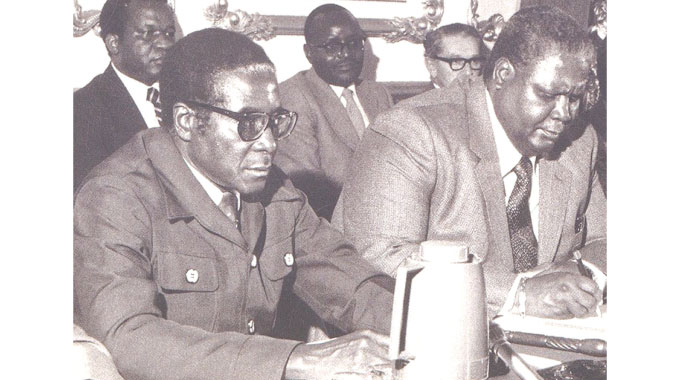
Bongani Ndlovu, Chronicle Reporter
THE late Advocate Siwanda Kennedy Mbuso Siba was instrumental in negotiating the Lancaster House agreement that brought independendance to Zimbabwe and the 1987 Unity Accord that brought peace to the country.
Adv Sibanda died in South Africa on December 22 after a long illness and was buried at West Park Cemetery in Johannesburg on Thursday.
In his condolence message to the Sibanda family, President Mnangagwa pointed out that he worked closely with Adv Sibanda, who was representing Zapu during the Lancaster House Agreement.
“I had the privilege of working closely with the late Advocate Sibanda who was part of the Patriotic Front legal team as we put together the framework for the Lancaster House Agreement, which enabled political settlement and delivered our national independence in 1980 after a protracted war for our national independence,” said the President.
“He was a fine legal mind who knew how to use his legal skills towards the defence of captured cadres and detained nationalists thus furthering the ideals of our National Liberation Struggle.”
During the Zimbabwean liberation struggle, Adv Sibanda was one of the few lawyers that dedicated their lives to defending political prisoners.
He participated in the formation of a Special Committee for the Defence of Political Prisoners working with Reverend Stephen Manguni in tracing and finding of arrested political “offenders” and guerrillas, to provide them with legal services.
This is contained in Sibanda’s detailed auto-biography, which has been published in his website, atributetoskmsibanda.com.
At a time when the white minority regime was using the law as a tool by which to oppress African people, Adv Sibanda was instrumental in helping the people to access and relate to the prescripts of the law and at the same time translated the grievances of the people into the law; thus, using the law as a tool and a weapon against injustice and oppression.
After independence, Zimbabwe went through a dark period, the Gukurahundi era and again Adv Sibanda was roped in, this time with Zimbabwe’s first head of state, the late Canaan Banana in coming up with the Unity Accord.
“Worked with Former President Banana in establishing the talks that led to the cessation of fire during the Gukurahundi era and ultimately the Unity Accord between Zapu and Zanu-PF,” read part of Adv Sibanda’s biography.
Adv Sibanda, affectionately known as “SK” or “SKM” was born on April 19, 1932 and grew up in Somnene, Bulilima-Mangwe in Zimbabwe.
He was the son of successful farmers, Jack Mbuso Sibanda and Volo Sibanda (nee Gumbo).
As the eldest of six children, he was raised to be responsible not just for himself but for his siblings as well. This was a trait that he would continue to exhibit throughout his life, which aspect was not only showcased in his family but also his community.
He was raised as a member of the Seventh Day Adventist Church,” read his bio.
Adv Sibanda attended primary school at Tshabanda Primary School and Solusi Mission. He would later be conferred with an Honorary Doctor of Laws by Solusi University.
From a young age, his educational potential was identified by teachers and mentors who facilitated the opportunity for him to attain a better education in South Africa.
Adv Sibanda was to ultimately enrol at Kilnerton Institute in Pretoria where he attained his matric in 1958. Thereafter, he moved to Durban and obtained a Bachelor of Arts from the University of Natal (1960-63).
While studying, Adv Sibanda worked at various companies to fund his education, for example working as a switchboard operator at the Monte Carlo, a driving instructor and a travelling biscuit salesman.
Despite the ups and downs including ill-health, sometimes resulting in hospitalisation and missing lectures, Adv Sibanda never lost sight of his dream, to graduate as a lawyer.
After graduating, Adv Sibanda did his articles in Durban at Bugwandeen and Company. He remained in Durban until 1971, after which he returned to his home country, then Rhodesia.
Despite the challenges posed by the Land Apportionment Act, prohibiting Black people from setting up business within the city precincts, Adv Sibanda was one of the first black advocates to set up Chambers in Matabeleland.
This practice was to later lay the foundations for Advocate SKM Sibanda and Partners, alternatively referred to as the People’s Law Firm, in some circles.
After Adv Sibanda’s admission as an Advocate of the High Court of Rhodesia, in 1971, he established an African Bar Association and served as founding member and chairman of the said association.
Due to white attorneys not briefing Black Advocates and setting racially prejudicial fees, Adv Sibanda pushed for the enactment of the Designated Advocates’ Act (1976) thus giving Advocates direct access to their clients.
Adv Sibanda was instrumental in changing the post-independence legal landscape, continuing to grow his legal practice whilst opening doors for many other lawyers who would go on to establish their own careers and firms. His practice survives him and continues to be a mainstay of Bulawayo’s legal fraternity.
Adv Sibanda was called to the bench in 1995 where he served as a Judge of the High Court of Zimbabwe and again contributed greatly to the legal profession and interpretation of laws.
After his retirement from the bench, he returned to private practice where he continued to provide legal services until his health made it no longer possible for him to continue to function as a practising Advocate.
Beyond legal practice, Adv Sibanda was very active within the political arena. He abhorred injustice and inequality. From his student days he actively participated in the struggle against apartheid. He joined the Pan African Congress of Azania and worked alongside Steve Biko and Griffiths Mxenge in the student movement that would resist the racist policies of the South African government.
His political involvement continued after his return to Zimbabwe, fighting against the Rhodesian white minority government.
He joined Zapu and rose to the position of being one of the legal advisers for Zapu. It was in this capacity that he served as one of the drafters of the Lancaster House Constitution, which paved the way to Zimbabwe’s independence from white minority rule in 1980.
Adv Sibanda also loved sports, especially football, dabbling in amateur boxing as well as playing cricket and chess in his younger days.
His biggest influence in the field of sports was football where he chaired the Bulawayo Wanderers Football Club, which he later took over and transformed it into a modern-day team, which was to become known as the Eagles Football Team.
Above all, Adv Sibanda was a dedicated family man. In 1964, while still studying, he met and married Leonora Nomampondo Makalima, from Ntabankulu, Transkei, with whom he moved back to Zimbabwe in 1971. The Sibandas were blessed with four children, Sandiso (deceased), Sabelo, Silindiwe and Sanele; seven grandchildren and three great grandchildren.
— Follow on Twitter @bonganinkunzi



 Bongani Ndlovu