

 admin
admin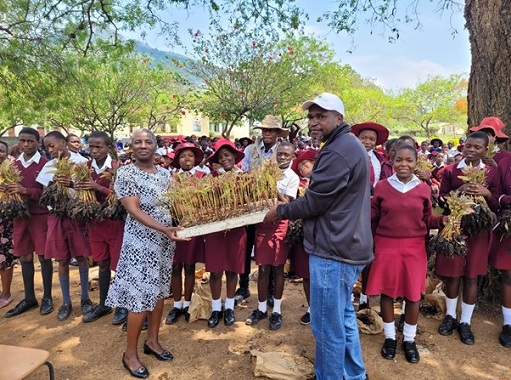
Edgar Vhera Agriculture Specialist Writer
THE Tobacco Research Board (TRB) has turned to its corporate social investment (CSI) portfolio to promote sustainable tobacco production in the face of climate change and deforestation, particularly in the tobacco-growing areas of Zimbabwe.
This comes on the backdrop of revelations that the country lost 9, 05 kilo-hectares of tree cover to tobacco curing activities in 2021.
In a speech read on his behalf by the board’s sales representative Aretha Rwafa at the inaugural handover and demonstration of gum tree planting at Odzi High School in Manicaland recently, TRB executive director business development and marketing, Mr Oswell Mharapara said the initiative would spread throughout the country.
“Tobacco producers require indigenous trees to cure tobacco. The Global Forest Watch (GFW) estimates that Zimbabwe lost 9, 05 kilo-hectares of tree cover in 2021. TRB wants to freely provide a hectare of gum tree seedlings (2 500 plantlets) and termite control chemicals to schools and farmers interested in the programme in the country’s tobacco-producing areas.
“Our contribution will help students gain practical experience in Agriculture, Geography and Science subjects related to afforestation, reforestation, soil erosion, and ecosystem management, among other things. The ultimate purpose of the CSI is to control the destruction of indigenous trees by tobacco growers through empowering learners. Schools partnering TRB in the woodlot initiatives will sell the products to tobacco growers, and retain the revenues for their use,” said Mr Mharapara.
The Government in 2021 came up with the tobacco value chain transformation plan (TVCTP), which seeks to achieve a US$5 billion industry by 2025 through sustainable intensification of tobacco production to 300 million kilogrammes. TRB is expected to play a crucial role for the successful execution of the plan.
“It is important for the nation to note that TRB is also seized with other sustainability projects, including research on tobacco curing solutions such as LPG, solar, bana grass and sawdust briquettes, electricity, among others with exotic tree species supplementing eucalyptus,” added Mr Mharapara.
Tree planting is mandatory for all tobacco growers, according to Statutory Instrument 116 of 2012, which requires farmers to plant a hectare of trees for every three hectares of tobacco they grown.
However, farmers are not much, which has prompted TRB to push farmers to comply with this requirement, hence its availing of trees to promote sustainable farming.
Odzi High School head Mrs Annie Padhuze welcomed the gesture saying it would go a long way in advancing children’s education as well as being a revenue earner for the school in future.
“We are grateful to TRB for remembering us at this time of the year. The planting and everyday maintenance of the gum tree will serve the dual purpose of children education and a source of future income inflows for the school.
“We plan to finish tree planting by end of next week, as children have little time to do so because they are busy writing examinations. Our students are surely going to get practical experience for agriculture and science in view of the climate change and human activities causing deforestation,” said Mrs Padhuze.
The school development committee (SDC) chair, Mr Soddie Muyambo commended TRB for its gesture saying it would enable the school to generate income from gum tree sales after the five-year maturity period and in future.
“This project will allow the school to get money from tree sales. Such money will be used to pay school fees for less privileged students to enable them to pursue their education without hindrance,” said Mr Muyambo.



 Online Reporter