Chronicle Editor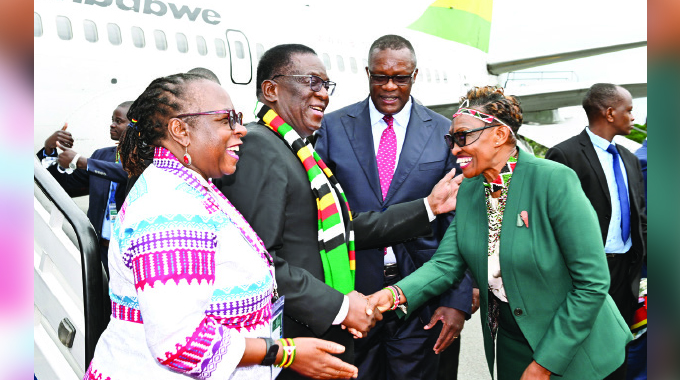
Zvamaida Murwira in Nairobi, Kenya
PRESIDENT Mnangagwa arrived in Nairobi yesterday to join other African leaders for the African Fertiliser and Soil Health Summit which is aimed at exploring ways to enhance fertiliser production and improve soil quality to ensure food security on the continent.
He was welcomed at Jomo Kenyatta International Airport by Zimbabwe’s Ambassador to Kenya, Ambassador Winipeg Moyo, Foreign Affairs and International Trade Minister, Frederick Shava, Secretary for Local Government and Public Works, Dr John Basera, senior Government officials from both Zimbabwe and Kenya.
The President was accompanied by Finance, Economic Development and Investment Promotion Minister, Professor Mthuli Ncube while Lands, Agriculture, Fisheries, Water and Rural Development Minister Dr Anxious Masuka was already in Kenya.
The summit will draw Heads of State and Governments from the continent and is being held following a decision by the African Union Assembly in February this year that there be such a meeting.
It is the second such Summit to be held at the continental level after the first one was held in Abuja, Nigeria in 2006.
The Summit is expected to come up with a 10-year Action Plan providing concrete steps to enhance fertiliser production and improve soil quality.
A meeting of African Ministers of Agriculture was held on Tuesday where Dr Masuka made a presentation outlining steps taken by Zimbabwe to improve its agriculture sector.
There was also a joint meeting of Ministers of Agriculture and Ministers of Foreign Affairs yesterday in which Minister Shava addressed his colleagues.
In his address, Minister Shava prefaced his presentation by expressing Zimbabwe’s condolences to Kenyan Government and its people for the tragic loss of more than 250 lives and the severe damage resulting from devastating floods.
He said the first Africa Fertiliser Summit held in Abuja, Nigeria in 2006, set an ambitious goal to increase fertiliser use and, consequently, agricultural productivity to address the associated challenges of food insecurity and poor incomes faced by smallholder farmers.
“Nevertheless, Africa’s fertiliser consumption per hectare has remained relatively low compared to the rest of the world. Many of our smallholder farmers still struggle with access to affordable, high-quality fertilisers, while soil degradation remains a pressing concern,” said Minister Shava.

“Despite the several challenges we face as a country which include climate change and illegal sanctions imposed on Zimbabwe, the country has made tremendous progress towards fulfilling the targets of the Abuja Declaration. On average, Zimbabwe uses 600 000 tonnes of basal and nitrogenous fertilisers annually on 3 to 3.5 million hectares. This development is mainly attributed to the Government’s commitment towards capacitating agricultural value chains, as it is the backbone of our economy.”
Minister Shava said agriculture is more powerful in reducing poverty than any other sector.
He chronicled efforts made by the Government to improve agriculture output, including the provision of seed, fertiliser, and agrochemicals to farmers participating in conservation farming practices such as the Pfumvudza/Intwasa Programme.
“This initiative is based on using a small land area and conservation agriculture principles to achieve higher returns, producing more on less and more from less. The programme has seen a three-fold increase in traditional grains yield and 2.5 times increase in communal maize yield, consequently adding to the nation’s food security thrust,” he said.
“However, climate change effects in the form of El Niño, negatively affected the 2023/2024 agricultural season in Zimbabwe, resulting in the country declaring a National State of Disaster. The decline in soil health has hindered agriculture productivity growth and compromised the health of natural ecosystems that affect lives and livelihoods. In this regard, that’s why the Government has adopted the sustainable Intensive Conservation Agriculture Model dubbed the Pfumvunza/Intwasa to reverse this trend.”
Minister Shava said Zimbabwe fully supported the recommendations contained in the draft declaration, to strengthen research and development on the utilisation of inorganic and organic fertilisers.
“In this regard, Zimbabwe supports the call to capacitate the Africa Centre for Fertiliser Development, as its mandate includes research in fertiliser and soil health issues. The Summit offers an opportunity to revitalise and strengthen the Centre and through it, support research and development of fertilisers in Africa. The Centre has a role to play in the implementation of the Ten-Year Africa Fertiliser and Soil Health Action Plan,” he said.
Minister Shava appealed to Member States who are yet to sign and ratify the Convention Establishing the Africa Centre for Fertilizer Development, to prioritise and consider doing so.
“The African Development Bank’s Africa Fertiliser Financing Mechanism should be supported to increase funding for fertiliser production on the continent and to assist more countries to produce fertilisers and its value chain. It is also important to promote and facilitate Public Private Partnerships in this area as it will result in huge benefits for our economies, and enhance local production of mineral fertilisers,” he said.



 Online Reporter