admin
admin
Ruth Butaumocho
African Agenda
On Monday women across the globe celebrated the International Women’s Day.
Running under the theme #ChooseToChallenge, most of the celebrations were held virtually owing to the effects of Covid-19.
Despite the pandemic, there was something to celebrate and smile about, after it appeared that more women are trickling out of the kitchen and taking up comfortable positions in huge boardrooms across the world.
However, the figures does not translate to the years of lobbying for gender equality.
In February, Africa scored a first when Nigerian Ngozi Okonjo-Iweala was elected the World Trade Organisation’s director-general.
She became the first woman and the first African to lead the 164-member organisation in the 73 years of the General Agreement on Tariffs and Trade (GATT), which later transformed to the World Trade Organisation.
Her feat does not only enhance Africa’s diplomatic profile, but it is also a validation of the competency and leadership skills of women in the continent.
While legions of African women might not achieve Okonjo-Iweala’s feat, they will be happier to be economically empowered and be able to feed their families while creating an economic pedestal for future generations.
Sadly that has not been possible among millions of women across Africa and beyond who continue to trail behind men and wallow in poverty because they cannot finance their projects.
Despite the avalanche of economic policies that strongly advocate the economic empowerment of women, the majority of them have not been able to access the means of production such as land, raw materials and machinery to finance their projects.
That probably explains why women still constitute the majority of the poor, although they provide labour in fields, factories and manufacturing plants, which they sadly do not own.
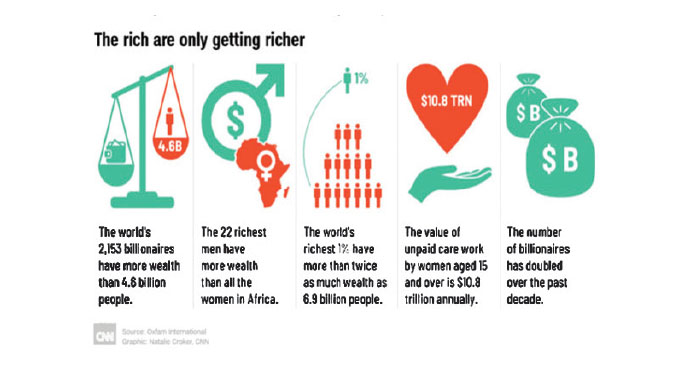
At the beginning of 2020, Oxfam released disturbing statistics on global economic disparities that showed that 22 of the world’s richest men now have more wealth than all women in Africa combined.
This is despite the fact that 52 percent of the continent’s population is made up of women.
According to Oxfam, the very top of the economic pyramid saw the tripling of trillions of dollars in the hands of a small group of people, predominantly men.
The report further noted that while men’s wealth is extreme, the global broken economy concentrates more wealth in their hands than anywhere else.
Back home the plight of women is no way better in Zimbabwe, where the financial inclusion gender gap between men and women has remained below 20 percent over the years.
Elsewhere across the continent women still struggle to get money to finance their projects despite the fact that they may be bankable enough to transform lives and communities if they are financed.
As we enter the women’s month, governments still have a responsibility to walk the talk and economically empower women by coming up with policies that promote and encourage tailor-made economic projects that respond to aspirations of women.
Over the years, several micro-financial schemes have been giving loans to women in groups, probably to reduce the rate of defaulting among borrowers.
Often, these were chicken-rearing, livestock, uniform-making and other equally peripheral projects that cannot be sustained, are ad hoc, and are usually seasonal and often oversubscribed.
As a result, most women ended up joining a group with diverse projects which they were often not passionate about, but did so in order to get financial assistance.
Often such projects failed to flourish, creating the impression that women lacked “business acumen”, forgetting that women with diverse interest undertook the projects within a group in a bid to secure funding.
The story that micro-finance schemes, financial institutions and national economic strategies should be pushing for is the promotion of home-grown solutions for communities, rather than rolling out blanket economic strategies which may not necessarily address the needs of specific populations.
A research by Duke University Department of Neuroscience Professors Grainne Fitzsimons, Aaron Kay, and Jae Yun Kim, published in the Journal of Personality and Social Psychology, shows that overemphasising messages of collective female empowerment diminish people’s sense of systemic obstacles that require societal redress.
Since communities are not a homogeneous group, it is critical for micro-finance schemes and financial institutions to respond to the needs of their communities through mentoring, market linkages, networking and start-up packs.
Both the Government and financial institutions should push for grassroots economic projects aligned to the specific needs of people.
Such projects should embrace diverse and unique projects such that even a woman in Kitsiyatota can be financed and be guided on a viable project of her choice without micro-finance schemes and financial institutions dishing out a template on what they deem as “viable projects” before looking at the needs and aspirations of that individual.
The existing empowerment initiatives should not continue to be institutionalised and remain elitist, but need to take their packages to communities where the majority of disadvantaged women and need to be economically empowered.
Once that has been achieved, Zimbabwe and Africa at large can change Oxfam’s narrative by focusing on the emerging female billionaires.


 Online Reporter