admin
admin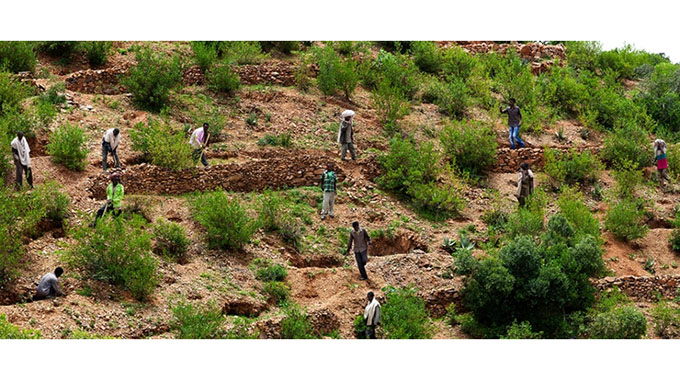
Ranga Mataire
Deputy Editor
Since the Earth Summit in Rio de Janeiro, Brazil in 1992, environmental issues have become topical the world over.
Sadly, it appears as though that since that summit the discourse on environmental conservation has been dominated by a “Euro-centred” worldview, which has yielded minimal results especially for people in the South.
This is so because the so-called “modern ways” of conserving the environment have over the years been recklessly imposed on people without consideration of the historical, cultural, social norms and context of individual communities.
Needless to say that this decontextualisation of environmental discourse has been the major deterrent in achieving effective biodiversity management.
What is biodiversity? Biodiversity is the shortened form of two words- biological and diversity. It refers to all the variety of life that can be found on Earth (plants, fungi and micro-organisms) as well as to the communities that they form and habitats in which they live.
The impression that is often given by outsiders particularly those from the West is that Africans lack knowledge of protecting their environment and need to be imparted with ways of managing their biodiversity. This kind of perception is fails to acknowledge the fact that Africans have always been masters of their environment well before European set foot on this continent.
It is common knowledge that before colonisation cases of stream bank cultivation, indiscriminate killing of animals and disposition of chemicals into water bodies were unheard of. Some might attribute this negligible impact to scarce human population but the truth is that there existed rules and taboos that governed how people lived in relation to their environment. The relation that existed between the people and their environment formed the basis of how they defined themselves from other communities and indeed formed their daily interactions.
In Media, Culture and Development Vol 1, Professor Lovemore Mbigi says: “African collective identity can be defined as I am because we are. Our traditional culture embraces caring, harmony and humanity. This is our gift to the world.”
The coming of white settlers forced many native inhabitants to be relegated to unfertile and barren lands. People started competing for the scarce resources that existed in those areas. After this displacement, indigenous people, out of economic necessity were forced to sell not only their labour but also aspects of their culture. In so doing, some aspects of indigenous knowledge structures were disrupted and the concept of matongo-ancestral attachment was adversely affected since there was no longer some spiritual attachment in the environment they found themselves in.
Another concept which was equally important in biodiversity management is that of mutupo (totem). The totem formed the basis of interaction or socialisation and because most if not all totems come from names of organisms in the ecosystem, it meant a special attachment to that environment. A good example is that people of the “nzou” totem were not allowed to kill or consume its flesh while animals like pangolins were either left roaming in the wild or occasionally captured alive and brought before the King as “mupiro” — gift. This ensured their continued existence without extinction.
It was taboo for anyone to cut trees like “mukute” found in the river banks or “mubani’’— veld. Mukute trees were and are believed to be sources and preservers of water. This prevented siltation of rivers, which have threatened the life fish, a totem of other people and subsequently could also have affected the livelihoods of everyone given the importance of water in sustaining life in general.
Another important concept that ensured the preservation of biodiversity was the concept of “mashura”, which instilled fear in people by identifying and labelling certain places, mountains, hills and caves as sacred. One could only tread, hunt or cut tress in such areas after consultations with the spirit mediums of the area. While indeed such places were sacred, the concept also worked exceptionally well in preserving the flora and fauna in such areas.
What has happened to all these indigenous ways of living that worked in ensuring the preservation of the environment? With the coming of white settlers, the relationship that existed between people and their environment was denigrated and discredited as superstition and nonsensical. The problem we currently have is that environmental experts think that the only way to preserve the environment or manage our biodiversity is through the enactment of strict laws. The environment expert assumes that he/she is the “knowledgeable” who everyone must submit to his or her academic authority.
The main problem with most environmental experts is their complacency and tendency to use a linear perspective approach which involves the “knowledgeable” sender and the “ignorant” receiver. They expect people particularly those in rural areas to meekly consume everything they say. They fail to realise that people have inbuilt systems of resisting total submission to change and when resisted they are quick to label the African an ignorant and uncaring human being.
In order to understand how Euro-centred ways of conservation have failed, we need to cite as examples some aspects of indigenous farming that were once frowned upon but are now being encouraged.
Intercropping was initially discouraged not because there was something fundamentally wrong with it, but I would like to be it was because of its African orientation. Backyard manure was also not very much encouraged but I think the advent of the “madcow” disease awakened people to the dangers of artificial feeds and fertilizers.
Even rotational farming, which is being ‘nicely’ packed and exported to Zimbabwe as a new farming method has always existence since time immemorial. I am not in any way suggesting that we must not appropriate foreign methods of farming if they are applicable to our environment, climate and soils. However, it is always critical to understand that Africans have always lived on their land before the coming of white settlers and they are best suited to know what is most appropriate in terms of conserving their environs.
It is without doubt that Africa or Zimbabwe’s own efforts will form the basis of any development. Instead of apportioning blame to indigenes, we need to consider putting in context other factors that negatively impact our biodiversity. These include the restrictive land tenure system, erosion of cultural values and lack of communal approach to biodiversity issues.
In the final analysis, what Zimbabwe probably needs are socially conscious communicators who are prepared to speak with compatriots as equals and be able to appreciate their concerns and interests. Environment experts should not pooh-pooh on indigenous knowledge system but be able to learn from it for mutual development and protection of our biodiversity.
An African agenda must be spelt out and conscientiously implemented in biodiversity management.


 Online Reporter