Online Reporter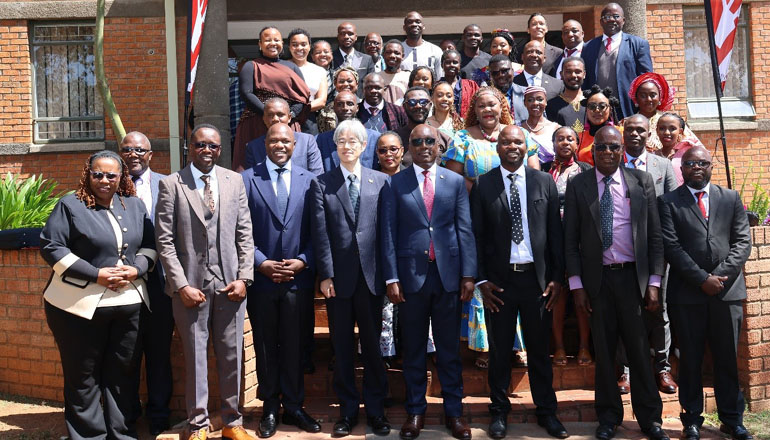
Lloyd Makonya
Correspondent
FOR 18 years, a partnership between the African Regional Intellectual Property Organisation (ARIPO), the World Intellectual Property Organisation (WIPO), Africa University and the Government of Japan has been quietly building something Africa will need in increasing measure if it is to transform its knowledge and creativity into economic power, a generation of intellectual property professionals.
Recently, that investment entered its 19th chapter when Africa University launched the 19th cohort of its Master in Intellectual Property programme. Beneath the ceremonial launch, speeches and welcoming of another group of postgraduate students was a much bigger conversation about Africa’s economic future.
It was a conversation about whether the continent can move beyond being predominantly a consumer of knowledge, technology and innovation to becoming a creator, owner and commercialiser of its own ideas.
The MIP programme has continued to expand its African footprint, with the latest cohort bringing together 11 nationalities, demonstrating the growing reach of intellectual property education across the continent. For a discipline once regarded largely as a specialised field for lawyers and patent practitioners, this expansion is significant.
Intellectual property is increasingly moving into the centre of conversations about innovation, industrialisation, entrepreneurship, technology, creative industries, cultural heritage and economic development. Speaking at the launch, Minister of State for Manicaland Provincial Affairs and Devolution, Advocate Misheck Mugadza, in a speech read on his behalf by a director in his office, Mr Past Tense Tarondwa, said intellectual property was an important component of Zimbabwe’s development agenda.
“As the country pursues its ambition of becoming an upper-middle-income economy, Zimbabwe must protect its knowledge economy, ideas and innovations,” he said.
Minister Mugadza also linked intellectual property to Zimbabwe’s heritage-based development philosophy, emphasising the need for collaboration among Government, academic and research institutions and communities.
“Let us create an environment where an idea generated in the classroom sees the light of day,” he said.
That may have been one of the most important messages from the launch. For an idea to see the light of day, however, it needs more than inspiration. It needs a system. A researcher may develop a potentially transformative technology, a university student may devise a solution to a local problem, an entrepreneur may build a distinctive product or brand, while a community may possess generations of knowledge about food, medicine, agriculture, crafts or cultural expressions. Without knowledge of intellectual property, many of those assets can remain vulnerable, invisible or commercially underdeveloped.
This is where the MIP programme assumes a much bigger role than simply producing graduates. It is helping to create a professional ecosystem capable of understanding the relationship between ideas and economic value.
Mr Victor Owade, Counsellor, Academic Institutions and Executive Programmes at the WIPO Academy, described intellectual property as a bridge between ideas, creativity and opportunity, while highlighting the contribution of the programme towards building IP capacity among Africans.
The global economy is increasingly rewarding intangible assets such as technology, software, data, brands, designs, research and development, creative works and other forms of intellectual capital. WIPO’s latest analysis shows that investment in intangible assets across the economies covered by its study surpassed US$10 trillion in 2025, underlining how profoundly the global economy is shifting towards knowledge and intangible value. For Africa, the implication is clear, the continent cannot afford to be merely a market for other people’s ideas.
Africa University Deputy Vice-Chancellor, Professor Dr Engineer Talon Garikayi, put the challenge more directly when he urged the incoming cohort and the wider university community to move beyond being predominantly consumers of knowledge, technology and innovation and increasingly become creators.
Prominent IP attorney, Mr Moses Nkomo, himself an alumnus of the Africa University MIP programme, argued that Africa’s greatest resource is its intellectual capital.
For too long, he suggested, intellectual property has been treated as a conversation for lawyers and specialists.
He said: “It should not be an elitist discipline, but a development tool.”
His challenge was particularly relevant to communities and entrepreneurs whose ideas may never pass through a traditional corporate or legal environment. If intellectual property is to contribute meaningfully to development, knowledge of it must reach innovators, farmers, researchers, students, creatives and communities.
An idea that remains permanently on paper may have intellectual value, but it has not yet reached its full developmental potential. Countries such as South Korea, where investment in knowledge, innovation, research and industrial capability has been closely connected to economic transformation should provide case studies to learn from.
The lesson for Africa is not necessarily to reproduce another country’s development journey, but to recognise the importance of building institutions and systems that enable ideas to travel from the classroom and laboratory into the marketplace. That journey is becoming even more complicated and more urgent with the rapid emergence of artificial intelligence.
ARIPO Director General, Mr Bemanya Twebaze, told the gathering that the organisation’s support for the development of IP professionals should be understood as an investment in Africa’s ideas.
Africa’s future, he said, will be shaped by the ideas in the minds of its people, with intellectual property increasingly touching everyday life, from health to the digital economy.
He also issued a warning that could not have been more timely. The task of spreading intellectual property awareness is becoming more urgent because of AI, which presents Africa with both a risk and an opportunity. The risk is familiar as Africa could once again find itself predominantly consuming technologies developed elsewhere. The opportunity is more exciting as African innovators can use AI to create solutions to African problems and build new enterprises, provided they understand the importance of ownership, protection and commercialisation.
That makes the decision by Africa University to introduce basic intellectual property knowledge to undergraduate students particularly significant. The MIP programme can produce specialists, but an IP-literate university can produce something broader, a generation of graduates in different disciplines who understand from the beginning that their ideas have value. That is how intellectual property moves from being a specialist subject to becoming part of the culture of innovation.
Japan’s contribution to that process also deserves recognition. Representing the Japanese Ambassador to Zimbabwe at the launch, Counsellor Mr Tetsuya Murakami reaffirmed Japan’s commitment to strengthening intellectual property systems in Africa through support for high-quality IP education. Japan’s involvement in the programme is important because capacity building is one of the less visible but most consequential aspects of development.
The students entering the programme are doing so at a moment when Africa is simultaneously trying to industrialise, digitise its economies, commercialise research, strengthen creative industries and derive greater value from its natural, cultural and intellectual resources.
Meanwhile later this year, ARIPO is celebrating 50 years of regional intellectual property cooperation under the theme: ‘Fostering innovation, creativity and a sustainable future for Africa.’
The Golden Jubilee year will culminate in Lusaka, Zambia, in December with the IP Africa Conference at the Mulungushi International Conference Centre.
As ARIPO looks back at five decades of building Africa’s regional IP architecture, the Africa University MIP programme is helping build another essential component of that architecture, the human capital required to make the system work.
Ends