Online Reporter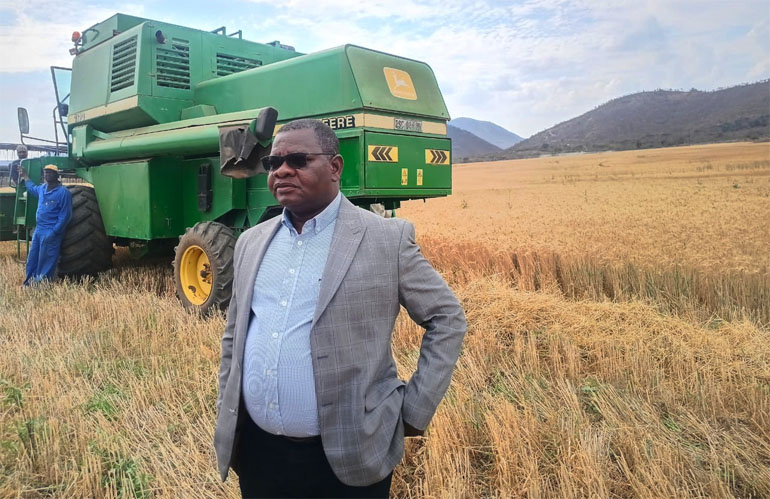
Lovemore Kadzura
Post Reporter
A RECORD-BREAKING wheat harvest is on the horizon for Manicaland, with the province expected to produce 75 000 metric tonnes this season, enough to achieve wheat self-sufficiency, while contributing significantly to national food security and strategic grain reserves.
The anticipated bumper harvest follows a successful winter cropping season underpinned by Government support programmes, expanded hectarage, improved financing arrangements and favourable yields across both commercial farms and irrigation schemes.
Farmers planted a record 16 300 hectares of wheat this year, an increase from the 15 000 hectares planted last season.
Funding was largely provided through the Presidential Inputs Programme (PIP), commercial banks, the Food Crop Contractors Association and self-financing farmers.
To facilitate timely harvesting, 20 combine harvesters have already been deployed across the province, while a further 11 machines are undergoing servicing and repairs. Most of the harvesters belong to AFC Leasing Company, although some private farmers are also hiring out equipment to neighbouring producers.
Hiring charges range between US$120 and US$150 per hectare, depending on the service provider. The Department of Mechanisation under the Ministry of Agriculture, Mechanisation and Water Resources Development coordinated the deployment of harvesting equipment to ensure smooth operations.
Encouragingly, high yields are being recorded across the province, with commercial farmers and irrigation schemes averaging between seven and nine tonnes per hectare.
Some smallholder farmers utilising vleis are also achieving yields of at least two tonnes per hectare. The strong performance has largely been attributed to Government interventions designed to boost wheat production, reduce imports, strengthen national grain reserves and conserve foreign currency.
More than 70 percent of the planted area was supported through the Presidential Inputs Programme, under which beneficiaries received free inputs worth approximately US$700 per hectare, including seed, Compound D fertiliser, Ammonium Nitrate and crop protection chemicals for up to seven hectares.
The Agriculture and Rural Development Authority (ARDA) also supported several irrigation schemes as part of Government efforts to transform them into wheat-producing greenbelts. Speaking during a tour of Greater Sisal Farm on the outskirts of Mutare on Tuesday, Permanent Secretary in the Ministry of Agriculture, Mechanisation and Water Resources Development, Professor Obert Jiri, said the season had progressed smoothly due to the timely provision of inputs and improved payment systems.
“We have now come to the end of the winter wheat season and are assessing harvesting progress across provinces. Farmers in Manicaland planted more than 16 000 hectares, which is a record for the province. We expect all harvesting to be completed by the end of October before the onset of the rains,” said Professor Jiri.
He said adequate harvesting equipment had been deployed and encouraged farmers to remain organised within wheat production clusters to maximise efficiency.
Professor Jiri also applauded improvements in the payment system for grain deliveries, saying Government remained committed to ensuring farmers receive their money promptly.
“The promise from Government is to ensure farmers are paid as quickly as they make deliveries. Working together with Treasury, we expect to fulfil that commitment,” he said.
He announced that the producer price for wheat has been set at US$532 per tonne, a development expected to further incentivise production. Professor Jiri urged farmers who benefited from the Presidential Inputs Programme and ARDA support to deliver their wheat to the Grain Marketing Board (GMB), while contracted farmers should honour agreements with their respective contractors.
He said the recently commissioned smart silos would play a critical role in post-harvest management by drying, fumigating and safely storing grain. “The smart silos are able to dry the wheat and correct moisture levels. Farmers should not worry if moisture content is slightly above the recommended threshold, as the silos are designed to handle that and ensure safe storage,” he said. At Greater Sisal Farm, general manager, Mr Tavonga Guda, said preparations for harvesting were almost complete, with the farm expecting above-average yields. “We planted 140 hectares of wheat this season and expect yields of about 7,5 tonnes per hectare. The crop quality is good, and harvesting should begin within a week once moisture levels fall further,” he said.
Minister of State for Manicaland Provincial Affairs and Devolution, Advocate Misheck Mugadza, said the projected record harvest reflects the success of policies introduced by President Mnangagwa to strengthen food production and climate resilience.
“The winter wheat season went well and we expect to harvest more than 75 000 metric tonnes. This means the silos commissioned by President Mnangagwa will be adequately stocked. This is particularly important as we prepare for the possibility of an El Niño-induced drought,” he said.
Minister Mugadza said the province had already put in place mitigation measures, including expanded irrigation and the promotion of traditional grains, to safeguard food security.