Raymond Jaravaza, [email protected]
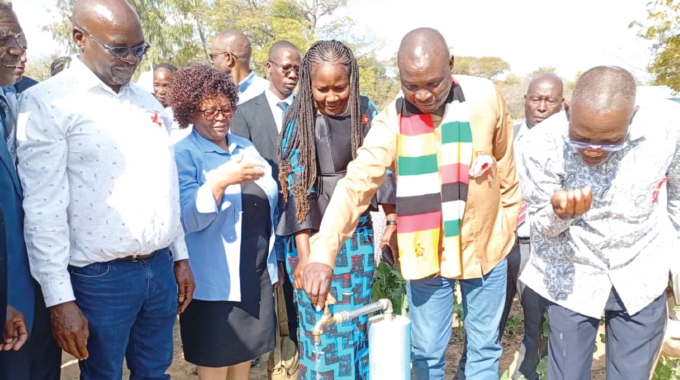
AFTER more than seven decades of relying on streams and boreholes for water, Malunku Primary School in Lupane District has entered a new era following the commissioning of a piped water system and a fully furnished classroom block, bringing hope to learners, teachers and the surrounding community.
The milestone project, commissioned by Government on Monday, also includes a nutrition garden that will enhance school feeding, provide practical agricultural lessons and generate income through the sale of vegetables to surrounding communities.
Constructed at a total cost of US$72 230, the project was funded and implemented through a partnership involving
Government, World Vision, the Mabhikwa Area Development Programme and Kusile Rural District Council.
Since the school was established in the 1950s, learners and teachers depended on water fetched from nearby streams and community boreholes in the semi-arid district, where prolonged droughts and the effects of climate change have made access to safe water increasingly difficult.
The absence of reliable water also meant the school could not establish a nutrition garden, while pupils often shared water sources with livestock.
Villagers described the commissioning of the piped water system as the fulfilment of a dream many had believed would never become reality.
“I never thought I would live to see the day when our children would drink water from taps here at Malunku Primary School,” said villager Mr Nqobile Ntini.
“For years, parents and villagers tried to find ways of bringing water to the school, but we were always told the area was too dry to sustain a borehole that could serve both the school and the community.”
Another villager, Mrs Prudence Malunga, said before the project was completed, learners were required to bring water from home each day for drinking and hygiene purposes.
“This part of Lupane is very hot, so every child was expected to carry a bottle of water to school. Some of the younger children ended up fetching water from unsafe streams where cattle and donkeys also drink just so they could comply with the requirement,” she said.
Mrs Malunga said the availability of clean running water would also improve staff retention.
“We hope teachers will now stay longer because they no longer have to fetch water from community boreholes and streams,” she said.
Mrs Malunga said the school’s nutrition garden would transform livelihoods in the area.
“For the first time, Malunku Primary School has a thriving nutrition garden in an area where even villagers struggle to grow vegetables. We can now buy fresh produce from the school while helping it raise money for other development projects,” she said.
Commissioning the facilities, the Minister of State for Matabeleland North Provincial Affairs and Devolution, Richard Moyo, said the project demonstrates the power of partnerships in accelerating rural development.
“These projects are a clear demonstration of what can be achieved through collaboration, commitment to community and shared development,” he said.
“The piped water system, valued at US$42 230, was funded by World Vision through its partner Ferrovial of Spain, while the fully furnished classroom block, valued at US$30 000, was financed by World Vision Spain through the Mabhikwa Area Development Programme.”
Minister Moyo said the investment reflects the Second Republic’s commitment to ensuring no child or community is left behind in the country’s inclusive development agenda.
“The new classroom block will significantly reduce overcrowding and create a learning environment that promotes effective teaching, improved learner participation and better academic performance,” he said.
“Our expectation is that this investment will translate into improved pass rates, enhanced teacher morale and learners who are motivated to attend school and perform to the best of their abilities.”
The minister challenged the school community to complement the improved infrastructure with better academic performance.
“Improved facilities must now be matched by greater commitment from school leadership, teachers, parents and learners alike. With these improved learning conditions, we expect nothing less than a 50 percent pass rate in 2026 and this is an achievable target if everyone plays their part,” said Minister Moyo.
Malunku Primary School headmaster Mr Bhekubuhle Dlodlo said the institution now has five classroom blocks catering for learners from Early Childhood Development (ECD) to Grade Seven.
“We are particularly excited that all our learners are now accommodated in proper classrooms, while the reliable water supply will enable us to sustain our nutrition garden,” he said.
“Our long-term vision is to increase the number of classroom blocks to 10 so that we can enrol more learners from surrounding communities.”
Last year, the school recorded a 22 percent pass rate, an improvement from 16 percent in 2022 and school authorities believe the new infrastructure will help drive further academic progress while improving teacher retention and learner attendance.