admin
admin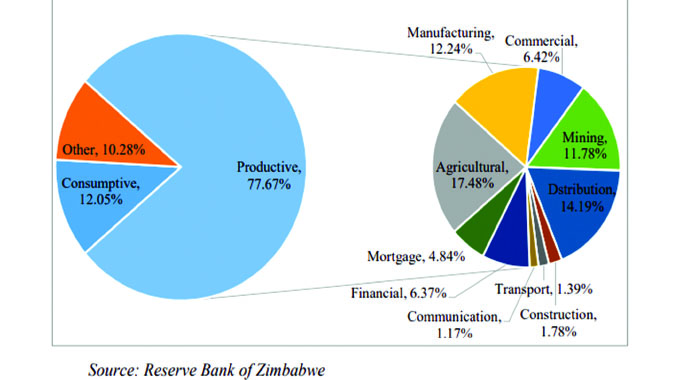
Michael Tome Business Reporter
AGRICULTURE and manufacturing dominated sectorial distribution of loans in the first six months of 2023, as players moved to ramp up capacity utilisation in key productive sectors of the economy.
Loans acquired by the productive sectors have mainly been directed towards the import of key raw materials, plant equipment, and machinery required for use by the local industry.
In the half-year period to June 2023 aggregate banking sector loans and advances totaled $10, 19 trillion an eight fold increase from $1, 29 trillion as at December 31, 2022.
According to the Reserve Bank of Zimbabwe (RBZ) the increase in loan uptakes is largely credited to an increase in foreign currency-denominated loans, which constituted 94 percent of the sector’s loan book.
At 17, 48 percent, the agriculture sector was the main recipient of banking sector loans and advances followed by the manufacturing sector which received 12, 24 percent while the mining sector got 11, 78 percent.Distribution sector was the other notable segment to receive the advances, receiving 14, 19 percent of the total loans.
Loans provide businesses and industries with the necessary capital to invest in productive assets such as machinery, equipment, technology, and infrastructure.
In total, productive sectors received 77, 67 percent of total loans and advances, while the consumptive segment received 12, 05 percent of the total loans.
Other notable areas which were allotted funds include the commercial segment at 6, 42 percent, financial 6, 37 percent, mortgage 4, 84 percent, construction 1, 78 percent, transport 1, 39 percent and communication 1, 17 percent.
Loans to the Medium Small to Medium Enterprises (MSMEs) accounted for 3, 87 percent of total banking sector loans disbursed in the first quarter while the second quarter accounted for 4, 58 percent.
Number of loans extended to MSMEs cumulatively stood at 34 469 in the first six months of 2023.
“The banking institutions continued to contribute to economic recovery and growth by channeling resources to the productive sectors of the economy. The loans to the productive sectors constituted 77, 67 percent of total loans as at 30 June 2023,” said RBZ Governor Dr John Mangudya in the mid-term monetary policy statement.
When companies and individuals have access to credit, they are able to enhance capacity utilisation, increase output, and foster economic growth.
In addition, credit can help companies expand and hire more workers, which can also contribute to economic growth.
Economist, Mr Eddie Cross noted that growth in the allocation of loans and advances to productive sectors signposted to growth in the basic productive sectors in the local economy.
“Growth in loans and advances to productive sector bring support to the local industry, Zimbabwe’s economy is growing and people are starting to invest in productive activities so I think it is a very encouraging indicator, that supported by other foreign exchange through the auction system, whose 70 percent is going to raw materials and machinery, all point to growth,” said Mr Cross
SME Association of Zimbabwe chief executive Farai Mutambanengwe alluded that the growing allocation of loans to the productive sectors of the economy was generally a positive trend for economic growth.
But however, indicated that the affinity for loans particularly in US dollar terms was being driven by favorable interest rates associated with accessing loans.
“Generally it is a good sign that most of the loans are finding their way into the productive sectors as this helps companies to expand capacity.
“However loan seekers are looking more at USD-denominated loans given that Zimbabwe Dollar is too expensive to borrow, the rates are running at 75 percent for the productive sector and 150 percent for everyone else, so if you look at the current inflation profile, those interest rates are too high, you would rather borrow in US dollars at an average rate of about 10 percent per annum,” said Mr Mutambanengwe.
Loans to productive sectors can assist businesses in developing export capabilities and entering international markets. By expanding export capacity, countries can generate foreign exchange earnings and reduce trade deficits, promoting economic stability.



 Online Reporter