Online Reporter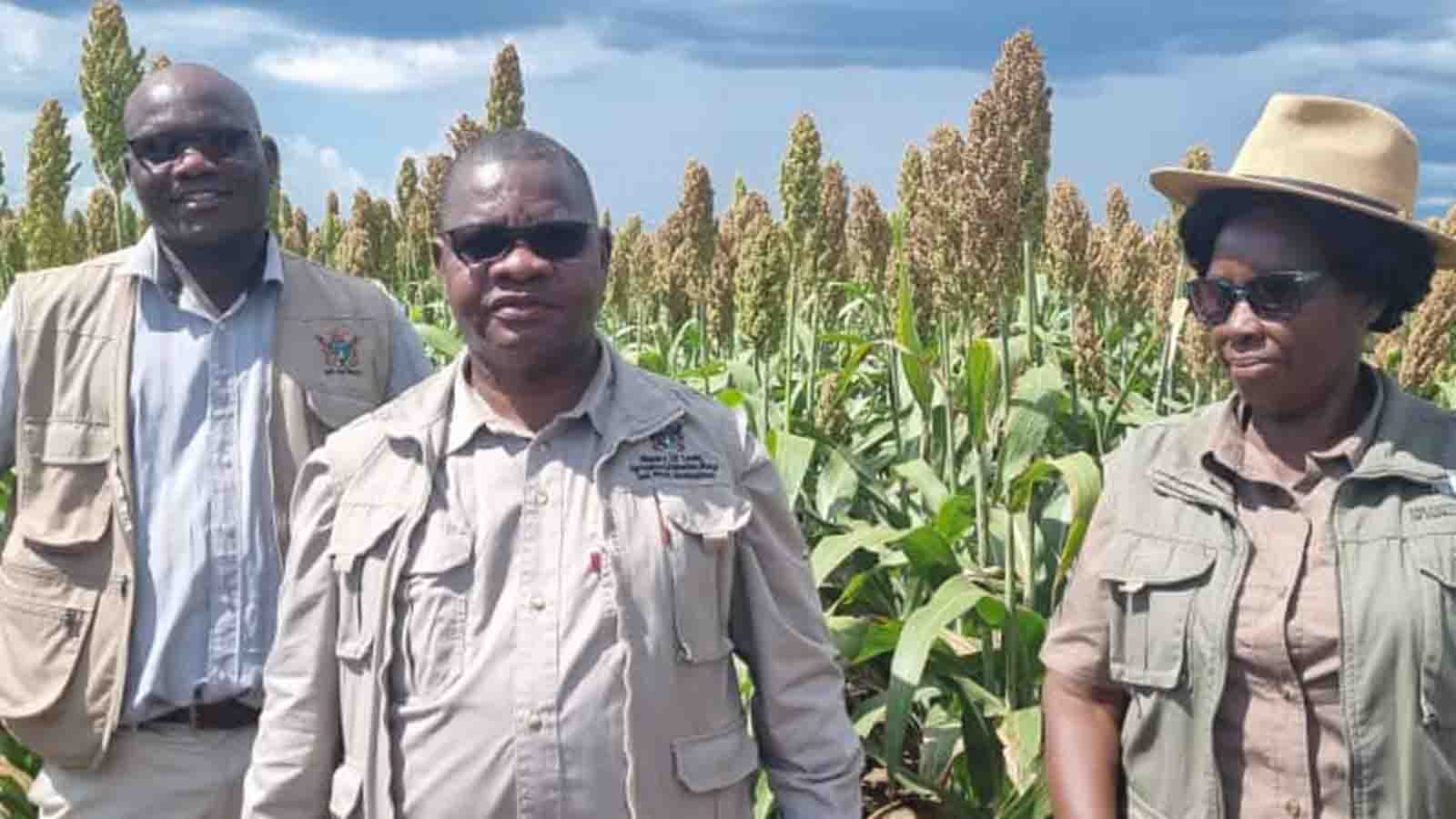
Nyasha Simbisai
Agriculture Correspondent
The Government’s multi-layered food security strategy, anchored on agro-ecological tailoring and irrigation development, is yielding visible results at both household and national levels, Permanent Secretary for Lands, Agriculture, Fisheries, Water and Rural Development Obert Jiri has said.
Speaking during a crop assessment visit in Umguza District, Matabeleland North Province, Prof Jiri said food security must be understood at the household and national levels.
“We look at food security at two levels. First is household food security, which must be achieved through agro-ecological tailoring — choosing the right crop for the right area. That ensures food security at the household level.
“At the upper scale, we then secure national food security through irrigation development at scale. From household production, we move to village level through Village Business Units, to community irrigation schemes, and ultimately to large-scale national irrigation development,” he said.
Prof Jiri emphasised that agro-ecological matching, growing crops suited to specific natural regions, remained central to building climate resilience.
He said the integration of conservation agriculture programming, application of manure, use of lime to correct soil acidity and proper basal fertiliser application, combined with correct crop selection, was proving effective even under erratic rainfall patterns.
“When you combine agroforestry programming, application of manure, application of lime and putting the right crop for the area, you get good results. Even in a mid-season drought, crops remain strong because of these practices,” he said.
The Government has been encouraging farmers in natural regions IV and V to prioritise traditional grains such as sorghum and millet, which are better adapted to low rainfall conditions.
In natural region III, traditional grains remain a reliable option due to variable rainfall, while farmers in regions I and II may grow maize under favourable conditions, alongside diversification into small grains where necessary.
“The value of agro-ecological tailoring and matching cannot be underestimated. We must align our agro-ecological regions to our crops,” Prof Jiri said.
The success of the approach is already evident among farmers in Umguza.
Farmer, Ms Ottie Mpofu (63), who is in her fourth year of practising Pfumvudza/Intwasa conservation agriculture, said the climate-smart model had transformed her household food security.
“I have seven plots, three under traditional grains; red and white sorghum and four under maize. Last year I harvested enough cereal for my family, neighbours and friends,” she said.
Ms Mpofu began potholing in August last year in preparation for the 2025/26 season, applying lime, organic manure and Compound D fertiliser before planting.
“The crops are growing very well,” she said, adding that the Pfumvudza model had strengthened her resilience against mid-season dry spells.
The Pfumvudza/Intwasa programme, championed under the Second Republic’s rural transformation drive, promotes minimum tillage, soil fertility enhancement and moisture conservation as key pillars of climate-smart agriculture.
As the Government scales up irrigation infrastructure nationwide while strengthening household-level climate-smart production systems, the layered strategy from household plots to national irrigation schemes continues to reinforce Zimbabwe’s pathway toward sustainable food security and agricultural transformation.