
Agroforestry, the best approach to establish indigenous trees in communities

Mahlabezulu Zulu

INDIGENOUS trees, due to their adaptive nature, have survived in different parts of the country which have different soil and climatic conditions.

It is unfortunate that some of them are preferred by herbivorous animals reared in communities, for example, the acacia/amawohlo/muzunga or mugowo tree whose leaves and pods are a delicacy to most livestock as they contain both calcium and protein. Growing such trees also improves soil fertility as they fix nitrogen into the soil promoting growth of  other plants. Besides being livestock feed, some trees like white syringa/ivimila/vimila and pod mahogany/umkamba/mukamba popular for craft making, and others like sjambok tree/isihaqa/muremberembe and violet tree/umfumfu/mufufu which are well known for their medicinal purposes whose continuous appearance in communities is a cliff hanger as their use involves human survival.

It’s good, Zimbabwe declared the first Saturday of each December as The National Tree Planting Day. On this special day, trees are planted countrywide to promote re-afforestation and afforestation. Deforestation activities have negative environmental repercussions, like soil erosion, destruction of plant pollinators including crops grown by the community as well as destruction of habitats of small game. In relation to re-afforestation and afforestation in communities, the following questions arise on the success or failures of such tree growing programs in communities: Are communities aware of rare or extinct indigenous tree species because of their demand?  Do indigenous tree growing approaches done by the Government through its arms like Forestry Commission, and non-governmental organisations involve continuous participation of community members for the survival of planted trees? Most tree planting activities have been undertaken in rural communities in the country with indigenous tree survival being perceived, and rated to have high chances because of sparsely populated human settlements, high usage of indigenous trees and the value of such trees in rural communities.
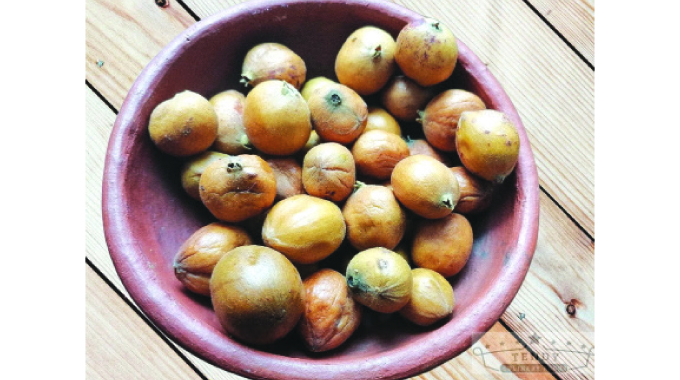
Velvet wild meddler/umviyo/munzviro

Indigenous tree planting, and care requires some form of motivation for communities involved. One of the characteristics of indigenous trees is that they take a longer period to grow, and this sometimes “erodes” the patience of those who are supposed to take care of them despite the fact of them being aware of both short and long-term benefits like prevention of soil erosion,  wind breaks,  edible components for humans and livestock. Food insecurity has always been a global priority, with most rural communities practising subsistence farming facing challenges as their farming practices rely on rains which are sometimes erratic. Due to climate change, which leads to drought and poor crop harvests, communities are forced to rely on products from such natural resources, indigenous fruit trees like monkey orange/umhlali/matamba/, brown ivory/umnyi/nyii and chocolate berry/ umtshwankela/mutsubvu or traditional African spinach/imbuya/mowa, spider plant/ulude/ nyevhe/  and bush okra/idelele/derere    which are very nutritious, and perform  well despite drought conditions. Some fruit trees fail to produce due to lack of certain pollinators like insects or birds whose habitats were destroyed by the community.

Indigenous trees planted at learning institutions like schools, colleges and universities become part of the curriculum offered, for example, agriculture or forestry studies. Students will always have hands-on activities like watering or manuring them which will ensure their survival. 

Community members have always responded well when self-help projects like gardening, crafts making or poultry rearing projects are introduced as these tend to have immediate and tangible benefits. It’s good that, during the establishment of such projects like gardening projects, well-wishers sometimes donate material like fencing material, and sometimes drill boreholes towards the establishment of such projects.  

However, communities need to change approaches towards establishment of such environment saving community related programs, for example, for a successful reafforestation or afforestation program in communities needs to be interwoven with a food security program like agro forestry model. Establishment of an  agro forestry model, that is, growing of crops and trees as well as keeping of animals concept can promote establishment of trees through good management by community members.  If, for example, a piece of land has been identified in a community for reafforestation or afforestation program, fencing material can be donated, and community members encouraged to inter-crop the planted tree seedlings with some of the climate resilient crops  which are  beneficial to the soil, including crops like cowpeas/uqedudubo/nyemba, round nuts/indlubu/nyimo  and ground nuts/amazambane/nzungu  fix nitrogen to the soil which promotes growth of planted  tree seedlings and are also a source of protein. Traditional vegetables easily establish themselves as they are easily brought into such community agro forestry models as their seeds are part of manure applied to growing plants. Crops like water or sweet melons and pumpkins with their creeping growth habit, protect the soil from direct heat of the sun therefore conserving water during the warmer season of the year which benefits the planted tree seedlings as well. During the initial stages of establishment of community agro-forestry projects, growing of crops like maize, sorghum or millet which grow taller and deny growing tree seedlings sunlight which is necessary for their growth should be discouraged. 

Community responses towards the management of environment saving projects will always be positive since they are interwoven with food security-related programmes as compared to those who are run as a separate entity, for example less attention is likely to be paid where only trees are grown, as compared to where both trees and crops are grown.

λ Mahlabezulu Zulu is a conservationist who has worked for various wildlife research, and conservation organisations in Hwange National Park, and Fuller Forestry in Victoria Falls. He can be contacted on 00263(0)713269827/0776196171. Email [email protected]   or   [email protected] 

Agroforestry, the best approach to establish indigenous trees in communities

Mahlabezulu Zulu

INDIGENOUS trees, due to their adaptive nature, have survived in different parts of the country which have different soil and climatic conditions.

It is unfortunate that some of them are preferred by herbivorous animals reared in communities, for example, the acacia/amawohlo/muzunga or mugowo tree whose leaves and pods are a delicacy to most livestock as they contain both calcium and protein. Growing such trees also improves soil fertility as they fix nitrogen into the soil promoting growth of  other plants. Besides being livestock feed, some trees like white syringa/ivimila/vimila and pod mahogany/umkamba/mukamba popular for craft making, and others like sjambok tree/isihaqa/muremberembe and violet tree/umfumfu/mufufu which are well known for their medicinal purposes whose continuous appearance in communities is a cliff hanger as their use involves human survival.

It’s good, Zimbabwe declared the first Saturday of each December as The National Tree Planting Day. On this special day, trees are planted countrywide to promote re-afforestation and afforestation. Deforestation activities have negative environmental repercussions, like soil erosion, destruction of plant pollinators including crops grown by the community as well as destruction of habitats of small game. In relation to re-afforestation and afforestation in communities, the following questions arise on the success or failures of such tree growing programs in communities: Are communities aware of rare or extinct indigenous tree species because of their demand?  Do indigenous tree growing approaches done by the Government through its arms like Forestry Commission, and non-governmental organisations involve continuous participation of community members for the survival of planted trees? Most tree planting activities have been undertaken in rural communities in the country with indigenous tree survival being perceived, and rated to have high chances because of sparsely populated human settlements, high usage of indigenous trees and the value of such trees in rural communities.

Velvet wild meddler/umviyo/munzviro

Indigenous tree planting, and care requires some form of motivation for communities involved. One of the characteristics of indigenous trees is that they take a longer period to grow, and this sometimes “erodes” the patience of those who are supposed to take care of them despite the fact of them being aware of both short and long-term benefits like prevention of soil erosion,  wind breaks,  edible components for humans and livestock. Food insecurity has always been a global priority, with most rural communities practising subsistence farming facing challenges as their farming practices rely on rains which are sometimes erratic. Due to climate change, which leads to drought and poor crop harvests, communities are forced to rely on products from such natural resources, indigenous fruit trees like monkey orange/umhlali/matamba/, brown ivory/umnyi/nyii and chocolate berry/ umtshwankela/mutsubvu or traditional African spinach/imbuya/mowa, spider plant/ulude/ nyevhe/  and bush okra/idelele/derere    which are very nutritious, and perform  well despite drought conditions. Some fruit trees fail to produce due to lack of certain pollinators like insects or birds whose habitats were destroyed by the community.

Indigenous trees planted at learning institutions like schools, colleges and universities become part of the curriculum offered, for example, agriculture or forestry studies. Students will always have hands-on activities like watering or manuring them which will ensure their survival. 

Community members have always responded well when self-help projects like gardening, crafts making or poultry rearing projects are introduced as these tend to have immediate and tangible benefits. It’s good that, during the establishment of such projects like gardening projects, well-wishers sometimes donate material like fencing material, and sometimes drill boreholes towards the establishment of such projects.  

However, communities need to change approaches towards establishment of such environment saving community related programs, for example, for a successful reafforestation or afforestation program in communities needs to be interwoven with a food security program like agro forestry model. Establishment of an  agro forestry model, that is, growing of crops and trees as well as keeping of animals concept can promote establishment of trees through good management by community members.  If, for example, a piece of land has been identified in a community for reafforestation or afforestation program, fencing material can be donated, and community members encouraged to inter-crop the planted tree seedlings with some of the climate resilient crops  which are  beneficial to the soil, including crops like cowpeas/uqedudubo/nyemba, round nuts/indlubu/nyimo  and ground nuts/amazambane/nzungu  fix nitrogen to the soil which promotes growth of planted  tree seedlings and are also a source of protein. Traditional vegetables easily establish themselves as they are easily brought into such community agro forestry models as their seeds are part of manure applied to growing plants. Crops like water or sweet melons and pumpkins with their creeping growth habit, protect the soil from direct heat of the sun therefore conserving water during the warmer season of the year which benefits the planted tree seedlings as well. During the initial stages of establishment of community agro-forestry projects, growing of crops like maize, sorghum or millet which grow taller and deny growing tree seedlings sunlight which is necessary for their growth should be discouraged. 

Community responses towards the management of environment saving projects will always be positive since they are interwoven with food security-related programmes as compared to those who are run as a separate entity, for example less attention is likely to be paid where only trees are grown, as compared to where both trees and crops are grown.

λ Mahlabezulu Zulu is a conservationist who has worked for various wildlife research, and conservation organisations in Hwange National Park, and Fuller Forestry in Victoria Falls. He can be contacted on 00263(0)713269827/0776196171. Email [email protected]   or   [email protected] 

Related Posts

Zimbabwe scoops top honour at Zambia Travel Expo

Nqobile Bhebhe, [email protected] Zimbabwe has clinched First Runner-Up spot in the Best International Stand category at the ongoing Zambia Travel Expo (ZATEX) 2026, a significant achievement that underscores the country’s…

Ziyah Media earns ZNCC CSR accolade, eyes national U20 tournament

Sikhulekelani Moyo [email protected] ZIYAH Media director Mr Loadwell Ziyadumah says the company’s recognition at the Zimbabwe National Chamber of Commerce (ZNCC) Matabeleland Annual Business Awards will inspire it to expand…

Leave a Reply

Your email address will not be published. Required fields are marked *

×
×