admin
admin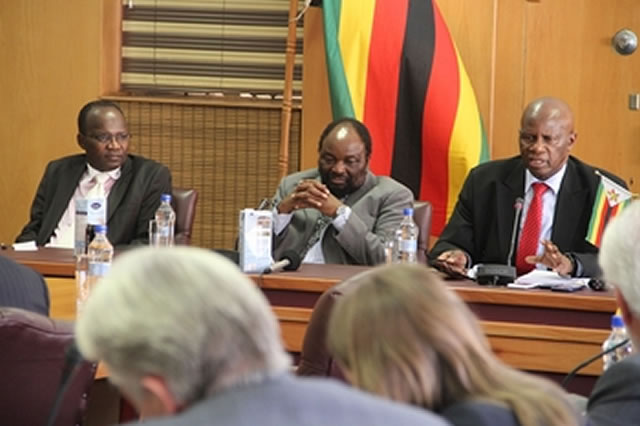
Farirai Machivenyika Senior Reporter
THE indigenisation and economic empowerment programmes are meant to increase participation of previously marginalised Zimbabweans in the mainstream economy and will be implemented in a flexible manner taking into account peculiarities of different sectors of the economy, Finance Minister Patrick Chinamasa has said.
Minister Chinamasa – who was flanked by Foreign Affairs Minister Cde Simbarashe Mumbengegwi and Information, Media and Broadcasting Services Minister Professor Jonathan Moyo – said this yesterday while briefing diplomats on the Zimbabwe Agenda for Sustainable Socio-Economic Transformation (Zim Asset), Government’s new economic blueprint.
“What we are saying is that we had a colonial history and up to colonialism, blacks did not have a stake in the economy. After we won our independence, our focus was on social issues and not on economic issues and not even the land because we had those undertakings. We then embarked on the issue of land, now we can put it behind us.
“What is critical and underlying to our policy (indigenisation) by whatever name we might call it is that the population of this country must have a stake in the economy. It is not in the interest of any investor to come to a country where the local population are not stakeholders, so we are addressing an issue of stakeholdership here,” he said.
Minister Chinamasa said prior to the land reform programme indigenous Zimbabweans had nothing to show for their independence.
“All of us here, until recently, had no stake. Up to year 2 000 we had no stake, maybe except our clothes. From the President down. Now you cannot have a country like that. You cannot have an economy like that where the President, ministers, MPs and everybody are all beggars looking for employment and no employer. That is what we have sought to correct.
“We basically want to be like Norway, we want to be like Sweden, we want to be like Germany where you can basically talk of a German economy, a Norwegian economy, a Swedish economy. It is a dream that we have and it is a dream we are committed to fulfil. We appreciate it is a process and it will take time, which is why the interaction will then be able to assist us on what we can do first. But surely we must get to a point where we can say we have a Zimbabwean economy,” Minister Chinamasa said.
He, however, said foreign investors remained welcome to do business in the country.
“What we now need to do is to define a path which is transparent where investors can come and exploit to our mutual advantage as we go along. By addressing you today (yesterday) we are basically inviting you to be partners in that journey and you must look at indigenisation as a journey and not an event,” he said.
Minister Chinamasa said the Minister of Youth Development and Indigenisation and Empowerment, Francis Nhema would soon embark on a process to clarify how the programe would be implemented in the various sectors of the economy but said it would not be a one-size fits all approach.
He however, said the mining sector, due to its nature was the Government’s main area of concern.
“Basically the major focus is on our minerals. We are saying we have a resource which is underground. When exploited the resource is depleting so we need also to see what is our benefit during the process of depletion. That is what we are saying.
“We have already passed a Sovereign Wealth Fund Bill which should be gazetted soon where maybe not in the immediate but in the future, we also want to look at our minerals and say during the depletion of our minerals what can we throw into the fund for future generations or infrastructure development which will assist future generations,” he said.


 Online Reporter