Chronicle Editor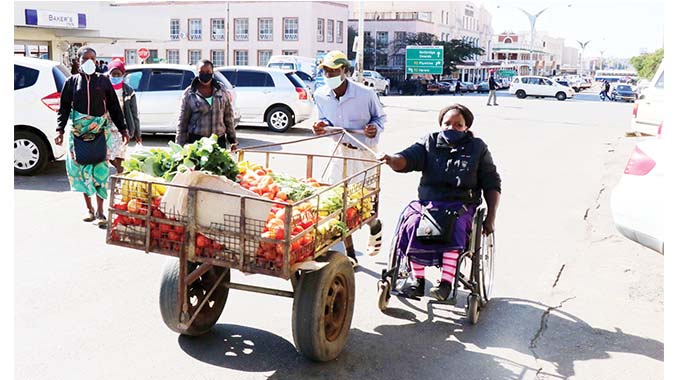
Mashudu Netsianda, Senior Reporter
The cliché “disability does not mean inability” is proving true for scores of entrepreneurial people living with disability.
Their lives are not defined by their disability. They brave the chilly weather, cycling to Bulawayo’s city centre every day to buy wares for resale in their residential suburbs. Some of them are wheelchair-bound while others have hearing and speech impairments.
Mrs Everjoy Kambarami (64) of Mabuthweni suburb, who was born physically handicapped due to polio is a sole breadwinner taking care of her ailing 69-year-old husband diagnosed of prostate cancer and her 15-year-old orphaned grandchild.
She is one of the 600 informal traders who were affected following the closure of 5th Avenue vending sites by the Bulawayo City Council (BCC).
As part of a raft of measures in response to Covid-19, council in April relocated all vendors who operated vending stalls in the area and permanently closed the popular weekend Khothama Market to bring order in the city beyond the lockdown period.

Mrs Kambarami wakes up as early as 5AM every day and cycles to the market place in the city centre where she buys her wares for resale.
She uses her tailor-made hand pedal wheelchair to cycle to the CBD. Due to her paralysed legs, Mrs Kambarami uses her arms to power the wheelchair and it takes between two to three hours for her to enter the CBD and navigate through the bustling morning traffic on her way to the market place.
“I was born with polio and it caused paralysis on my legs, which is why I use this hand pedal wheelchair to move around. I don’t have money for bus fare and therefore, I use my wheelchair as my mode of transport to travel to the CBD to buy my stock in the market place,” she said.
The vendor sells airtime, popcorn and sweets in Mabuthweni and says her life revolves around selling to survive.
“Our challenge mostly as disabled persons is that we struggle to buy wares at the marketplace due to crowding and it puts people like me with underlying medical conditions at high risk of contracting Covid-19. Sadly, despite those risks, I have no choice because I have to eat, look after my ailing husband and orphaned grandchild, pay council rates and buy Zesa tokens every month and that money comes from vending business,” said Mrs Kambarami.
She said due to low business in the residential areas, she now prefers selling her wares at designated Zupco bus termini targeting an influx of commuters.
Due to their vulnerability, disabled vendors are also targeted by pickpockets, vagrants and street kids. Flashing their hard-earned cash in crowded streets like Lobengula Street is risky, preferring counting and arranging their money in spaces where there is little or no obstruction.
Mr Possent Mlilo (43) of Sizinda, a paraplegic, uses his wheelchair to get into the city centre where he sells airtime, bananas, cigarettes and sweets between Leopold Takawira Avenue and Herbert Chitepo Street.
He takes care of his two able-bodied siblings aged 26 and 35 years.
Mr Mlilo says due to prolonged lockdown, his business was adversely affected.
He said vending on the streets is increasingly getting tough even to able-bodied as they tussle for limited clients among themselves.

“There are many street vendors on the streets and for us who are disabled it’s a struggle because we are not mobile and most of the time, we will be confined in one place,” he said.
Mlilo dropped out of school because his parents could not afford to pay school fees.
He said despite his condition, he resorted to street vending.
“Disability is not inability. I don’t believe in street begging which is why I wake up daily and go to town to sell airtime, sweets and bananas to eke out a living,” he said.
Mr Mazhonga Chakanetsa of Makokoba is paralysed and speech impaired.
He sells bananas from his pushcart.
“I stay with my four siblings and they are not employed, which means if I don’t wake up every day to sell bananas we will starve,” he said.
Mr Chakanetsa appealed to authorities to help establish more market stalls in strategic areas in the city centre with low rentals to enable them to sell their wares without being harassed by municipal police.
Ms Juliet Mutamhiri goes to the market daily where she buys fruits and vegetables.
Like all other vendors in her predicament, she doesn’t believe in handouts from well-wishers. She hires pushcart operators to carry her wares to her selling points.
“Yes, I might be disabled, but that doesn’t mean that I am unable to fend for myself and my family. In fact, I managed to take my children to school, pay council rates and put a meal on the table through proceeds from vending,” said Ms Mutamhiri. — @mashnets



 Online Reporter