admin
admin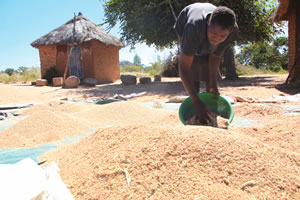
A teenage girl, standing in the blistering heat of the sun, is involved in the mechanical routine of loading the brown grain into a plastic vessel and gently letting it fall onto the sack-covered ground whereupon a gentle wind blows away the chaff to some insignificant distance.
She has, and has apparently succeeded, to master the art of detecting the direction and the strength of the wind, which element is essential in the extraction of grain — and let it be every one of it — from the chaff.
The poise in the older woman seems to suggest some contentment in having imparted successfully this art of preternatural wind vanes and cup anemometers on the younger one.
It is an art she no doubt got from her elders and the latter from theirs in the continuum of African knowledge systems.
But the old woman is not exactly content with her harvest.
It is another year of drought here.
The grain in front of her will only translate into two 50kg bags.
“I did not expect this,” she mourns, “I expected about one tonne.”
“The rain came in good time but went away at a critical time when it should have nourished the crops,” she adds.
She recalls the fecund hopes she had as the rains came down and she engaged the earth in the annual intercourse of committing seed to the ground with the hope of plenitude.
Now, with the pale produce, a sense of despair has set in and a lot of hungry days are looming on the horizon.
“The harvest won’t be enough for all nine of us and we have now to go for labour in the farms in Wedza and Chivhu so that we bring back maize to feed the family,” she says.
This kind of sojourn might take up to a month as she ensures that she has enough to satisfy the many gaping mouths.
Buhera’s climate, like the rest of the agro-ecological regions of its kind, can be very inclement.
Here is where even the much-vaunted small grains like sorghum, millet and rapoko take a battering, wilt and even die, making it small wonder then that for the last few seasons all but a couple of Buhera’s 33 wards have had to live with want.
Government, in its Final Crop Assesment Report says almost 45 percent of the crop failed this year.
The Government has promised to import close to 1 million tonnes to add to the strategic grain reserve which has been tottering dangerously at 1,4million tonnes.
Before this year’s harvest, the SGR has only 400 000 tonnes.
Agnella Mukushwa (43) of Chipuro Village has also seen her tonne-dream blown into the hot air.
Her sorghum crop, grown from a 10kg bag of seed which she had hoped would give her plenty, can barely translate into five buckets.
The widow will have to make do with buying mealie-meal at Murambinda Growth Point to feed herself and three others.
A 20kg bag costs US$10.
The reprieve that NGOs have been providing is no more.
First, for the likes of Mukushwa, an HIV-based NGO that has been providing food for the infected and the affected called Dananai has discontinued disbursements.
The second reason is a technicality.
Headman Daniel Muradzikwa explains: “NGO programmes end in March every year so they streamline and eventually cut out everyone.”
In a stroke of irony, they would have assumed that people would be done with harvesting and would be self-sufficient.
The Government’s Grain Loan Scheme would provide an alternative.
However, the programme’s reach is still limited and thus unable to cater for all the famished. “The scheme is noble but it only benefits 10 out of about an average of 100 households per month. So the 90 remain in need of food.
“Sometimes it takes two months when the Buhera GMB does not have grain (which is usual) and has to outsource,” he explained.
This is a fact that is also a concern for Chief Magaya Gunguwo Chitsunge, who called for the increase in the number of beneficiaries of the grain loan scheme.
He was thankful to local legislator Mtomba for providing transport when called to transport grain from as far afield as Mutare.
Staring hunger in the face, as they usually do, the people of Buhera are calling for income-generating projects that would enable them to buy food.
For Rhoda Chinyanga who says she cannot go out mending or thatching people’s roofs to earn money, a poultry project would do, she says.
Headman Muradzikwa says: “We have been very lucky, we have the Ruti Dam which was constructed in the 70’s but it’s not being used, ending up being utilised as far as Chisumbanje.
“We want irrigation programmes that would be able to grow food.
“At the moment there are some very small plots but we want to do it on a larger scale.
“We should also be able to grow maize when it is out of season so that we sell green mealies,” he outlined.
However, the pick of the self-help projects on the ground, which represents the hope, the industry and the unity of an afflicted people of Buhera is the Mutandwa Kudzanai women’s co-operative.
The group of about 20 women in Kunzwa village is involved in the growing of red sorghum which they later sell to a beverages company to make opaque beer.
Among them are seven widows and a couple of old women.
When The Herald recently visited the area the women were busy thrashing the grain belonging to Yemurai Panganai.
She had two tonnes of the iridescent crop.
The women, perhaps taking after the spirit of a co-operative, spoke almost at once and sometimes tried to outdo each other.
However, the following were in order: they had decided on this venture because it would give them money to buy food, pay school fees for the children, and buy clothing, among other necessities.
This crop was not for sadza — and that had to be emphasised lest donors would think they had a bumper harvest and not give them aid.
This crop, said Panganai — who stands to pocket some US$300 — was less than she expected and next year would hopefully be better.
Then emerged 66 year-old Priscilla Mushonga as the de facto spokesperson when it came to the projects that the women could embark on.
“We want cattle for draught power, meat and milk,” she said, to the approval of the group.
“We can venture into poultry production, soap and candle-making. (Murmur of agreement). We are hardworking women and we urge each other on,” she said.
Ngoni Magada, a Midlands State University graduate, is among the women, though on the periphery which happens to be the location of a pot of opaque beer expertly brewed from the same “chibuku” sorghum.
He says: “This is an example of the sustainable projects that the people could do.
“We could also venture into livestock rearing. We do not want donor funds anymore because they are not sustainable.”
He says Government should assist in providing infrastructure such as roads so that farmers could access markets easily.
Meanwhile, Agricultural Extension Services insists it is still the best brains behind agriculture, even if some people have expressed despair.
An Agritex official who preferred anonymity said they provide advice on how farmers should manage their crops.
She said they also advise farmers on animal husbandry in terms of breeding, feeding techniques, disease prevention and marketing.
Agritex also advises farmers on the kind of crops to grow in relation to different climatic conditions and regions.
“We are teaching farmers to adjust in line with the changes taking place.
“For example, we have been advising them to plant early. We also ask them to stagger planting dates so that one batch survives in the event of a mid-season dry spell.
“Our extension officers also advise farmers on use of early maturing varieties of crops when seasons are short,” she added.
The Agritex officer also explained that they also provide information on conservation agriculture where farmers dig holes, add manure and cover with soil and plant the seed.
“Planting stations allow farmers to trap moisture. In the event of little rains it gathers in the hole and is utilised by the plant.
“The method guarantees very minimal soil disturbance as it allows it to regain in crumb structure.”



 Online Reporter