admin
admin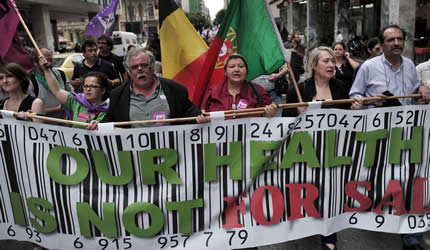
growth.
The Alter Summit sponsored by the European Trade Union Confederation was expected to bring together more than 300 movements, organisations and unions against austerity, poverty and racism.
“Europe stands on the edge of the cliff, facing the abyss,” the groups said in a joint manifesto.
“We demand an immediate cancellation of (fiscal pacts) imposed on indebted countries,” they said, calling also for a moratorium on debt repayments, higher taxes on the rich and more scrutiny of wealth hidden in offshore accounts.
They also called for stronger integration of migrants who are increasingly being treated as scapegoats in crisis-hit countries including Greece.
A group of doctors from France and Belgium last Friday joined a demonstration in Athens held by Greek medics and hospital staff to protest against health cuts.
A broader demonstration under the auspices of the Alter Summit will be held on Saturday, when the summit’s manifesto is to be officially unveiled.
Greece is caught in a six-year recession which austerity critics say has been exacerbated by successive pay and pension cuts imposed at the behest of its EU-IMF creditors.
Unemployment is steadily rising and now exceeds 26 percent, with more than one in two youths out of work.
In another bleak message, the Greek statistics agency last Friday said the economy had contracted at a sharper rate in the first quarter than originally envisaged.
The figure announced earlier this month — 5,3 percent of output — was revised to 5,6 percent.
The Greek finance ministry forecasts a contraction of 4,3 percent this year before the economy limps back into growth in 2014, at a rate of at least 0,2 percent.
However, the optimism is not shared by the OECD which forecasts that the Greek economy will remain in recession in 2014 for a seventh straight year.
Overall, Greece’s economy has contracted by more than a fifth since 2008.
To weary Greeks, a dispute between the EU and the IMF on whether the first phase of Greece’s bailout plan was poorly designed has offered little consolation.
And with European economic affairs dominated by Germany, many fear that few decisions of importance will be taken until national elections are held in Berlin later this year.
“I’m afraid that basically that there will be no change after German elections because there is a consensus for austerity policies,” said Alexis Passaidikis, a German of Greek origin who came to the summit as a member of the German branch of anti-capitalist group Attac.
“This crisis is used to restructure the balance of power in Europe,” he said. — AFP.



 Online Reporter