

 Online Reporter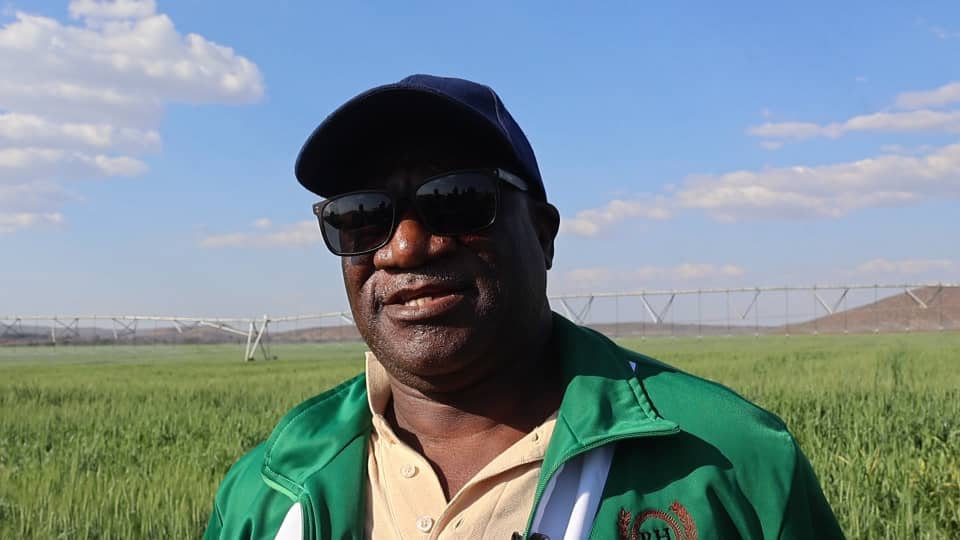
Theseus Mauruki Shambare
ZIMBABWE’S Agricultural and Rural Development Authority (ARDA) should serve as a regional reference point for strengthening food security, as its production model offers lessons for countries battling hunger and climate-induced production challenges and for those seeking to enhance agricultural trade, Namibia’s Kavango East Region Governor Hambyuka Hamunyera has said.
Governor Hamunyera made the remarks during a tour of ARDA-supported Barwick L Farm, cultivated by Mr Phib Mutibura and Victory Farm in Mashonaland West, owned by Mr Tichaona Mapfoche, where he assessed Zimbabwe’s approach to commercial agriculture and farmer support.
The tour showcased the role of technology, strategic partnerships and peer-to-peer collaboration in transforming agricultural production, with ARDA working alongside commercial farmers through technical support, mechanisation, irrigation development and access to modern farming systems.
Both farms are part of the Strategic Grain Reserve (SGR) 200 Hectare Plus Club, a Government-supported initiative bringing together large-scale producers to increase grain output and strengthen national food reserves.
The visit came during an eight-day Parliamentary Portfolio Committee on Lands, Agriculture, Fisheries, Water and Rural Development oversight tour of ARDA estates and supported farms across Zimbabwe’s eight rural provinces to assess the authority’s contribution to food security, irrigation expansion and agricultural transformation.
By Tuesday, the committee had covered Mashonaland West, Mashonaland Central and Mashonaland East provinces, with the delegation expected to proceed to Midlands Province on Wednesday and Thursday, Matabeleland provinces on Friday, Masvingo on Saturday and Manicaland on Sunday.
Parliamentary Portfolio Committee on Lands, Agriculture, Water, Fisheries and Rural Development chairperson Hon Felix Maburutse said the farms visited so far demonstrated the impact of ARDA’s expanded mandate in improving national grain production.
“This is Vision 2030 accelerator at play. Because we are seeing that ARDA is doing a great job in improving our grain reserves with every farmer we have visited, we have seen that they are doing very well,” he said.
Hon Maburutse said ARDA’s integrated support model was removing production barriers for farmers by assisting in the farming cycle.
“ARDA is supporting them fully from the inputs, technical services, even harvesting and the transportation of their products to GMB. So, I can safely say ARDA is doing very well,” he said.
Governor Hamunyera said the farming practices he witnessed provided valuable lessons that Namibia could adopt in its quest to increase production and eliminate hunger.
“One of my observations of what I am seeing here is that these farmers are doing a wonderful job,” he said.
“And when you compare it to where I come from, Namibia, Kavango East Region, we have farmers, but it is not the way they are doing it here.
“There is one thing which one has to learn from here, that what they are doing is wonderful, and we are ready in the few days or few years to come for us to say, go away food insecurity, go away hunger, go away poverty.”
Governor Hamunyera also commended the quality of crop management, saying the clean fields and irrigation infrastructure demonstrated sound agricultural practices capable of delivering reliable food production.
Zimbabwe has repositioned ARDA from a land administration institution into a production-driven agency and designated it as the National Food Security Agency, with a mandate to lead commercial agriculture, irrigation development and climate-smart production.
ARDA chief executive officer Mr Tonotenda Mhiko said increasing production and productivity remained central to Zimbabwe’s economic transformation agenda.
“There is no way we can talk of an upper-middle income economy when our production performance is poor. So, increased production and productivity is the starting point,” he said.
Mr Mhiko said ARDA was embracing modern technologies including artificial intelligence, robotics, seed science, tissue culture, drones and rural connectivity to improve agricultural efficiency.
“ARDA now uses advanced soil testing systems, geographic information systems, satellite mapping and AI-powered yield prediction models,” he said.
“For a drought-prone region where fertiliser, fuel and foreign currency are expensive, efficiency matters.”
ARDA operations and commercial production director Mr Shingirai Jenah said the authority’s transformation into the National Food Security Agency had strengthened its ability to drive large-scale grain production while building resilience against climate shocks.
“ARDA has already surpassed its target of delivering 150 000 tonnes of grain to the Strategic Grain Reserve from the previous summer cropping season and is now targeting another 150 000 tonnes from the current winter wheat crop, followed by a further 150 000 tonnes from the forthcoming summer season,” he said.
Mr Jenah said the authority was targeting at least 75 000 hectares under irrigated maize during the coming summer season, while traditional grains would be planted under dryland farming to strengthen climate resilience.
He said ARDA was also expanding climate-smart seed production, with 32 percent of production financed directly by the authority while the remainder was supported through bank guarantees.
“By 2030, we anticipate that ARDA internally would have established an additional 21 000 hectares under irrigation,” he said.
Mr Mapfoche said ARDA’s intervention had created a conducive environment for commercial farmers to increase production through coordinated technical support, mechanisation and access to modern farming technologies.
Mr Mutibura said ARDA’s support had enhanced productivity by ensuring farmers had access to critical production services and technical expertise throughout the farming cycle.
The growing regional interest in ARDA’s model comes as Southern African countries intensify efforts to develop resilient food systems in response to climate change, recurrent droughts and rising demand for agricultural output.
Zimbabwe’s approach of combining Government support, commercial partnerships, irrigation development and technology is increasingly positioning ARDA as a regional blueprint for strengthening food security.



