admin
admin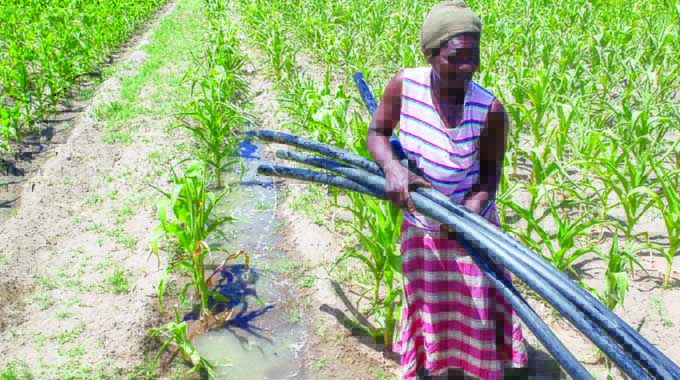
Obert Chifamba
Agri-Insight
LAST month the Agricultural and Rural Development Authority (ARDA) ran an advert to the effect that they were looking for 450 business managers to superintend the development and management of rural irrigation schemes.
To date, the authority has since engaged and deployed 26 managers out of the targeted number with the hunt still on for the outstanding figure.
Upon being recruited and deployed, the managers are expected to help farmers in the preparation of crop production budgets and estimates according to their annual production programmes, do soil sampling and recommend fertilisers for the schemes and will be actively involved in the arrangement and logistics of inputs for the schemes under their charge.
They will also ensure timely land preparations and monitor planting and irrigation schedules and timelines while giving day-to-day technical advice to the farmers on production, pest, disease and weed management, harvesting and post-harvest technology.
Their roles will also include keeping detailed records on fields, customers, crops and samples; monitor and evaluate programmes and crop yield forecasts for scheme farmers, which has not been happening all along in a development that has been blamed for the resultant poor showing by the farmers in the process.
The managers will be tasked with coordinating key-value chain actors and Government departments such as Agritex to ensure seamless production and marketing of produce and prepare weekly and monthly reports for irrigation management committees.
They will also focus on research and development, as well as train and facilitate learning opportunities for farmers to ensure best management practices.
The arrangement makes a lot of business sense, as it seeks to give a business approach to farming activities in irrigation schemes, which has been missing with farmers mainly focusing on producing just enough to satiate their domestic requirements with surplus for the market coming as a bonus that they would not have prepared for.
In most cases, the farmers did not have marketing plans in place and usually targeted the occasional buyers who happened to chance by while the production process was not properly planned.
On the one hand, the arrangement will also mean that ARDA will perform the role enunciated in its name and be involved in the promotion of agricultural and other forms of rural development.
Essentially, this will feed into the National Development Strategy 1 (NDS1), as well as the devolution agenda, as it will enable the managers to help farmers in different agro-ecological regions to develop in line with what they can offer both in terms of agricultural production and value addition.
In the long run, the arrangement will help develop a vibrant value chain that will also create employment and business opportunities in various localities while empowering the scheme farmers like any other business people.
This will see vital infrastructure like processing industries, roads, dip tanks and boreholes to name just a few, being developed to enable the smooth flow of business, which will boost the process of industrialising rural areas.
In fact, not much of the rural development part has been happening in the history of the authority, which has been restricting itself to the “agricultural” part most of the time so the current business slant may help initiate other forms of development out of just agricultural production circles.
This will create the right environment for projects running under devolution programmes to start taking shape, especially when they are linked to agriculture.
It will also be logical for these managers to work hand in hand with Agritex and provide the developmental aspect that had been missing all along as the latter was usually there for extension services mostly while rural development in other vital spheres remained stagnated.
ARDA’s deployment of managers should allow regions like Mwenezi where amarula and cattle farming are prominent to be explored to levels where value addition starts with products being sold processed and not raw.
This will give more value to the producers with other players along the value chain also benefiting significantly.
Rural development should speak to infrastructural development and facilitate the progression of crop commodities into value chains that create employment and boost the gross domestic product (GDP) of the areas in which they are being produced.
The authority should play a pivotal role in the development of rural areas and strengthen the levels of interaction among farmers and their extension officers and farmers’ organisations whose relevance seems to have been underrated all along.
It will not take rocket science for anyone to appreciate that rural areas are home to the country’s the biggest population, hence the need for authorities such as ARDA to develop an open attitude towards prioritising development there.
The long and short of it is that ARDA should push a development agenda that goes beyond its estates for the benefit of the surrounding communities.
Business managers are expected to help boost agricultural production in irrigation schemes and beyond and enhance rural industrialisation as part of the state enterprises’ operationalisation of Statutory Instrument 38 of 2021.
SI makes it mandatory for irrigation based projects to operate as business entities in line with NDS1 that identifies agriculture as one of the country’s major economic drivers.
Agriculture is expected to create employment in the communities and reduce the rural-urban migration trends that have been caused by the absence of economic activities that generate incomes for people living in rural areas.
Incidentally, ARDA is mandated to manage 450 irrigation schemes across the country, hence its decision to engage a corresponding number of business managers to create that business aura that will attract the productive age groups to stay in the rural areas.
The schemes sit on 10 500ha that exclude new schemes that are constantly coming up as more and more farmers join the band wagon of commercial scheme farmers.
The managers must also give it their all and work closely with Agritex and come up with a plan of action to breathe life into each irrigation scheme in a process that should logically start with rehabilitation and training farmers on efficient water usage.
ARDA has also mandated the managers to link farmers with the Agricultural Marketing Authority (AMA) and ZimTrade for market identification so that they produce crops for specific markets and avoid producing crops that will rot by the roadside while they are looking for markets.



 Online Reporter